Introduction
"And what is your religion?" I asked him. "I think it is California", he replied (from an interview with Gottardo PiazzoniView auction records and biographical information conducted by Max Stern)
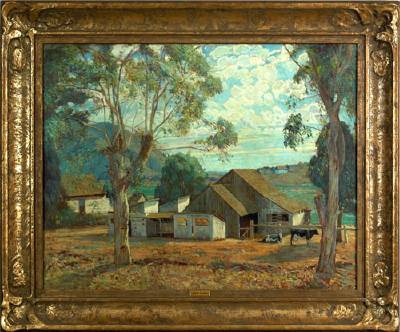
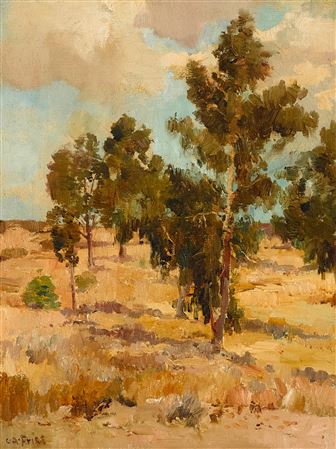
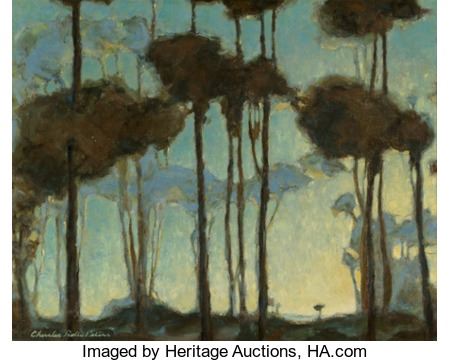
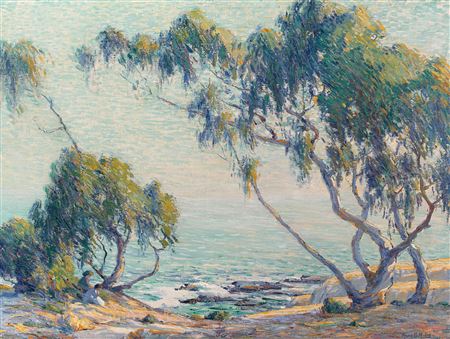
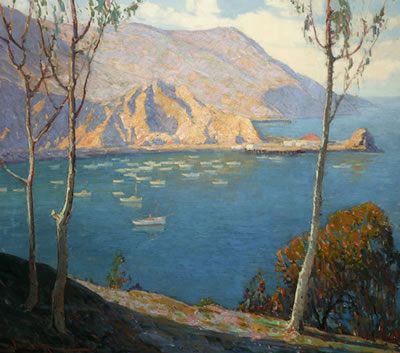
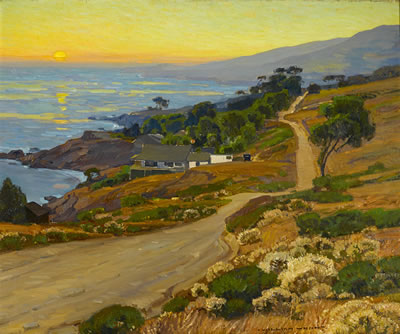
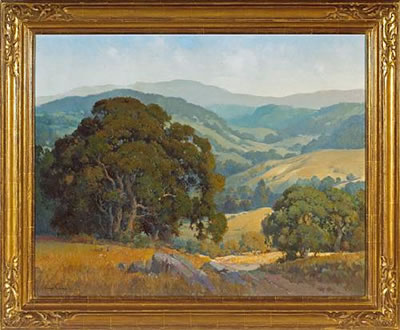
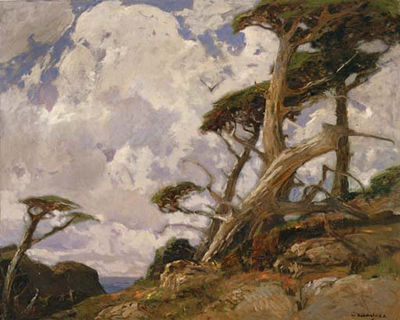
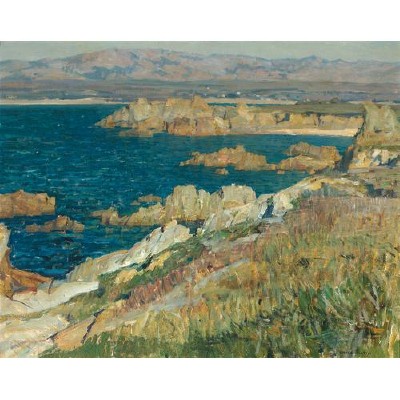
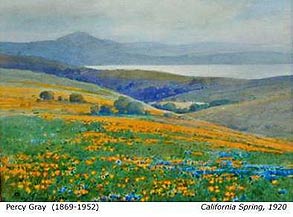 Historical California landscape painting demonstrating the distinctive light and scenery that attracted artists to the region
California has long been a land that has inspired the imagination, from the time of the first Native Americans, through the tumultuous years of settlement, to the present. The story of art in California has many fascinating chapters: the Age of Exploration, the Spanish and Mexican periods, The Gold Rush, the Missions, the Railroad, the 'Golden Age' of Landscape Painting, the influence of European art, the evolution of two distinct centers of art in Southern and Northern California, the Great Depression, World War II and postwar to Modernism and beyond. Despite the state's 'late start' on the national artistic scene, California painters have always been among the top ranks of American artists, and in the 1960s it might be argued they even took the lead for the country.
The Spanish and Mexican Periods
 Interior of Spanish colonial mission church with painted religious decorations by early California artists
During the years of Spanish control (1769-1822) twenty-one missions were established in California, along with presidios and towns for settlers. The priests were not only good businessmen, they were also educated and often artistically sensitive. During the period of Spanish domination, art was primarily made for, or at, the various missions, and was most often the painted decoration of the interior of the churches. It was during this period that artists such as Jose CarderoView auction records and biographical information (1768-1791) and Louis ChorisView auction records and biographical information (1795-1828) who accompanied expeditions, recorded views of the land, the presidios, and the population. Mexican revolutionaries broke Spain's hold on California, and it became an empire in 1821. Rancho owners became the land's aristocracy, but their tastes ran more to decorative arts, and pictorial art was kept alive mainly by artists coming from outside California with scientific expeditions, or by gentlemen travelers. Continuing interest in 'mission art' is reflected, however, in the work of late 19th-century resident painters including Henry Chapman Ford (1828-1894), Christian Jorgensen (1860-1935), William Lees Judson (1842-1928), Manuel Valencia (1856-1935), as well as into the 20th century with Charles Rollo Peters (1862-1928), see 'nocturnes', Florence Upson Young (1872-1974), Ellen Farr (1840-1907), and Minnie Tingle (1874-1926).
 Historical sketch by expedition artist documenting California during the Mexican-American War period
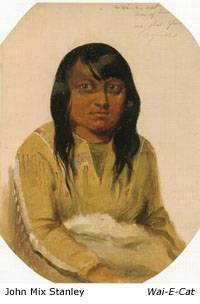
When war was declared between the United States and Mexico in 1846, some of the military engagements were recorded. Accompanying one U.S. battalion were artists John Mix Stanley (1814-1872) and William Hemsley Emory (1811-1887) who created pictures of people and places of that period. In 1847 California came under U.S. jurisdiction, and the first noted artist to arrive after the land had come under United States protection was Titian Ramsay Peale (1799-1885). Since most artists arrived by ship, their views are often confined to areas not far from the coast. For example, French engineer Jean-Jacques Vioget (1799-1855) painted early landscapes of the Klamath River and Mount Shasta; Alfred Thomas Agate (1812-1846) painted the upper Sacramento River; William Henry Meyers (1815-?) made drawings of San Diego and San Pedro; and James Madison Alden (1834-1922) traveled up and down the West Coast for almost a decade recording scenes from the Coast Survey ship on which he served.
The Gold Rush
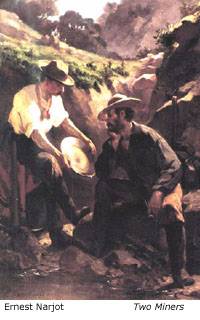 Historical painting from the Gold Rush era showing miners and prospectors in the California wilderness
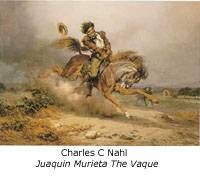
The Gold Rush of 1849 attracted artists from the East Coast, some to prospect, others to create illustrations for magazines and books. Money was also earned by making panoramas, which were scenes painted on long rolls of canvas that could be viewed like today's motion pictures. One of the most notable in this medium was Henry Miller (active 1856-1857). The most important result from such profit-from-art ideas was the development of a professional resident art community in San Francisco. Immigrant artists began to turn out oils and watercolors in a full range of subjects, displaying styles from the cities from which they had come. Particularly well-known artists of the Gold Rush era are German born Charles Christian Nahl (1818-1878), Albertus Del Orient Browere (1814-1887), who made extended trips from his native New York, and Ernest Narjot (1826-1898) who came from France in search of gold in 1849. Narjot settled in San Francisco to paint, becoming one of the most accomplished artists in the city. An outstanding portraitist was William Smith Jewett (1812-1873), as was Nahl.
Statehood and the Railroads
 Historical painting commemorating the completion of the Transcontinental Railroad with portraits of prominent California citizens
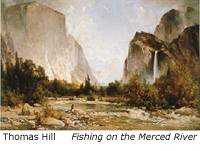
In 1850, California became the 31st state in the Union. By 1860, San Francisco was entering a 20-year economic boom with a developing upper class that patronized art. Portraits of prominent citizens were important in pictures commemorating historic occasions, such as the painting by Thomas Hill (1829-1908) commemorating the completion of the Transcontinental Railroad, with Leland Stanford at its center. Aside from his portraiture, Hill is best known for his views of Yosemite Valley.
Several highly talented artists moved to the city and organizations such as the California Art Union, the Bohemian Club, the Graphic Club, and The San Francisco Art Association, formed to encourage the fine arts. When the Transcontinental Railroad was completed in 1869, artists could move more easily between the two coasts, and California's magnificent landscapes were a great attraction for painters. The year 1874 marked the establishment of California's first art school, The School of Design, in San Francisco.
 Group of bohemian artists in San Francisco during the late 19th century cultural and artistic renaissance
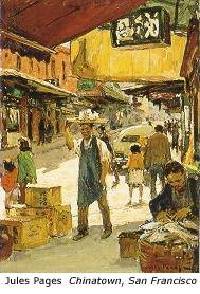
In the later 19th century, the city also attracted a number of 'bohemians', a term applied to persons who flouted bourgeois norms and enjoyed vagabond lifestyles. Bohemian artists found inspiration in San Francisco subjects, as well as the California wilderness. In 1873, two Frenchmen, Paul Frenzeny (1840-1902), who had been with the French cavalry in Mexico, and Jules Tavernier (1844-1889), who had fought in the Franco-Prussian war, were hired by Harper Brothers to sketch the American frontier for the magazine. Together they traveled on horseback from Denver to San Francisco, where both became active in the art community and became members of the Bohemian Club. The Bohemian Club, a men's club founded in 1872, was originally a fellowship of journalists and other writers, but later expanded to include artists, musicians, and others interested in the fine arts. Tavernier and Jules Francois Pages (1833-1910) were founders of the Palette Club, a dissident group that in early 1884 rebelled against the dictates of the San Francisco Art Association. Pages' studio was often a meeting place for San Francisco painters such as Julian Rix (1850-1903), Charles Dormon Robinson (1847-1933), Joseph Strong (1852-1899), and Samuel Marsden Brookes (1816-1892), as well as his good friend, Tavernier. Later, Tavernier founded the first art colony in the Monterey area, where he was joined by Frenzeny as well as Rix, Strong, Peters, and others.
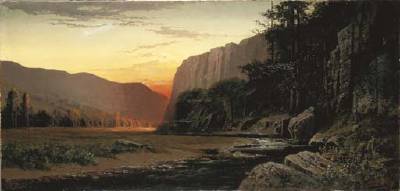
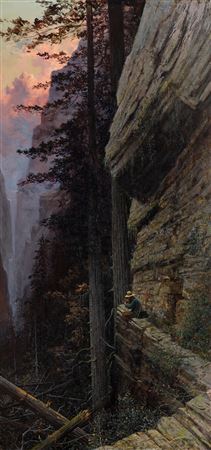
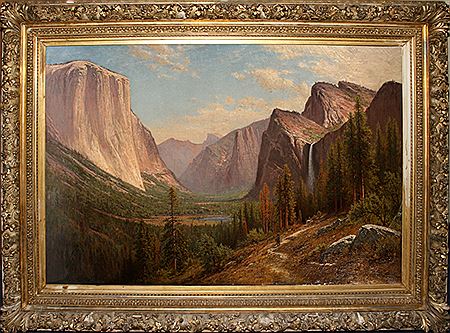
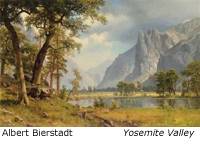 Dramatic landscape painting of Yosemite Valley showcasing the sublime wilderness scenery that inspired California artists
The most nationally recognized landscapist to come to California at that time was Albert Bierstadt (1830-1902) who was born in Germany, but was raised in Massachusetts. Bierstadt is especially noted for his paintings of Yosemite, as is English-born Thomas Hill. William Keith (1838-1911) painted Yosemite too, and while there met poet-naturalist John Muir, beginning a relationship that shaped his art. The subjects of painters such as Bierstadt, Hill, and Keith were often sublime panoramic views of the California wilderness, revealing the grandeur and drama of nature, in a style some term Romantic Realism. Other active landscapists of the period were Frederick Ferdinand Schafer (1839-1927), William Hahn (1829-1887), and Hermann Herzog (1832-1932), who rose to prominence in the 1870s.
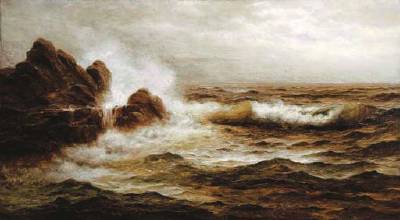
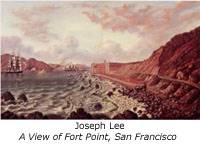 Marine painting depicting Pacific Ocean coastal scene with sailing vessels, reflecting the importance of maritime themes in California art
With time, California artists moved away from grand panoramas and dramatic wilderness, and more towards pictures of lowland activities or intimate genre scenes. Albertus D.O. Browere (1814-1887) depicted fishermen. George Albert Frost (1843-1907) painted the mansion of W.C. Ralston. Marine paintings were created by Charles Nahl (1818-1878), Raymond Dabb Yelland (1848-1900), William A. Coulter (1849-1936), Joseph Lee (1827-1880), and Charles Dormon Robinson (1847-1933), thus reflecting the importance of the Pacific Ocean in the growth of the state. Some, such as Nahl, Browere, and Norton Bush (1834-1894) painted pictures of the tropics, having traveled the Isthmus of Panama en route to California. The fashion for the tropics sold well, both to romantics stimulated by their exotic themes, and to patrons as mementos of their own trips.
European Influences
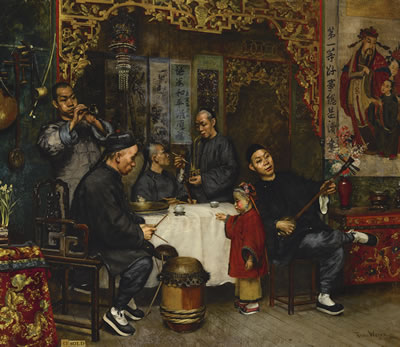
During the 1870s and 1880s many of San Francisco's artists went to Europe for advanced study at the popular centers of Dusseldorf and Munich. This European exposure changed their art, and those decades were the 'glory days' for the production of subjects such as history, still life, and genre, that were promoted in those German art centers. Some of the artists reflecting these influences include historical painters Toby Rosenthal (1848-1917) and Domenico Tojetti (1806-1892), still life painter Samuel Marsden Brookes (1816-1892), and Theodore Wores (1859-1939), who studied in Munich and once back in San Francisco often painted Chinatown subjects. California genre painters generally presented a carefree and bucolic way of life, with scenes of the industrial world and poverty rarely depicted.
Although Paris was a magnet for art students with means, few could pass the rigorous entrance exams at the Ecole des Beaux-Arts, which included fluency in French language. The most popular alternative was the Academie Julian, an open-enrollment school, which attracted large numbers of foreigners from many nations, including Americans from California such as Guy Rose and Charles Rollo Peters. Other Californians who studied in Paris were Thomas Hill and Ferdinand Kaufmann. Due to restrictions regarding models, female students had their own studios at Julian's. Among the California women artists who studied there were Matilda Lotz (1858-1923) who painted landscapes and portraits including Chinatown scenes; Elizabeth Strong (1855-1941) a painter of landscapes as well as animals; Evelyn McCormick (1862-1948) who painted townscapes, including Monterey; muralist and landscape painter Florence Lundborg (1871-1949); and portrait and genre painter Anna Klumpke (1856-1942).
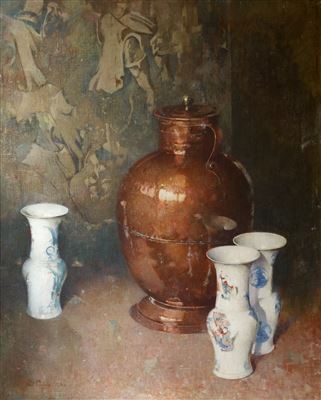
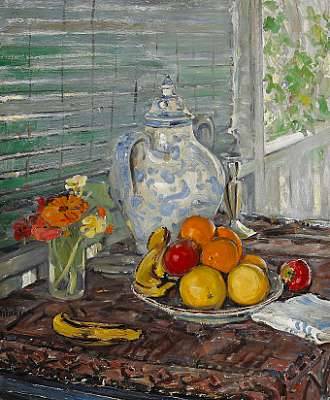
Still-life painter Emil Carlsen (1853-1932) studied in France as well as Munich, and as a teacher at the San Francisco School of Design had strong impact. Edwin Deakin (1838-1923) created landscapes of ruins and historic architecture, as well as exceptional floral still-lifes, often of roses, which he cultivated at his Berkeley home. Alice Chittenden (1859-1944) was one of San Francisco's most talented still-life painters at the end of the century. Interestingly, it was Chittenden, along with Maren Froelich (1868-1921), who in 1898 first broke the all-male monopoly at the Bohemian Club's annual art exhibition. At the other end of the state, Frenchman and floral painter Paul De Longpre (1855-1911) lived in Los Angeles at the turn of the century on what is now Hollywood Boulevard, in a Moorish mansion where he flew both the French and American flags. There he planted thousands of roses and other flowers and is renowned for his mastery in painting them.