Federico del Campo was one of the prominent painters of Venetian views in the latter half of the 19th century. Born in Lima, Peru, del Campo, he studied in Madrid with Lorenzo Valles (1830-1910), an... Read full biography
Federico del Campo was one of the prominent painters of Venetian views in the latter half of the 19th century. Born in Lima, Peru, del Campo, he studied in Madrid with Lorenzo Valles (1830-1910), an artist who himself worked in Italy. The majority of del Campo's work, like that of his contemporary... Read full biography
Federico del Campo was one of the prominent painters of Venetian views in the latter half of the 19th century. Born in Lima, Peru, del Campo, he studied in Madrid with Lorenzo Valles (1830-1910), an artist who himself worked in Italy. The majority of del Campo's work, like that of his contemporary Rubens Santoro, consists of Venetian views. In choosing to settle in Venice, del Campo joined a significant community of emigrant artists, among them Antoinetta Brandeis and the Spanish colony of... Read full biography
Federico del Campo was one of the prominent painters of Venetian views in the latter half of the 19th century. Born in Lima, Peru, del Campo, he studied in Madrid with Lorenzo Valles (1830-1910), an artist who himself worked in Italy. The majority of del Campo's work, like that of his contemporary Rubens Santoro, consists of Venetian views. In choosing to settle in Venice, del Campo joined a significant community of emigrant artists, among them Antoinetta Brandeis and the Spanish colony of painters who included Rafael Senet, Mariano Fortuny, and Martin Rico who had already found a great international demand for their work. Del Campo's technical precision, lively brushwork and luminous palette are displayed in these works which he painted,... Read full biography
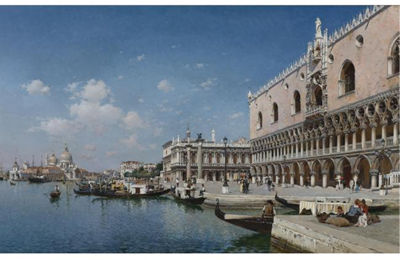
Federico del Campo was one of the prominent painters of Venetian views in the latter half of the 19th century. Born in Lima, Peru, del Campo, he studied in Madrid with Lorenzo Valles (1830-1910), an artist who himself worked in Italy. The majority of del Campo's work, like that of his contemporary Rubens Santoro, consists of Venetian views. In choosing to settle in Venice, del Campo joined a significant community of emigrant artists, among them Antoinetta Brandeis and the Spanish colony of painters who included Rafael Senet, Mariano Fortuny, and Martin Rico who had already found a great international demand for their work. Del Campo's technical precision, lively brushwork and luminous palette are displayed in these works which he painted, among many others, to satisfy the demand for the quintessential souvenir for a newly mobile bourgeoisie in the 1880s and 1890s.... Read full biography