An Objibwa/Chippewa shaman, Norval Morrisseau was one of the first native Canadians to adopt modernist* styles that conveyed traditional aboriginal imagery. "His style, which became known as... Read full biography
An Objibwa/Chippewa shaman, Norval Morrisseau was one of the first native Canadians to adopt modernist* styles that conveyed traditional aboriginal imagery. "His style, which became known as Woodland* or Legend painting, evoked ancient etching from birch-bark scrolls and often used X-ray like... Read full biography
An Objibwa/Chippewa shaman, Norval Morrisseau was one of the first native Canadians to adopt modernist* styles that conveyed traditional aboriginal imagery. "His style, which became known as Woodland* or Legend painting, evoked ancient etching from birch-bark scrolls and often used X-ray like motifs: skeletal elements and internal organs visible within the forms of animals and people, and black spirit lines emanating from them.". He used saturated, startling colors described by a curator of the... Read full biography
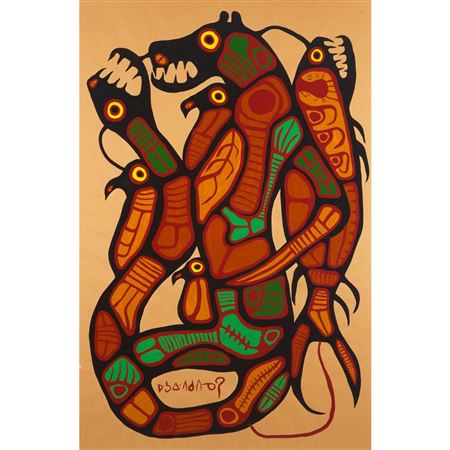
An Objibwa/Chippewa shaman, Norval Morrisseau was one of the first native Canadians to adopt modernist* styles that conveyed traditional aboriginal imagery. "His style, which became known as Woodland* or Legend painting, evoked ancient etching from birch-bark scrolls and often used X-ray like motifs: skeletal elements and internal organs visible within the forms of animals and people, and black spirit lines emanating from them.". He used saturated, startling colors described by a curator of the National Gallery of Canada as appearing "to vibrate under the viewer's gaze." In 2006, the Gallery sponsored a retrospective of Morrisseau's work. From there, the exhibition moved for a year to the George Gustav Heye Center at the Smithsonian... Read full biography
An Objibwa/Chippewa shaman, Norval Morrisseau was one of the first native Canadians to adopt modernist* styles that conveyed traditional aboriginal imagery. "His style, which became known as Woodland* or Legend painting, evoked ancient etching from birch-bark scrolls and often used X-ray like motifs: skeletal elements and internal organs visible within the forms of animals and people, and black spirit lines emanating from them.". He used saturated, startling colors described by a curator of the National Gallery of Canada as appearing "to vibrate under the viewer's gaze." In 2006, the Gallery sponsored a retrospective of Morrisseau's work. From there, the exhibition moved for a year to the George Gustav Heye Center at the Smithsonian Institution in Washington DC. A 2001 exhibit in New York City at the Drawing Center featured Morriss... Read full biography