Page loaded successfully. Showing biography for Peter Arno.
Peter Arno BIOGRAPHY
1904 New York City - 1968 Port Chester, New York. Known for: Magazine cartoons.
Born January 8, 1904 as Curtis Arnoux Peters, Jr., Peter Arno was best known for his satirical cartoons of New York cafe society, which appeared for many years in The New Yorker magazine. He was... Read full biography
Born January 8, 1904 as Curtis Arnoux Peters, Jr., Peter Arno was best known for his satirical cartoons of New York cafe society, which appeared for many years in The New Yorker magazine. He was about to abandon his ambition to be an artist for a musical career when he received a check for a... Read full biography
Born January 8, 1904 as Curtis Arnoux Peters, Jr., Peter Arno was best known for his satirical cartoons of New York cafe society, which appeared for many years in The New Yorker magazine. He was about to abandon his ambition to be an artist for a musical career when he received a check for a drawing that he submitted to a new humor magazine, The New Yorker, that had debuted February 21, 1925. With the publication of that spot illustration on June 20, 1925, Arno began a 43-year association with... Read full biography
Born January 8, 1904 as Curtis Arnoux Peters, Jr., Peter Arno was best known for his satirical cartoons of New York cafe society, which appeared for many years in The New Yorker magazine. He was about to abandon his ambition to be an artist for a musical career when he received a check for a drawing that he submitted to a new humor magazine, The New Yorker, that had debuted February 21, 1925. With the publication of that spot illustration on June 20, 1925, Arno began a 43-year association with editor Harold Ross's weekly magazine. Arno can be credited with having helped develop the publication's tradition of sophisticated humor. Although he may not have invented the single-speaker-captioned cartoon, he surely perfected it. Arnos work... Read full biography
Born January 8, 1904 as Curtis Arnoux Peters, Jr., Peter Arno was best known for his satirical cartoons of New York cafe society, which appeared for many years in The New Yorker magazine. He was about to abandon his ambition to be an artist for a musical career when he received a check for a drawing that he submitted to a new humor magazine, The New Yorker, that had debuted February 21, 1925. With the publication of that spot illustration on June 20, 1925, Arno began a 43-year association with editor Harold Ross's weekly magazine. Arno can be credited with having helped develop the publication's tradition of sophisticated humor. Although he may not have invented the single-speaker-captioned cartoon, he surely perfected it. Arnos work appeared in the New Yorker magazine from 1925 until his death. He achieved a distinctive drawing style featuring heavily... Read full biography
Artist Biography
Biography page for Peter Arno ((1904 - 1968)), known for Magazine cartoons. Showing 1 biographical entries and 0 sample artworks.
Peter Arno - Artist Info
About Peter Arno
Name variants
Curtis Arnoux Peters
Biography from the Archives of askART
 Born January 8, 1904 as Curtis Arnoux Peters, Jr., Peter Arno was best known for his satirical cartoons of New York cafe society, which appeared for many years in The New Yorker magazine.
He was about to abandon his ambition to be an artist for a musical career when he received a check for a drawing that he submitted to a new humor magazine, The New Yorker, that had debuted February 21, 1925. With the publication of that spot illustration on June 20, 1925, Arno began a 43-year association with editor Harold Ross's weekly magazine. Arno can be credited with having helped develop the publication's tradition of sophisticated humor. Although he may not have invented the single-speaker-captioned cartoon, he surely perfected it.
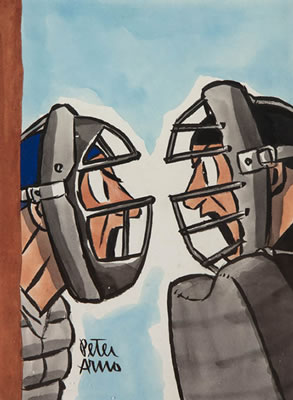
Arnos work appeared in the New Yorker magazine from 1925 until his death. He achieved a distinctive drawing style featuring heavily outlined figures. Notable among his urbane characterizations are the self-important executive and the generously endowed woman. Embodying the spirit of the magazine as no other New Yorker cartoonist, Arno made his words completely dependent upon the pictures for comedic sense.
In the mid-1930s cartoons and comic strips also briefly dominated advertising. The work of Peter Arno, appeared not only in the New Yorker, but also in advertisements and anthologies in the 1930s, and had broad influence on other artists. A condensation of reality, both truthful and emotional, though the use of strong imagery, was what most print makers of his day strove to achieve.
In the 1940s and 1950s The New Yorker magazine was in its prime; aspiring writers wanted to be like James Thurber; cartoonists looked to Peter Arno, whose characters dressed for dinner and hated Roosevelt. In its early days, New Yorker cartoons played a subtle game of making fun of the upper classes, while at the same time courting them. There were lots of drawings of maids and butlers, plumbers and coal deliverymen, putting on airs that blew in both directions
The New York Public Library held an exhibit of celebrity caricatures from the Golden Age of this satiric art. Focusing on caricatures of the 1920s through the 1950s, the library show was titled "Celebrity Caricature in America". It offered more than 200 works by most of the top caricature artists of the era Peter Arno, Ralph Barton, Al Frueh, Miguel Covarrubias, Will Cotton, William Auerback-Levy, Peggy Bacon, Marius de Zayas, Paolo Garretto, and Al Hirschfeld. Among the highlights were Rea Irwin's caricature of New Yorker editor Harold Ross in the dandy's costume of Eustace Tilley, subject of an annual magazine cover, peering through his lorgnette at a bug in the form of critic Alexander Woollcott; Peter Arno's caricature portrait of flapper cartoonist John Held Jr., and a profile by Peggy Bacon of writer Dorothy Parker looking as though she had a serious hangover.
If any magazine was worth emulating, The New Yorker certainly was. The Yale Record was one of many publications that subtly borrowed from some of The New Yorker's great style. Julien Dedmans cartoons clearly paid homage to Peter Arno.
Other cartoonists remember how Peter Arno used to work: "His drawings always looked like very casually inked work, with wash drawings and bold brush strokes. And reportedly he would draw dozens, hundreds, of the same cartoon. He didn't pencil either. But he drew with a brush-like painting. He'd whip one out and not like it and start over just keep doing it over and over until he got it right other cartoonists do that, too, in order to get that feeling of spontaneity in the drawing, they do the same drawing six or seven, eight times.
Arno also was involved in theater, including a forgotten Broadway show he produced with financier Jock Whitney, called Here Goes The Bride (46th Street Theater, November 3, 1931: 7 performances).
Arnos cartoons have been collected in Peter Arno's Parade (1929), Peter Arno's Hullabaloo (1930), Sizzling Platter (1949), and Lady in the Shower (1967). Michael Maslin, a contributor to the New Yorker Magazine since 1977, is currently writing a biography of Peter Arno.
Peter Arno died on the 22nd of February 1968.