Page loaded successfully. Showing biography for Thomas Worth.
Thomas Worth BIOGRAPHY
1834 New York City - 1917 Staten Island, New York. Known for: Sport genre illustration-horse racing.
An illustrator, Thomas Worth was one of the best-known artists for the New York lithography firm of Currier and Ives, beginning that association in 1855. Much of his popularity was tied to his... Read full biography
An illustrator, Thomas Worth was one of the best-known artists for the New York lithography firm of Currier and Ives, beginning that association in 1855. Much of his popularity was tied to his comical genre scenes, especially for his Darktown series, which was "overtly racist" (Reed 27) with... Read full biography
An illustrator, Thomas Worth was one of the best-known artists for the New York lithography firm of Currier and Ives, beginning that association in 1855. Much of his popularity was tied to his comical genre scenes, especially for his Darktown series, which was "overtly racist" (Reed 27) with depictions of African-American figures. Called 'The Darktowns', these drawings that became lithographs were humorous interpretations of nearly every aspect of 'Negro' life: horse racing, watermelon-eating... Read full biography
An illustrator, Thomas Worth was one of the best-known artists for the New York lithography firm of Currier and Ives, beginning that association in 1855. Much of his popularity was tied to his comical genre scenes, especially for his Darktown series, which was "overtly racist" (Reed 27) with depictions of African-American figures. Called 'The Darktowns', these drawings that became lithographs were humorous interpretations of nearly every aspect of 'Negro' life: horse racing, watermelon-eating contests, bicycle rides, and banjo playing. These prints attracted a wide following including The Duke of Newcastle from England who, seeing some of the "Darktown" prints in a window of a Currier & Ives store, bought an entire set. Of Thomas Worth, it... Read full biography
An illustrator, Thomas Worth was one of the best-known artists for the New York lithography firm of Currier and Ives, beginning that association in 1855. Much of his popularity was tied to his comical genre scenes, especially for his Darktown series, which was "overtly racist" (Reed 27) with depictions of African-American figures. Called 'The Darktowns', these drawings that became lithographs were humorous interpretations of nearly every aspect of 'Negro' life: horse racing, watermelon-eating contests, bicycle rides, and banjo playing. These prints attracted a wide following including The Duke of Newcastle from England who, seeing some of the "Darktown" prints in a window of a Currier & Ives store, bought an entire set. Of Thomas Worth, it was written that along with Louis Maurer, he was one of the artists who contributed most to... Read full biography
Artist Biography
Biography page for Thomas Worth ((1834 - 1917)), known for Sport genre illustration-horse racing. Showing 2 biographical entries and 0 sample artworks.
Thomas Worth - Artist Info
About Thomas Worth
Biography from the Archives of askART
 An illustrator, Thomas Worth was one of the best-known artists for the New York lithography firm of Currier and Ives, beginning that association in 1855. Much of his popularity was tied to his comical genre scenes, especially for his Darktown series, which was "overtly racist" (Reed 27) with depictions of African-American figures. Called 'The Darktowns', these drawings that became lithographs were humorous interpretations of nearly every aspect of 'Negro' life: horse racing, watermelon-eating contests, bicycle rides, and banjo playing. These prints attracted a wide following including The Duke of Newcastle from England who, seeing some of the "Darktown" prints in a window of a Currier & Ives store, bought an entire set.
Of Thomas Worth, it was written that along with Louis Maurer, he was one of the artists who contributed most to the success of Currier & Ives that "lived to see the rediscovered prints take their place as valued and sought-after collectors' items." (Peters 22)
Worth did his originals as wash drawings, pen-and-ink sketches, and pencil sketches, and they were often very sketchy and much deserving of the subsequent refining they received from the lithographers. However, he did some works that were quite finished, especially his horse racing series with fashionable trotting horses. His ability to sketch quickly served him well when recording the fast action at the track, where he was often accompanied by, James Merritt Ives, co-owner of the firm. Worth was an avid sportsman, and loved hunting and fishing as well as horse racing.
Although the most prolific of the Currier & Ives contributors, Worth was never a full-time employee of Currier & Ives. Under Charles Parsons, the head of the art department at Harper & Brothers, Worth also did illustration for many years for Harper's magazine.
Thomas Worth was born and raised in Greenwich Village, New York, and showed early drawing talent. When he was eighteen or twenty, he showed his first sketches to Nathaniel Currier, the first one drawn on blue blotting papers and showing a scene with two boys driving an old horse pulling a wagon with a barrel of ashes, whose flying debris was blinding the driver of the wagoneer behind the boys. Currier purchased the drawing for five dollars, and published it with the title A Brush on the Road, Mile Heats, Best Two in Three. Payment for that original drawing was the first money Worth ever made for his artwork, and it was the beginning of a long, productive career as an illustrator.
He lived much of his life at Islip, Long Island, but later moved to Staten Island.
Sources include:
Harry T. Peters, Currier & Ives
Walt Reed, The Illustrator in America,1860-2000
Peter Falk, Who Was Who in American ArtBiography from the Archives of askART
 Note from Kay Hart who is collecting biographical data on this artist:
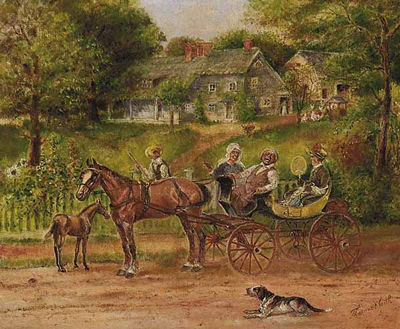
We know that Thomas Worth lived in Staten Island, Richmond County, NY in the 1890's and/or the early 1900's. It was here that he gave three watercolors as payment for legal work done by John Jerome Kenney, my husband's grandfather. We don't know if these paintings were done for this purpose or were some already owned by the artist. They could possibly be originals for Currier and Ives.