Domenichino fully subscribed to the classical notion that painting was like silent poetry and required a stylized expressive vocabulary to be properly understood and deciphered. Together with his... Read full biography
Domenichino fully subscribed to the classical notion that painting was like silent poetry and required a stylized expressive vocabulary to be properly understood and deciphered. Together with his fellow northern Italian painters, Guido Reni (1575-1642), Francesco Albani (1578-1660), Giovanni... Read full biography
Domenichino fully subscribed to the classical notion that painting was like silent poetry and required a stylized expressive vocabulary to be properly understood and deciphered. Together with his fellow northern Italian painters, Guido Reni (1575-1642), Francesco Albani (1578-1660), Giovanni Lanfranco (1582-1647), and Guercino (1591-1666), Domenico Zampieri—known after his small stature as Domenichino (little Domenico)—is one of the towering figures of seventeenth-century painting. Indeed,... Read full biography
Domenichino fully subscribed to the classical notion that painting was like silent poetry and required a stylized expressive vocabulary to be properly understood and deciphered. Together with his fellow northern Italian painters, Guido Reni (1575-1642), Francesco Albani (1578-1660), Giovanni Lanfranco (1582-1647), and Guercino (1591-1666), Domenico Zampieri—known after his small stature as Domenichino (little Domenico)—is one of the towering figures of seventeenth-century painting. Indeed, until the mid-nineteenth century, his reputation stood second only to that of Raphael, and his influence far outstripped that of Caravaggio, with whose work his own was often contrasted. Domenichino was trained in Bologna, where he joined the academy... Read full biography
Domenichino fully subscribed to the classical notion that painting was like silent poetry and required a stylized expressive vocabulary to be properly understood and deciphered. Together with his fellow northern Italian painters, Guido Reni (1575-1642), Francesco Albani (1578-1660), Giovanni Lanfranco (1582-1647), and Guercino (1591-1666), Domenico Zampieri—known after his small stature as Domenichino (little Domenico)—is one of the towering figures of seventeenth-century painting. Indeed, until the mid-nineteenth century, his reputation stood second only to that of Raphael, and his influence far outstripped that of Caravaggio, with whose work his own was often contrasted. Domenichino was trained in Bologna, where he joined the academy founded by the Carracci. Reni and Albani were fellow pupils. Like them, he moved to Rome in 1602 to assist Annibale Carracci in the completi... Read full biography
Domenico (Domenichino) Zampieri - Art Prices in Auction LotsAuction Lots
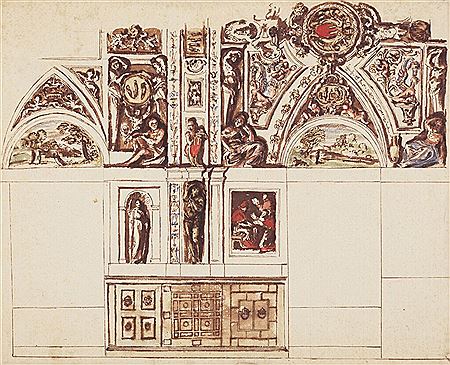
Study for a section of the decoration of a room with a vaulted ceiling, including the coat of arms of Pope Gregory XV (Ludovisi), and the wall below with indications of compartments with wainscoting