Franz Leo Ruben PRICE CHARTS
1842 - 1920. Known for: Genre scenes of everyday life, Favrettian style.
Franz Leo Ruben was a Nordic artist who trained at the Academy of Fine Arts in Prague under his father's guidance. He completed his artistic training with a study trip to Italy, particularly Rome in... Read full biography
Franz Leo Ruben was a Nordic artist who trained at the Academy of Fine Arts in Prague under his father's guidance. He completed his artistic training with a study trip to Italy, particularly Rome in 1869. However, he was most fascinated by Venice, where he stayed from 1874 until 1914. Ruben's works... Read full biography
Franz Leo Ruben was a Nordic artist who trained at the Academy of Fine Arts in Prague under his father's guidance. He completed his artistic training with a study trip to Italy, particularly Rome in 1869. However, he was most fascinated by Venice, where he stayed from 1874 until 1914. Ruben's works depict genre scenes of everyday life with a certain mannerism, such as a market episode set in a Venetian field. His brushwork and chromatic softness are of Favrettian style, and his writing and... Read full biography
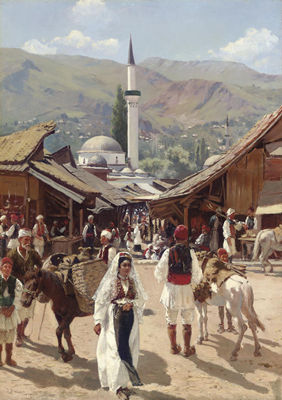
Franz Leo Ruben was a Nordic artist who trained at the Academy of Fine Arts in Prague under his father's guidance. He completed his artistic training with a study trip to Italy, particularly Rome in 1869. However, he was most fascinated by Venice, where he stayed from 1874 until 1914. Ruben's works depict genre scenes of everyday life with a certain mannerism, such as a market episode set in a Venetian field. His brushwork and chromatic softness are of Favrettian style, and his writing and composition have a strong theatrical sense.
Franz Leo Ruben was a Nordic artist who trained at the Academy of Fine Arts in Prague under his father's guidance. He completed his artistic training with a study trip to Italy, particularly Rome in 1869. However, he was most fascinated by Venice, where he stayed from 1874 until 1914. Ruben's works depict genre scenes of everyday life with a certain mannerism, such as a market episode set in a Venetian field. His brushwork and chromatic softness are of Favrettian style, and his writing and composition have a strong theatrical sense.