Timmy Payungka Tjapanagarti PRICE CHARTS
c.1942 Parayirpilynga near Wilkinkarra, Australia - 2000. Known for: Aboriginal painting, symbolic images of dreaming.
Timmy was among the first Pintupi men to begin painting on hardboard at Papunya in 1971. He lived on traditional courtry in the Gibson Desert. He was a driving force to return the Pintupi to their... Read full biography
Timmy was among the first Pintupi men to begin painting on hardboard at Papunya in 1971. He lived on traditional courtry in the Gibson Desert. He was a driving force to return the Pintupi to their traditional lands in the mid 1980s. He was a highly individual painter among the Pintupi artists,... Read full biography
Timmy was among the first Pintupi men to begin painting on hardboard at Papunya in 1971. He lived on traditional courtry in the Gibson Desert. He was a driving force to return the Pintupi to their traditional lands in the mid 1980s. He was a highly individual painter among the Pintupi artists, figuration played a large part in his earlier works. In the later phase of his work he fills the picture space with intricate 'key ' patterns which are characteristically incised onto wooden objects... Read full biography
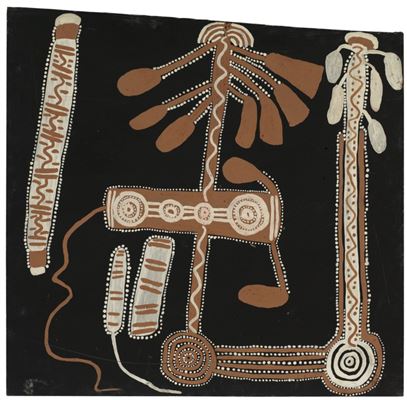
Timmy was among the first Pintupi men to begin painting on hardboard at Papunya in 1971. He lived on traditional courtry in the Gibson Desert. He was a driving force to return the Pintupi to their traditional lands in the mid 1980s. He was a highly individual painter among the Pintupi artists, figuration played a large part in his earlier works. In the later phase of his work he fills the picture space with intricate 'key ' patterns which are characteristically incised onto wooden objects associated with secret ceremonies, & the palette is reduced to a red ochre underocat covered by a maze of black & white dotted lines.
Timmy was among the first Pintupi men to begin painting on hardboard at Papunya in 1971. He lived on traditional courtry in the Gibson Desert. He was a driving force to return the Pintupi to their traditional lands in the mid 1980s. He was a highly individual painter among the Pintupi artists, figuration played a large part in his earlier works. In the later phase of his work he fills the picture space with intricate 'key ' patterns which are characteristically incised onto wooden objects associated with secret ceremonies, & the palette is reduced to a red ochre underocat covered by a maze of black & white dotted lines.