Page loaded successfully. Showing biography for Adolf Arthur Dehn.
Adolf Arthur Dehn BIOGRAPHY
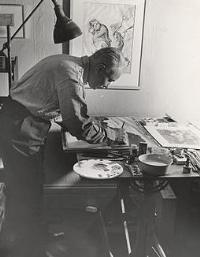
1895 Waterville, Minnesota - 1968 New York City. Known for: Genre, figure and street-landscape painting, illustration.
Born in Waterville, Minnesota, Arthur Dehn became a master lithographer and noted painter of landscapes in watercolor and oil. He studied at the Minneapolis School of Fine Arts and then received a... Read full biography
Born in Waterville, Minnesota, Arthur Dehn became a master lithographer and noted painter of landscapes in watercolor and oil. He studied at the Minneapolis School of Fine Arts and then received a scholarship to the Art Students League in New York. During the 1920s, he spent eight years in Europe... Read full biography
Born in Waterville, Minnesota, Arthur Dehn became a master lithographer and noted painter of landscapes in watercolor and oil. He studied at the Minneapolis School of Fine Arts and then received a scholarship to the Art Students League in New York. During the 1920s, he spent eight years in Europe and got an early reputation as a satirical lithographer. In 1936, he gave up the print medium for watercolor and then added oil to his media. From 1939 to 1951, he traveled world wide. In 1943, he won... Read full biography
Born in Waterville, Minnesota, Arthur Dehn became a master lithographer and noted painter of landscapes in watercolor and oil. He studied at the Minneapolis School of Fine Arts and then received a scholarship to the Art Students League in New York. During the 1920s, he spent eight years in Europe and got an early reputation as a satirical lithographer. In 1936, he gave up the print medium for watercolor and then added oil to his media. From 1939 to 1951, he traveled world wide. In 1943, he won First Prize at the International Watercolor Exhibition at the Art Institute of Chicago. He was also a member of the Guggenheim Foundation.... Read full biography
Born in Waterville, Minnesota, Arthur Dehn became a master lithographer and noted painter of landscapes in watercolor and oil. He studied at the Minneapolis School of Fine Arts and then received a scholarship to the Art Students League in New York. During the 1920s, he spent eight years in Europe and got an early reputation as a satirical lithographer. In 1936, he gave up the print medium for watercolor and then added oil to his media. From 1939 to 1951, he traveled world wide. In 1943, he won First Prize at the International Watercolor Exhibition at the Art Institute of Chicago. He was also a member of the Guggenheim Foundation.... Read full biography
Artist Biography
Biography page for Adolf Arthur Dehn ((1895 - 1968)), known for Genre, figure and street-landscape painting, illustration. Showing 6 biographical entries and 0 sample artworks.
Adolf Arthur Dehn - Artist Info
About Adolf Arthur Dehn
Biography from the Archives of askART
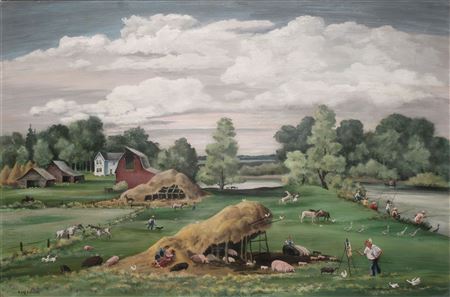 Born in Waterville, Minnesota, Arthur Dehn became a master lithographer and noted painter of landscapes in watercolor and oil.
He studied at the Minneapolis School of Fine Arts and then received a scholarship to the Art Students League in New York. During the 1920s, he spent eight years in Europe and got an early reputation as a satirical lithographer.
In 1936, he gave up the print medium for watercolor and then added oil to his media. From 1939 to 1951, he traveled world wide.
In 1943, he won First Prize at the International Watercolor Exhibition at the Art Institute of Chicago. He was also a member of the Guggenheim Foundation.Biography from David Cook Galleries
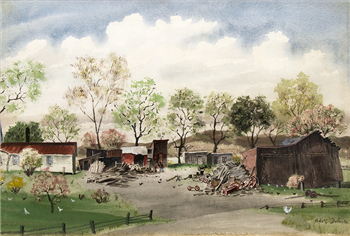 Adolf Arthur Dehn, the great-grandson of pioneers, was born in Waterville, Minnesota. Dehn was an illustrator, lithographer, and painter. He studied at the Minneapolis School of Fine Arts from 1914-1917, and then received a scholarship to the Art Students League in New York, where he studied under Boardman Robinson.
Around 1921, Dehn traveled to Germany, France, England, and Vienna. He remained in Vienna until 1929, building a reputation as a satirical lithographer. In 1930, he relocated his studio to New York City. Until 1937, his work consisted entirely of black and white drawings and lithography. After 1937, his work was almost entirely in watercolor, though he occasionally worked with oil paint.
Dehn taught at the Colorado Springs Fine Art Center in the summers of 1941 and 1942. He painted landscapes in Colorado in lithographs and watercolors. In 1943, he won First Prize at the International Watercolor Exhibition at the Art Institute of Chicago. He coauthored a book with Lawrence Barrett published in 1950, How to Draw and Print Lithographs. Dehn frequently stayed in Woodstock, New York as the guest of Arnold Blanch. In Woodstock, Dehn participated in the affairs of the Artists Association. He was also a member of the Guggenheim Foundation.Biography from Southport Galleries (CLOSED)
 Born in Waterville, Minnesota, Adolf Dehn began creating artwork at the age of 6. For the first two decades of his student and professional life he worked almost entirely in black and white as a natural and expressive watercolorist. By1920, after formal training as an illustrator and lithographer, he began to create ink drawings and lithographs, which he was able to sell and supported him though the difficult years of the depression.
In the early 1920's Dehn moved to Europe, and he developed his imagery for the decade, which was made up of cabaret, park scenes, burlesque and landscapes of the roaring 20's in Europe. He returned to the Midwest during the depression and by 1936 started to work in the watercolor medium. He discovered that he liked the watercolor medium, its characteristics and finish, its very fluidity, its suitability for either deliberate or spontaneous effects.
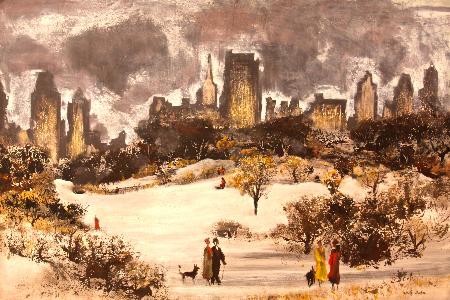
Significantly, watercolor also agreed with Dehn's open, effusive, and passionate character. During the 30's and 40's, Dehn's favorite subjects were the farmscapes of the Midwest and later the Northeast. His eventual home of New York City also became a frequent subject matter for Dehn, who captured the essence of the city's burlesque, Central Park, Harlem nightclubs, industrial yards and high society.
Dehn died in New York City in May 1968 and left behind a vast body of lithographs, watercolors, drawings and prints, which are in the permanent collections of nearly 100 museums across the United States and Europe.Biography from Butler Institute of American Art
The Butler Institute of American Art has approximately 12 of Adolf Arthur Dehn's paintings, prints, and drawings. We also own 117 of his sketch books dating from the 50's and 60's from his travels around the world.Biography from Williams American Art Galleries
Adolf Dehn, printmaker, watercolorist, and illustrator, was born in Waterville, Minnesota, in 1895. In 1914 he began studying at the Minneapolis School of Art, and in 1917, the year his first published drawing appeared in the progressive magazine, The Masses, he received a scholarship to study at the Art Students League in New York. There he worked with Kenneth Hayes Miller and was introduced to lithography by Boardman Robinson.
While in New York, Dehn threw himself into liberal politics. Declaring himself a conscientious objector in 1918, he was forced to spend four months in a Spartanburg, South Carolina, boot camp for refusing to serve in the armed forces and eight months as a volunteer instructor teaching painting and drawing at a hospital for war victims in Asheville, North Carolina.
Dehn spent the years 1920 to 1929 in art-related travel in Europe, primarily in Vienna and in Paris, where he made lithographs at the Atelier Desjobert. Throughout this time, Dehn exhibited his work at the Weyhe Gallery in New York and contributed drawings both to magazines abroad and to the radical journal The Masses.
Upon his return to New York in 1929, he became a leading figure in printmaking circles, exhibiting his prints to considerable critical acclaim. In 1937, Dehn had worked exclusively in black and white until 1937—halfway through his career—when he began to work in watercolor. During his summer visits to Minnesota, he created a large body of regional watercolors depicting the lakes and farms of his home state. Lithography and watercolor remained his two primary media, and his subjects ranged from social satire to naturalistic landscapes.
He authored the treatise, Water Color Painting, in 1945 and two other instructional books on lithography and watercolor in 1950 and 1955. From 1938 to 1939 he taught at Stephens College in Columbia, Missouri, and during the summers of 1940-1942 he taught at the Colorado Springs Fine Arts Center.
In 1939 and 1951 Dehn received Guggenheim Fellowships, and 1961 he was elected Full Academician to the National Academy of Design.
Dehn exhibited throughout his career, and his works are in the permanent collections of the Metropolitan Museum of Art, the Museum of Modern Art, the Art Institute of Chicago, the Museum of Fine Arts in Boston, and the British Museum, among others.
Adolf Dehn died in New York in 1968.Biography from Harmon-Meek Gallery
Adolf Dehn
The Harmon-Meek Gallery in Naples, Florida has represented the Adolf Dehn estate since 1970 during which time it has hosted more than twenty exhibitions of all aspects of the artist’s work. William Meek has also arranged for Dehn loan exhibitions to be viewed in more than thirty art museums throughout the country.
Recent major publications about Adolf Dehn, his life, and his art, present a more complete picture of who he was and what he accomplished. Dr. Philip Eliasoph of Fairfield University in Connecticut wrote Adolf Dehn – Midcentury Manhattan which was published in 2017 by The Artist Book Foundation in North Adams, Massachusetts revealing his fifty years spent living there.
In 2021 Dr. Henry Adams of Case Western University in Cleveland, Ohio wrote about Dehn’s entire life in The Sensuous Life of Adolf Dehn which was published by the University of Missouri Press in Columbia.
To the best of our knowledge Dehn was included in every Whitney Museum of American Art “Annual” invited exhibition from 1931 until his death in 1968, a feat not attained by any other artist.