Page loaded successfully. Showing biography for Agnes Cleve-Jonand.
Agnes Cleve-Jonand BIOGRAPHY
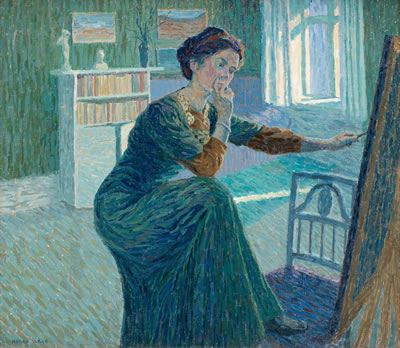
1876 Sweden - 1951. Known for: Painting and sculpture.
Agnes Cleve was a female artist who developed her Cubist style in Paris in 1913. She later moved to New York where she was inspired by the city's colors and created an expressionist futuristic style.... Read full biography
Agnes Cleve was a female artist who developed her Cubist style in Paris in 1913. She later moved to New York where she was inspired by the city's colors and created an expressionist futuristic style. She used her camera to document the city's urban environment and portrayed it up close, making her... Read full biography
Agnes Cleve was a female artist who developed her Cubist style in Paris in 1913. She later moved to New York where she was inspired by the city's colors and created an expressionist futuristic style. She used her camera to document the city's urban environment and portrayed it up close, making her a co-actor in the modern city. Her work Bro, New York features a twisted silhouette of a bridge seen from below with several geometric planes. Agnes Cleve is known for her modernist avant-garde... Read full biography
Agnes Cleve was a female artist who developed her Cubist style in Paris in 1913. She later moved to New York where she was inspired by the city's colors and created an expressionist futuristic style. She used her camera to document the city's urban environment and portrayed it up close, making her a co-actor in the modern city. Her work Bro, New York features a twisted silhouette of a bridge seen from below with several geometric planes. Agnes Cleve is known for her modernist avant-garde artwork style and medium. Agnes Cleve was a Swedish modernist artist who was known for her radical and bold design language. She often portrayed her hometown Stockholm, capturing the city's pulsating atmosphere and changing light. Cleve studied at Valand's... Read full biography
Agnes Cleve was a female artist who developed her Cubist style in Paris in 1913. She later moved to New York where she was inspired by the city's colors and created an expressionist futuristic style. She used her camera to document the city's urban environment and portrayed it up close, making her a co-actor in the modern city. Her work Bro, New York features a twisted silhouette of a bridge seen from below with several geometric planes. Agnes Cleve is known for her modernist avant-garde artwork style and medium. Agnes Cleve was a Swedish modernist artist who was known for her radical and bold design language. She often portrayed her hometown Stockholm, capturing the city's pulsating atmosphere and changing light. Cleve studied at Valand's art school and later in Paris under Henri Le Fauconnier and André Denuyer. She returned to Sweden with her husband, artist John Jon-And,... Read full biography
Artist Biography
Biography page for Agnes Cleve-Jonand ((1876 - 1951)), known for Painting and sculpture. Showing 2 biographical entries and 0 sample artworks.
Agnes Cleve-Jonand - Artist Info
About Agnes Cleve-Jonand
Biography from Uppsala (also see Stockholms Auktionsverk)
Agnes Cleve was a female artist who developed her Cubist style in Paris in 1913. She later moved to New York where she was inspired by the city's colors and created an expressionist futuristic style. She used her camera to document the city's urban environment and portrayed it up close, making her a co-actor in the modern city. Her work Bro, New York features a twisted silhouette of a bridge seen from below with several geometric planes. Agnes Cleve is known for her modernist avant-garde artwork style and medium.
Agnes Cleve was a Swedish modernist artist who was known for her radical and bold design language. She often portrayed her hometown Stockholm, capturing the city's pulsating atmosphere and changing light. Cleve studied at Valand's art school and later in Paris under Henri Le Fauconnier and André Denuyer. She returned to Sweden with her husband, artist John Jon-And, and settled in Stockholm. They lived in a combined apartment and studio where Cleve painted interiors, beautiful objects, and industrial buildings. The auction's still life painting shows sunlight streaming in from an open window over a pink flower in a pot on the windowsill. It is believed to have been painted after the couple's return to Stockholm or possibly in Paris.Biography from Christie's New York, Rockefeller Center
Agnes Cleve’s artistic legacy is one of being a pioneering female modernist, due in large part to her forceful, expressive painting style. Born in Sweden in 1876, Cleve moved to Paris in 1913 and studied under Le Fauconnier, one of the Montparnasse Cubists. Cleve and her husband Johan Jonand moved back to Sweden in 1915, where their summer home became a meeting place for other European Modernists, including Wassily Kandinsky.
The influence of Kandinsky and other Der Blaue Reiter artists including Franz Marc can be seen in the expressive use of color by Cleve in Vision I. Cleve’s artistic output in 1915, the year Vision I was painted, shows an artist synthesizing the varying modernist styles being pioneered across early 20th century Europe, yet producing work distinctly her own.