Page loaded successfully. Showing biography for Al Raymond.
Al Raymond BIOGRAPHY
1909 New Rochelle, New York - 1956. Known for: Illustration and cartoons.
Alexander Raymond, noted for his illustrative style, rose from the bullpen at King Features Syndicate to become one of the most celebrated cartoonists of the 1930s, 1940s, and 1950s. In a career that... Read full biography
Alexander Raymond, noted for his illustrative style, rose from the bullpen at King Features Syndicate to become one of the most celebrated cartoonists of the 1930s, 1940s, and 1950s. In a career that spanned a quarter of a century, Raymond was responsible for four influential strips: Secret Agent... Read full biography
Alexander Raymond, noted for his illustrative style, rose from the bullpen at King Features Syndicate to become one of the most celebrated cartoonists of the 1930s, 1940s, and 1950s. In a career that spanned a quarter of a century, Raymond was responsible for four influential strips: Secret Agent X-9, Flash Gordon, Jungle Jim, and the cerebral Rip Kirby. Alexander Gillespie Raymond was raised in the affluent suburb of New Rochelle, New York, the son of a civil engineer. If he showed any sign of... Read full biography
Alexander Raymond, noted for his illustrative style, rose from the bullpen at King Features Syndicate to become one of the most celebrated cartoonists of the 1930s, 1940s, and 1950s. In a career that spanned a quarter of a century, Raymond was responsible for four influential strips: Secret Agent X-9, Flash Gordon, Jungle Jim, and the cerebral Rip Kirby. Alexander Gillespie Raymond was raised in the affluent suburb of New Rochelle, New York, the son of a civil engineer. If he showed any sign of following in this fathers footsteps, it was a closely guarded secret. In fact, he credits his father for having "a vision to see beyond his own business, to realize that art could be a worthwhile career, too", and claimed the elder Raymonds office... Read full biography
Alexander Raymond, noted for his illustrative style, rose from the bullpen at King Features Syndicate to become one of the most celebrated cartoonists of the 1930s, 1940s, and 1950s. In a career that spanned a quarter of a century, Raymond was responsible for four influential strips: Secret Agent X-9, Flash Gordon, Jungle Jim, and the cerebral Rip Kirby. Alexander Gillespie Raymond was raised in the affluent suburb of New Rochelle, New York, the son of a civil engineer. If he showed any sign of following in this fathers footsteps, it was a closely guarded secret. In fact, he credits his father for having "a vision to see beyond his own business, to realize that art could be a worthwhile career, too", and claimed the elder Raymonds office walls were tattooed with his artwork. When, or even why Raymond decided on a career as a cartoonist can only be guessed. It is known, however, th... Read full biography
Artist Biography
Biography page for Al Raymond ((1909 - 1956)), known for Illustration and cartoons. Showing 1 biographical entries and 0 sample artworks.
Al Raymond - Artist Info
About Al Raymond
Name variants
Alex Raymond
Biography from the Archives of askART
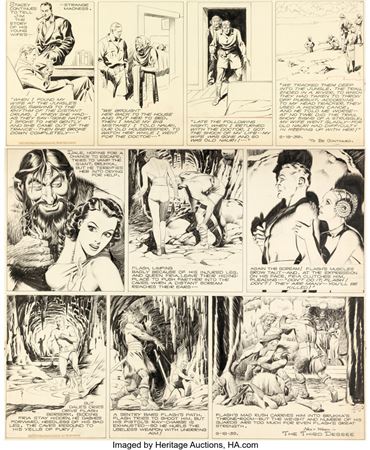
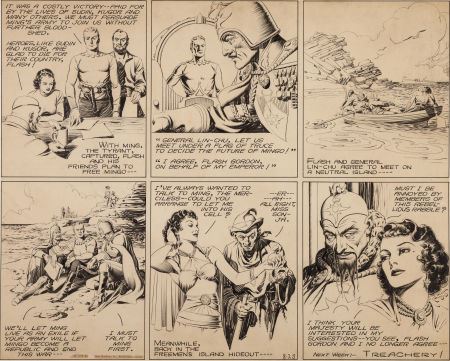 Alexander Raymond, noted for his illustrative style, rose from the bullpen at King Features Syndicate to become one of the most celebrated cartoonists of the 1930s, 1940s, and 1950s. In a career that spanned a quarter of a century, Raymond was responsible for four influential strips: Secret Agent X-9, Flash Gordon, Jungle Jim, and the cerebral Rip Kirby.
Alexander Gillespie Raymond was raised in the affluent suburb of New Rochelle, New York, the son of a civil engineer. If he showed any sign of following in this fathers footsteps, it was a closely guarded secret. In fact, he credits his father for having "a vision to see beyond his own business, to realize that art could be a worthwhile career, too", and claimed the elder Raymonds office walls were tattooed with his artwork. When, or even why Raymond decided on a career as a cartoonist can only be guessed. It is known, however, that his family lived near Russ Westover, of Tillie the Toiler fame. It is possible that on visits to the Westover home, Raymond became fascinated by his neighbors work and chose to be a cartoonist also.
When his father died, Raymond was still leaning toward sports, having entered Iona Prep School in New Rochelle on a football and baseball scholarship. He is said to have been offered an athletic scholarship to Notre Dame University also. But, as the eldest of five children, he was forced to be the familys breadwinner and took a job on Wall Street as an order clerk while still a teenager. The Crash of 1929 sent him scurrying elsewhere to earn a dollar, and he wound up, as he described it, a solicitor for a mortgage broker. He also enrolled in the Grand Central School of Art, and was soon calling on his old neighbor, Russ Westover, for advice.
Westover apparently recognized Raymonds talent and used him as an assistant on Tille the Toiler. He then landed Raymond a job in the bullpen at King Features in 1930. Raymond did some toiling of his own at $20 a week, assisting the Young brothers, Lyman and Chic, on Tim Tylers Luck and Blondie, while also continuing to work on Tillie.
For the next four years about the time it takes to earn a college degree Raymond received as good an education in the field of cartooning as could be found anywhere. Under the management of president Joe Connolly, King Features was one of the premier syndicates in the country. While Raymond was going to "school" in the KFS bullpen, Connolly was a whirling dervish of ideas, looking for anything to capture the lucrative newspaper market detective stories, jungle stories, science fiction, mystery. He hired Dashiell Hammett, the famous author of The Maltese Falcon, to write Secret Agent X-9, a new strip based on the hard-boiled detective characters Hammett had created for pulp magazines. He also hungered for a strip to go head-to-head against Buck Rogers, and another to counter Tarzan. A major beneficiary of all these ambitions was Alexander Raymond, the former clerk from Wall Street.
In late 1933, and early 1934, the almost 23-year-old Raymond emerged from the bullpen to win the illustrating chores of Secret Agent X-9 as well as Flash Gordon and Jungle Jim. All three debuted in 1934.
Initially, Raymonds style was stiff, almost amateurish in contrast to his later work. However, he quickly developed into one of the leading cartoon artists of his day, a fitting rival to Hal Foster to whom he was often compared. But three strips proved too much even with the assistance of the able Austin Briggs and so Raymond stopped work on Secret Agent X-9.
During World War II, Raymond relinquished Flash Gordon and Jungle Jim to Briggs, and enlisted in the Marine Corps. He served aboard an aircraft carrier as a combat artist and public information officer. In 1946, with the war behind him, he expected to resume Flash Gordon, but to his surprise, King Features had other plans a detective strip to compete against Dick Tracy. As an enticement, KFS offered him ownership of the new strip, which turned out to be Rip Kirby. Kirby was a private investigator with intellect, a retired Marine officer (like Raymond) who wore glasses, smoked a pipe, and (as Raymond did) loved classical music, golf, and drove sports cars. Devoting nearly all his energy to the strip, Raymond turned Rip Kirby into a tour de force.
In 1956, Raymond drove a sports car into a tree in Westport, Connecticut, killing himself and cutting sort a brilliant career. He was a month shy of his 47th birthday.
(Information on the biography above is based on writings from the book, "The Encyclopedia of American Comics," edited by Ron Goulart.)