Page loaded successfully. Showing biography for Albert Ernest (Beanie) Backus.
Albert Ernest (Beanie) Backus BIOGRAPHY
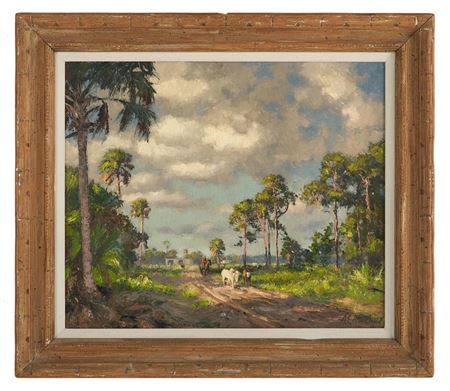
1906 Fort Pierce, Florida - 1990 Fort Pierce, Florida. Known for: Everglade landscape, trees and figure painting.
A painter whose career was almost entirely focused on Florida landscapes, skyscapes, people and botanics, Albert Backus is regarded as the Dean of Florida Painters. He first received attention for... Read full biography
A painter whose career was almost entirely focused on Florida landscapes, skyscapes, people and botanics, Albert Backus is regarded as the Dean of Florida Painters. He first received attention for his still-lifes, especially hibiscus, and later for his landscape and figure works of the Florida... Read full biography
A painter whose career was almost entirely focused on Florida landscapes, skyscapes, people and botanics, Albert Backus is regarded as the Dean of Florida Painters. He first received attention for his still-lifes, especially hibiscus, and later for his landscape and figure works of the Florida backwoods country. Although he was basically self-taught, taking summer classes at the Parsons School in New York City, he gave lessons to numerous artists. Today, among persons knowledgeable about... Read full biography
A painter whose career was almost entirely focused on Florida landscapes, skyscapes, people and botanics, Albert Backus is regarded as the Dean of Florida Painters. He first received attention for his still-lifes, especially hibiscus, and later for his landscape and figure works of the Florida backwoods country. Although he was basically self-taught, taking summer classes at the Parsons School in New York City, he gave lessons to numerous artists. Today, among persons knowledgeable about American folk art, Albert Backus is known as the most influential person of The Highwaymen, a group of 1950s African-Americans who are arguably the best known of the Florida folk-art painters. Using art expression as a way of working through their despair... Read full biography
A painter whose career was almost entirely focused on Florida landscapes, skyscapes, people and botanics, Albert Backus is regarded as the Dean of Florida Painters. He first received attention for his still-lifes, especially hibiscus, and later for his landscape and figure works of the Florida backwoods country. Although he was basically self-taught, taking summer classes at the Parsons School in New York City, he gave lessons to numerous artists. Today, among persons knowledgeable about American folk art, Albert Backus is known as the most influential person of The Highwaymen, a group of 1950s African-Americans who are arguably the best known of the Florida folk-art painters. Using art expression as a way of working through their despair at having no future beyond their jobs as workers in citrus groves and packing houses, The Highwaymen sold paintings out of their vehicles. Descr... Read full biography
Artist Biography
Biography page for Albert Ernest (Beanie) Backus ((1906 - 1990)), known for Everglade landscape, trees and figure painting. Showing 3 biographical entries and 0 sample artworks.
Albert Ernest (Beanie) Backus - Artist Info
About Albert Ernest (Beanie) Backus
Name variants
AE Bean Backus, Bean (Beanie) Backus
Biography from the Archives of askART
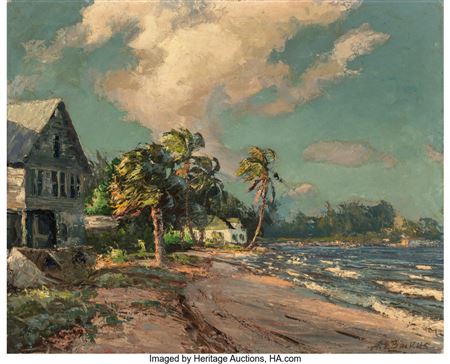 A painter whose career was almost entirely focused on Florida landscapes, skyscapes, people and botanics, Albert Backus is regarded as the Dean of Florida Painters. He first received attention for his still-lifes, especially hibiscus, and later for his landscape and figure works of the Florida backwoods country.
Although he was basically self-taught, taking summer classes at the Parsons School in New York City, he gave lessons to numerous artists. Today, among persons knowledgeable about American folk art, Albert Backus is known as the most influential person of The Highwaymen, a group of 1950s African-Americans who are arguably the best known of the Florida folk-art painters. Using art expression as a way of working through their despair at having no future beyond their jobs as workers in citrus groves and packing houses, The Highwaymen sold paintings out of their vehicles. Described as creating "hybrid versions" of the painting style of Backus, (Neal) members of the group, whose leader Alfred Hair was a student of Backus, were also inspired by his personal advocation of equal rights and racial tolerance.
Albert Backus was born in 1906 in Fort Pierce, Florida, a small and sparsely populated town where his parents had moved two years prior to his birth. At this time, the Fort Pierce economy was totally oriented to fishing and agriculture, and this pre-urban development culture is reflected in many of the Backus paintings.
At an early age, Backus, known by the family nickname of "Beanie", showed art talent. During his early years, he worked with watercolors, painting small pictures of tropical landscapes, portraits of friends and basically anything that would amuse the local townsfolk.
His first major painting job was doing backdrops in a local Fort Pierce theatre. Other commissions followed; however, the money he received was never much until he was encouraged to leave high school to help support his family.
In 1931, at the height of the Great Depression, Backus, encouraged by his family and friends, had a one-man show, which, to his great surprise, proved very successful. "He later remarked, 'I couldn't believe that people were willing to pay me $10 for a painting, what with us having such a bad economy and all!' Modesty was almost always a Backus trademark.
During this period, he supplemented his income with a variety of jobs in local businesses and continued to paint, primarily with heavy use of a palette knife in an impressionist style inspired by Claude Monet. He especially loved storm scenes with tumultuous skies, which gave his work a sense of great vigor.
His painting style later became more representational but it was written that throughout his career there was "hardly a cloud formation, plant or animal species that Backus could not name" (Backus Museum) and that his favorite times of day to paint were early mornings and late afternoons.
Albert Backus received his first national recognition in 1939 in an exhibition sponsored by IBM and the Golden Gate Exposition committee. Called "Art Across the Nation", the exhibition was composed of entries that artists across the country regarded as their finest work. In Florida, Backus won the competition to determine which artist would be represented with his work titled "And Then There Was Light". It received special recognition at the national exhibition, which for Backus was the turning point of focusing his life on his art.
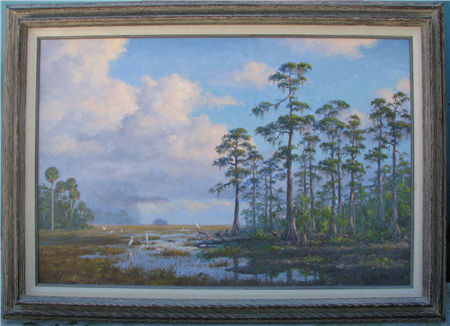
In 1942, Backus joined the Navy, and aboard ship and later when recuperating from wounds in a naval hospital, continued to sketch and paint as much as possible. When the war was over he did paintings of the Florida Everglades that became some of his trademark work. He received commission work, especially from a winter visitor named Arthur De Yo, but few persons to that time outside of Fort Pierce knew of the talents of Albert Backus. In 1949, he decided to try to enhance his reputation and began exhibiting and selling his work in Miami, which much increased his name recognition.
In 1951, Backus married Patsy, who died several years later at age 29 during open-heart surgery. He, apparently devastated and with no children, changed from being a moderate drinker of alcohol to excessive, and problems of alcoholism and depression began that affected the remainder of his personal life.
Although, rewards from his art talents continued, he, at the urging of friends concerned about his grief-ridden lifestyle, spent time in the Caribbean in order to regain mental stability. In 1957, he set up a studio in Port Antonio, Jamaica, and remained there for several years until local politics forced him back to Florida.
In the next two decades his career skyrocketed, continuing through the 1970s despite his ever-increasing eyesight problems and despite his dependence upon an ever-nearby bottle of rum.
The Backus studio in Fort Pierce became a gathering place for aspiring artists and also for friends seeking stimulating conversation, for Haitian refugees, troubled local kids whom he housed, and for bus-loads of tourists. He hated "pleasant" conversation, stating that "I'd rather be a liar than a bore". (Backus Museum). Reportedly he could hold forth on almost any topic ranging from personal finance, through politics, philanthropy and religion. He spoke of the virtues of Christianity but alternated between atheism and agnosticism. He was known for his annual Halloween parties, always integrated by race and age, and ever featuring the recent artwork of his students known as the Backus Brats.
In those years, his lifestyle was a combination of personal creativity, gregariousness and modest day-to-day existence with old appliances, and only one air conditioned room, his studio where he most likely was playing recorded music of Duke Ellington. Backus donated generously to charities and paid for the academic art education of numerous young people he thought deserving.
Of this ever-outreaching man and much-admired artist, Unitarian minister, Charles Lelly, wrote in 1969: "Here is a man who gives of himself, of his time, and of his love. He gives to the rich, to the poor, and to the in-between. He takes in the destitute or homeless and takes care of their needs until they are able to stand alone. He never knows whether another man is white, black, yellow or red. He only knows that man is a person. He has the courage to be firm when necessary, yet is always tender...understands and loves, but rarely passes judgment...puts himself last and everyone else ahead." (Backus Gallery)
Albert Ernest Backus died at age eighty four of heart failure on June 6, 1990. His studio, at the corner of Avenue C and Second Street in Fort Pierce, is maintained as the Backus Gallery where the doors to his "gabled house with the turquoise shutters are wide open, a sure sign that the artist is in residence. . . .On a typical day, you could find the man with the shock of silver hair and the guyabera shirts in one of three places: In the kitchen cooking; sitting on a wrought-iron chaise lounge reading the paper; or standing at his easel, preserving Florida's vanishing beauty on canvas (Backus Museum)
His work can be found in the LBJ Texas library, the rooms of the Georgia State Supreme Court and the A.E. "Bean" Backus Gallery and Museum in Fort Pierce, Florida, which is the location of his studio and much of his collection of paintings and original sketches including the earliest known work, painted in 1918 and the unfinished painting on his easel at the time of his death. Also at the Backus Gallery and Museum is a collection of work by The Highwaymen.
Source:
http://www.backusgallery.com
http://www.fineartstrader.com/backus.htmd, Written by Glenn Firestone
Neal Auction HouseBiography from A.E. Backus Museum & Gallery
 The salt air from the Indian River at low tide wafts up to Avenue C, mingling with the heady smell of bread baking at the Flowers Bakery on U.S 1. A car skitters down Tickle Tummy Hill.
The old electric plant across the street hums eternally. The doors to the gabled house with the turquoise shutters are wide open, a sure sign that the artist is in residence. An even surer sign is the Duke Ellington record, scratched from decades of use, wailing from the stereo.
On a typical day, you could find the man with the shock of silver hair and the guyabera shirts in one of three places: In the kitchen cooking; sitting on a wrought-iron chaise lounge reading the paper; or standing at his easel, preserving Florida's vanishing beauty on canvas.
A.E. "Bean" Backus was a curious blend of artist and humanitarian, who lived modestly but gave generously to his friends and community.
It was at his studios - first at the mouth of Moore's Creek, a stone's throw from where this gallery stands, and later, at the northeast corner of Avenue C and Second Street - that both a forum and sanctuary were given to artistic expression, racial tolerance and gestures of human decency.
Born January 3, 1906 along the Indian River in Fort Pierce, Backus was largely self-taught as an artist. Abiding by the aphorism "Seize upon that which is nearest and make from it your work of art," he first became known for his still lifes of the ever-present hibiscus and later for his landscapes of Florida's backwoods. After Winslow Homer, he was one of the few artists in the early 20th century to depict Florida's rugged beauty on canvas.
While Backus became teacher to a legion of artists, he is best remembered by friends as a humanitarian. It was around his kitchen table that debates would erupt on almost any issue. A rum bottle beneath the kitchen sink seemed always to be at the ready.
The conversations were often lively, if not shocking. Backus liked to have people around him with whom he disagreed. He said he could imagine nothing more boring than a night of pleasant conversation and liked to quote friend and fellow artist Waldo Sexton, "I'd rather be a liar than a bore."
Leaning back in a captain's chair, Backus could hold forth on any topic, ranging from personal finance ("Never give money to a friend on the condition that it must be repaid"); social etiquette ("Never throw a party and ask your guests to bring something"); and philanthropy ("You have to give away $10 for $1 to do any good").
Though Backus was alternately agnostic and atheistic, friends said he extolled the virtues of Christianity better than many Christians. His studio became home for Haitians off the boat, West Virginians off the bus, kids on the outs with their parents or friends down on their luck.
Backus also channeled much of his energies into influencing the children who hung around his studio. (Backus had been married, but his wife Patsy died when she was just 29, and they never had any children.)
For generations of "Backus Brats," the studio became the place where you might finish your first painting, steal your first kiss or win your first debate with an adult. The annual Backus Halloween parties, always intergenerational and interracial affairs, were a show-case for the creative talents of the latest crop of Backus kids.
Backus lived modestly. Appliances and cars were always replaced with used ones, and a single room in his house, the art studio, was air-conditioned. But he gave generously, writing checks or donating paintings to almost any charity that would ask. He also quietly helped finance the educations of several generations of art students.
Charles Lelly, a Unitarian minister, wrote of Backus in 1969: "Here is a man who gives of himself, of his time, and of his love. He gives to the rich, to the poor, and to the in-between. He takes in the destitute or homeless and takes care of their needs until they are able to stand alone. He never knows whether another man is white, black, yellow or red. He only knows that man is a person. He has the courage to be firm when necessary, yet is always tender...understands and loves, but rarely passes judgment...puts himself last and everyone else ahead."
Albert Ernest Backus died of heart failure on June 6, 1990. While the studio survives only as a place in the heart for the hundreds of people who knew him.
Artistic Technique
A.E. "Bean" Backus was largely self-taught, relying on books and magazines for much of his early training. His formal art education was limited to summer sessions at Parsons art school in New York City.
From the 1930s through the 1950s, much of Backus' work was impressionistic. Monet had been one of his early influences, and the French artist's use of color was adapted on Backus' early Florida canvases.
Paintings from this period are characterized by Backus' heavy use of the palette knife. His sweeping gestures with the knife and his preference for painting storm scenes brought a sense of unbridled vigor to this work.
In the last 30 years of Backus' life his landscapes became more representational, and he employed the brush far more often than the knife.
The backwoods paintings done at this time were often more serene and detailed than his earlier works.
Backus' success at capturing Florida's rugged beauty came as much from his scientific inquiries as from his artistic ability. He spent a lifetime studying plants, wildlife and meteorology.
There was hardly a cloud formation, Florida plant or animal species that Backus could not name. Even in his 80s, he could be seen around Fort Pierce studying and sketching the nuances the light of sunrise could have on a favorite jacaranda tree or sabal palm cluster. His favorite times of day were late afternoon or early morning, because the light is more alive then. Backus mastered light: the handling of light, the effect of light on the color of an object, and how light differs from day-to-day, season-to-season, place-to-place.
Submitted by Kathleen Fredrick, A.E. Backus Gallery & Museum
The Board of Directors of the A.E. Backus Gallery wishes to thank Gregory Enns for sharing his personal knowledge and reminiscences with us. Enns, a Fort Pierce native and veteran Florida journalist, wrote "Ellington Essentials: A Guide to the Duke of Jazz" while on a Knight Foundation fellowship at the University of North Carolina in 1997. Backus had introduced Enns to the music of Duke Ellington some 30 years earlier. Copyright 1996.Biography from The Johnson Collection
ALBERT ERNEST BACKUS (1906–1990)
The terrain of unspoiled Florida was Albert Ernest “A. E.” Backus’s passion. When he was born in 1906, his birthplace, Fort Pierce, was surrounded by citrus groves; in the early 1920s it was transformed when an inlet was dredged to provide access for commercial and sports fishing. His family ran a boatyard, which Backus, known as “Bean” or “Beanie,” used as a studio. Fort Pierce was named after the Army post built in 1838 during the Second Seminole War, and the city continued to expand throughout the twentieth century. Showing an early interest in art, “Bean” practiced with watercolors and learned about oil-based paints at his father’s boat shop.
Although Backus is often described as self-taught, claiming he “learned by doing,” he gained some education in art fundamentals during two summer sessions at the Parsons School of Design in New York in 1924 and 1925. Explaining his modest training, Backus commented: “If you go to art museums you can see how other people did certain things and try to analyze why they did it. It’s faster if you have lessons and take advantage of someone else’s experience. The only reason I didn’t get more schooling was because it was economically impossible.”
For a time he did commercial work, producing signs and billboards, and became the artist-in-residence for the Sunrise Theater, a performing arts venue. In 1931 he enjoyed the patronage of Dorothy Binney Palmer, giving Backus his first show. Shortly after the attack on Pearl Harbor, he joined the United States Navy and served as quartermaster, second class aboard the troop transport USS Hermitage (AP-54) where during his time, the ship’s commander encouraged his painting. His horizons increased extensively with ports-of-call in Europe, Central America, Australia, and New Zealand.
At the conclusion of World War II, Backus returned home and renovated the old boatyard, which became his base until 1960. His work from this phase reflected his attempts to capture the light of Florida, rendered with heavy impasto which he applied with a palette knife. His discovery of this technique was somewhat serendipitous: “What happened was that I had one of these regular old [flat] painting knives that you use to scrape with, and I thought, well, I’m just going to whack this paint in with this thing… Several years after that, they started making painting knives because there were other people, I guess, who had the same idea. With me it was just an accident. I used the palette knife exclusively for a while.”
After his wife’s death in 1955, Backus began to spend time in Jamaica, enjoying its lush vegetation and slower pace, claiming “I moved to Jamaica for the rum, the painting was secondary.” In his Jamaica paintings he used more complementary colors and included more figures than in his earlier Florida work. Selling his first Fort Pierce studio to a power plant, he purchased a home nearby, known as the New Studio, and hired a studio manager. Still interested in capturing the Florida light, Backus shifted his style to incorporate more detail, smoother surfaces, and quiet inland scenes.
Known for treating people with respect, Backus also mentored young students, hosted parties, and gave back to his community. He opened his studio to clients, numerous friends, and students, many of whom became known as the Indian River School. In the mid-1950s he welcomed and mentored Alfred Hair, an aspiring Black artist who in turn organized other African American artists, becoming known as the Florida Highwaymen. Traveling up and down the coast they sold their colorful canvases, many based on Backus’s work, from the trunks of their cars. In 2004, twenty-five Florida Highwaymen were recognized by the Florida Artists Hall of Fame. In 1993, Backus was posthumously awarded this same honor.
Backus had his own accolades; he was frequently referred to as “Florida’s painter laureate,” and by 1968 he was declared the “Dean of Florida’s landscape painters.” Eight years later he was called a “state treasure,” followed in 1979 when Governor Bob Graham announced that Backus was the best-known representational artist in the state. The next year Florida Atlantic University presented him with an honorary degree of Doctor of Humane Letters. In typical fashion, Backus commented: “It’s kind of funny for someone who never graduated from high school.” Backus’s lasting legacy is the A.E. Backus Museum & Gallery (originally the Fort Pierce Art Gallery), which he established in 1960 to showcase and sell his work, along with the Highwaymen and members of the Indian River School.
The Johnson Collection, Spartanburg, South Carolina
thejohnsoncollection.org