Alberto Pasini BIOGRAPHY
Artist Biography
Biography page for Alberto Pasini ((1826 - 1899)), known for Figure, genre, oriental scene painting and lithography. Showing 3 biographical entries and 0 sample artworks.
Alberto Pasini - Artist Info
About Alberto Pasini
Biography from the Archives of askART
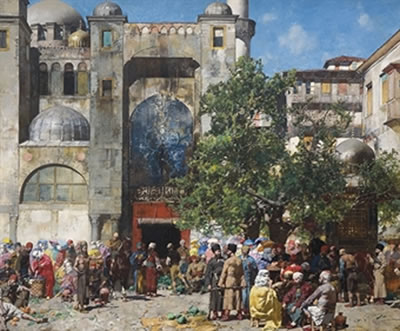
 Alberto Pasini was an Italian painter. At the age of two years he lost his father Joseph, and his mother Crotti Adelaide Balestra led him to Parma, to the house of his uncle Antonio Pasini, painter and collaborator of John Bodoni. At 17 he enrolled at the Accademia di Belle Arti di Parma, choosing the Landscape section. He was then directed to lithography* by the director of the academy, the engraver* Paolo Toschi. Among his early works, a series of thirty lithographs of the castles of the Duchy of Parma and Piacenza (1850-51).
He took part in the War of Independence as a soldier in the column of Modena. After staying for a short time in Turin in 1851, he went to Geneva and then to Paris, where he was directed by Toschi Henriquel to the study of Dupont, who introduced him to renowned watercolorist and printmaker Eugene Ciceri. In 1854 he passed in the study of Theodore Chassériau, which enhanced his appetite for oil painting and began his interest in Orientalism*.
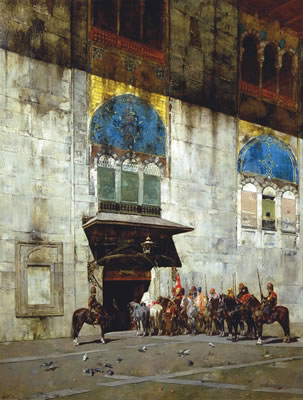
In March 1855, the intervention of Chassériau, he was sent as a designer at a diplomatic mission of the French Government to Persia, Turkey, Syria, Saudi and Egypt. During that trip, he made sixty studies and many drawings, which were the basis of works such exotic realist mold that made his fortune first in France and then in Italy.
He received many honors: In Paris he was awarded the Medal of Honor for painting; the Shah of Persia gave him the official title DDEL Leo and the Sun; Napoleon III decorated him the Legion d'Honneur (1878); the King of Italy Order of Saints Maurice and Lazarus.
His works are preserved in museums and galleries around the world, including the Gallery of Modern Art in Turin, Milan, Florence and Rome, the National Gallery, the Museum Foundation Cariparma and Pinacoteca Stuard of Parma, the Pennsylvania Academy of the Arts in Philadelphia and the auction house Christie's .
Bibliography: Roberto Lasala, Biographical Dictionary of Parma, Vol. III, Parma, 1999. III, Parma, 1999.
Source:
Wikipedia, Alberto Pasini
* For more in-depth information about these terms and others, see AskART.com Glossary http://www.askart.com/AskART/lists/Art_Definition.aspxBiography from Cannes Encheres
Alberto Pasini attended the Parma School of Fine Arts and later studied with Théodore Chassériau, where he honed his oil technique and delved into Orientalist works. In 1855, he became the official painter of a French diplomatic mission to Persia, during which he created numerous paintings and sketches. Pasini's specialization in Orientalist-themed paintings brought him success and wealth in France and Italy. Today, his works are featured in public collections in Italy and the United States.Biography from Setdart
Alberto Pasini is known for depicting orientalist themes in a late romantic style. He trained at the Academy of Fine Arts in Parma. In 1852, he exhibited a series of thirty designs, converted into lithographs, depicting various castles around Piacenza, Lunigiana, and Parma. He was noticed by the artist Paolo Toschi, who encouraged Pasini to travel to Paris, where Pasini first joined the workshop of Pierre-Luc-Charles and Eugène Cicéri, of the Barbizon School. In 1853, his lithograph of The Night won him entry into the Paris Salon and the workshop of the famous Théodore Chassériau. The outbreak of the Crimean War offered a new opportunity, when in February 1855, the latter painter recommended Pasini to replace him in the entourage of the French minister plenipotentiary Nicolas Prosper Bourée to Persia. Pasini accompanied him, returning through northern Persia and Armenia before reaching the port of Trebizond. On subsequent trips, he visited Egypt, the Red Sea, Arabia, Istanbul, and Persia. Pasini took advantage of his exhibitions during this trip in numerous very detailed paintings of orientalist subjects. In 1865, he spent a season in Cannes, where he painted landscapes of the Côte d'Azur.