Page loaded successfully. Showing biography for Andre Brasilier.
Andre Brasilier BIOGRAPHY
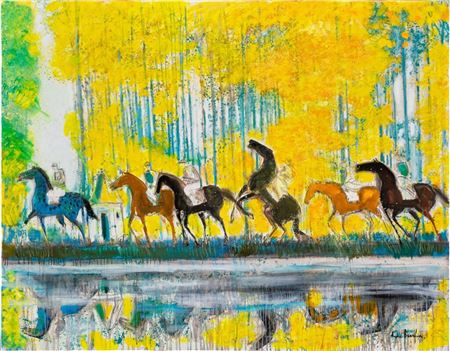
1929 Saumur, Anjou, France - 2004. Known for: Abstract figurative, landscape and horse painting, set design, ceramics.
Born into an artistic family in 1929, Andre Brasilier has spent more than half a century creating canvasses that are a blend of abstraction, expressionism, and something distinctly his own. His works... Read full biography
Born into an artistic family in 1929, Andre Brasilier has spent more than half a century creating canvasses that are a blend of abstraction, expressionism, and something distinctly his own. His works often feature themes and motifs such as horses, nature, music, and women. Brasilier's art is known... Read full biography
Born into an artistic family in 1929, Andre Brasilier has spent more than half a century creating canvasses that are a blend of abstraction, expressionism, and something distinctly his own. His works often feature themes and motifs such as horses, nature, music, and women. Brasilier's art is known around the world, from Japan to the United States. He was recently the subject of an exhibition/retrospective at St. Petersburg, Russia's Hermitage Museum. Following is an interview with the artist by... Read full biography
Born into an artistic family in 1929, Andre Brasilier has spent more than half a century creating canvasses that are a blend of abstraction, expressionism, and something distinctly his own. His works often feature themes and motifs such as horses, nature, music, and women. Brasilier's art is known around the world, from Japan to the United States. He was recently the subject of an exhibition/retrospective at St. Petersburg, Russia's Hermitage Museum. Following is an interview with the artist by The Net Cristal team, which caught up with him to find out about his views on art, inspiration, and what's going on next in his busy calendar of events.?. Q. In the fall of 2005, the Hermitage Museum held a large exhibition/retrospective of your... Read full biography
Born into an artistic family in 1929, Andre Brasilier has spent more than half a century creating canvasses that are a blend of abstraction, expressionism, and something distinctly his own. His works often feature themes and motifs such as horses, nature, music, and women. Brasilier's art is known around the world, from Japan to the United States. He was recently the subject of an exhibition/retrospective at St. Petersburg, Russia's Hermitage Museum. Following is an interview with the artist by The Net Cristal team, which caught up with him to find out about his views on art, inspiration, and what's going on next in his busy calendar of events.?. Q. In the fall of 2005, the Hermitage Museum held a large exhibition/retrospective of your work from 1950-2004. To see one's own paintings displayed in such a prestigious museum, must be every artist's... Read full biography
Artist Biography
Biography page for Andre Brasilier ((1929 - 2004)), known for Abstract figurative, landscape and horse painting, set design, ceramics. Showing 1 biographical entries and 0 sample artworks.
Andre Brasilier - Artist Info
About Andre Brasilier
Biography from the Archives of askART
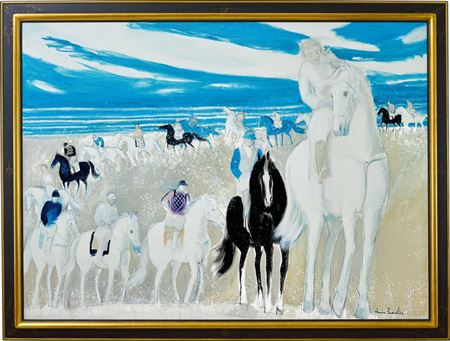 Born into an artistic family in 1929, Andre Brasilier has spent more than half a century creating canvasses that are a blend of abstraction, expressionism, and something distinctly his own. His works often feature themes and motifs such as horses, nature, music, and women. Brasilier's art is known around the world, from Japan to the United States. He was recently the subject of an exhibition/retrospective at St. Petersburg, Russia's Hermitage Museum.
Following is an interview with the artist by The Net Cristal team, which caught up with him to find out about his views on art, inspiration, and what's going on next in his busy calendar of events.?
Q. In the fall of 2005, the Hermitage Museum held a large exhibition/retrospective of your work from 1950-2004. To see one's own paintings displayed in such a prestigious museum, must be every artist's dream.??
A. It's true, it was a very unique experience. At the beginning, I was lucky enough to meet Mikhaïl Piotrovski, the director of the Hermitage, who, in discovering my paintings, wanted to know more about my artistic evolution. He consulted the complete catalogue of my works. Then, over the course of several discussions, we planned this exhibition. Seeing the enormity of this event, I sometimes had some doubts that it would ever be realised. But the exhibit finally did take place, and it was for me the source of a very great satisfaction. It also allowed me to meet art-lovers from around the world. A group from Japan even offered me an exhibition at the Espace Mitsukoshi-Étoile, located off the Place de l'Étoile. And so, a show organised in Saint Petersburg opened the doors of a prestigious place in the heart of Paris, up until that point exclusively reserved for exhibits on Japanese art and culture. Rather surprising, isn't it?
Q. There are certain major themes in your work, such as women, music, horses, and nature. Can you tell us more about these themes???
A. I like to paint the human form. For me, we measure the importance of a painter by his or her abilities at portraying this human form. Look at what point the human "figure" has allowed painters like Picasso, de Stael, or Bacon to go beyond their contemporaries. I love, above all, life, and in all of its forms. Music is one of these forms that I especially appreciate. My first exhibition in 1959 was entitled "Autour de la musique" ("About Music"). Since then, I've always liked to work with this theme. All is beautiful in music, the discipline of the orchestra, the harmony of a quartet…. As for nature, I've always liked landscapes, pastoral scenes. I remember my first impressions of rural scenes, like oxen pulling a plow… As for the horse, I really like this animal, as much for its beauty, as for the harmony that it has with nature. In nature, the horse gives a sense of scale. It provides interesting proportions with the sea and the sky, for example. I love life, and horses, with their forms and their ardour, delight and intrigue me.
Q. As a young artist, after your stay at the Villa Medici, you decided to leave and discover the world. What was your spiritual state then, and how did you work?
A. I did in fact want to discover the world. And so, I traveled a great deal around Europe: Holland, Germany, Norway, Sweden, etc. I lived where I was dropped down. At the time, I painted devant motifs. This is no longer the case today. When I see a motif that interests me [now], I take notes and I re-transcribe my impressions much later in front of a canvass. In my opinion, a painting is a physical object, [but] it must represent an emotion born from life. In my canvasses, I try to establish a harmony between the two.
Q. Looking at your biography, it seems Europeans and Americans greatly appreciate your paintings. But the Japanese are equally fans, and yet, their culture is very different from that of the West. How do you explain this?
A. ??I think it comes from my way of expressing my thoughts and emotions, my way of using color, and above all my taste for the ellipse. I am absolutely not a realist painter. I only like when things are suggested, and even when they appear mysterious. I have a nature that wants to simplify. I always try to give the quintessence of a subject with little effect, to say a lot with a little, like Japanese artists who focus on asceticism and simplicity. I already had this inclination during my studies at the Institut des Beaux-Arts. But above all things, what's important for me is composition. Before making any sketch, I try to compose the painting in my mind. If composition is at the base of all painting, in the end, it must be forgotten or overlooked, the public must not notice it. All of this characterizes my painting, and it's no doubt what makes me able to touch people of different cultures.??
Q. Your canvasses are often very large. Do you have a preference for large-format painting???
A. Yes, without a doubt I like to express myself in a large size. I like ample and generous gestures. In fact, I wouldn't deny using the term "Tachsim" [(painting using bold strokes of colour in an abstract manner)] to characterize my works. I'm not a miniaturist, my nature doesn't lend itself to that. To me, the impact of a work of large dimensions allows the viewer to better absorb it. A large canvass can even have an entrancing power over the person looking at it. Some subjects require grand proportions. But the choice of large format comes overall from my research into the spontaneity of gestures. When I paint, I want to feel life in my movements, as life is found in the gallop of a horse or in the undertow of the sea. In Spring 2006, it will be essentially large format canvasses that will be exposed at the Espace Mitsukoshi-Étoile. And all of these will be recent creations, more in keeping with my present style.??
Q. In the past, you've made non-pictorial works, as in 1985, when you created the scenery and costumes for a play, and in 1987 when you created a mosaic. Are you still open to other modes of expression?
A. ??In 1985, my friend Pierre Jourdan, a theatre director, gave me carte blanche to create the scenery and costumes of Ciboulette, a play by Raynaldo Hahn. The play was performed in the grandiose setting of the Opéra Garnier de Monte Carlo. I remember painting some of the scenery during rehearsals, in front of the actors. This was an unusual experience, and a very interesting one. I had another, similar experience at the Théâtre de Compiègne for the play Mignon by Ambroise Thomas. Rather than create scenery portraying a city, which didn't inspire me at all, I decided to depict a natural landscape, with rocks and ivy. The scenery was a success, it seemed, and I was asked afterwards to decorate a stage curtain, which is still in use in the theater today. As for the mosaic, in 1987, I did, in fact, do a drawing for one intended for a German friend's property in Vence, Provence. An interesting experience, and again one that I wasn't used to.
?Q. In the 1980's, you adopted a new mode of expression : ceramic painting. But you eventually stopped this activity. Do you think you'll take it up again one day???
A. A few years ago, I did indeed create ceramics at Vallauris. But I had to stop for a time because I had the feeling of not being able to control the distribution of the finished works. If I still have the energy, I'd like to take up this activity again, but only in creating unique, individual pieces. Pottery interests me very much because I like forms that for painters are not the norm, and are sometimes even quite bizarre. I like for these forms to guide me creatively, and at the end to be forgotten, leaving only the painted decorations as the focus.
Q. Do you have any other upcoming projects?
A. ??I recently had a wonderful and unusual experience in the art of campanology (the decoration of bells). I did a drawing for the cathedral of Saint-Étienne de Toulouse, dedicated to the Virgin Mary. The drawing is an image of the Virgin, intended to adorn a 1.5 ton bell that sits in the campanile of the cathedral. It was a surprising discovery for me to be present at the casting of the bell, at its blessing by the Bishop of Toulouse, and at its installation in the bell tower. After this, I created other drawings for churches along the route to the church of Saint-Jacques (Saint James) of Compostella, most notably at Rocamadour. And I'm currently in the middle of another particularly enriching experience: I've been commissioned to decorate the interior of the chapel of Arnac Pompadour, a small village in the Corrèze region. Although it's small, this chapel makes for a great challenge for a painter: to create panels 25 meters (82 feet) across and 7 meters (23 feet) high isn't something done very much today, even by someone like me who appreciates large canvasses! This work is truly fascinating.
Q. Do you always feel the desire to paint???
A. I am always painting. And if I'm not in front of a canvass, I always have sheets of paper with me to take notes, and to set down ideas that come to me. I consult them later when I start a new work. Painting is my life.
CHRONOLOGY
1929
Born in Saumur, in Anjou. His parents were painters.
1949
Ecole Nationale des Beaux-Arts (Fine Arts School)
1952
Florence Blumenthal Price Award
1953
Premier Grand Prix de Rome of painting
1954
Stay at Villa Médicis
1957
Travels around the world
1959
First lithography in Mourlot's workshop, Jacques Sorlier adviser
First exhibition in Paris, galerie Drouet, with music as the chosen theme
1960
First exhibition at the galerie Weil, à Paris
Prix de Villeneuve-sur-Lot Award
1962
Exhibition in New York, David B. Findlay Gallery
1963
Exhibition in New York, David B. Findlay Gallery
1964
Exhibition at the Weil Gallery. Chosen theme : Cadre Noir de Saumur ( the famous training school of cavalry)
1969
First exhibition at galerie de Paris
First exhibition in Tokyo, Yoshii Gallery
Exhibition at the Centre Gildas Fardel, Nantes Museum
1971
Exhibition in Caracas, Arte Gallery
Exhibition in New York, David B. Findlay Gallery
1972
Exhibition at Galerie de Paris
1974
Exhibition of lithographs and tapestries at the Vision Nouvelle Gallery, in Paris
Exhibition at Yoshii Gallery, in Tokyo
1976
Exhibition at Galerie de Paris
1979
Exhibition at Galerie Matignon, Paris
1980
First retrospective (1950-1980), 100 artworks at the Château de Chenonceau
1983
Exhibition of watercolors, Galerie des Chaudronniers, in Genève
Exhibition in Tokyo, Nichido Gallery
1985
Exhibition in New York, Hammer Gallery
Decoration and costumes for "Ciboulette", a Reynaldo Hahn's play, staged by Pierre Jourdan
1987
Mosaic work (15 x 3m) in Vence, Provence
1988
Exhibition in Vancouver (Canada), Buschlen-Mowatt Gallery
Retrospective exhibition at the Musée Picasso-Château Grimaldi in Antibes (French Riviera)
Médaille de Vermeil, distinction granted by the Ville de Paris
Exhibition at the Hopkins-Thomas Gallery, Paris
1989
Exhibition retrospective "Hommage à André Brasilier", in Angers. Chevalet d'or dinstinction
1990
Exhibition in Tokyo, Nichido Gallery
1991
Publication of "Harmonies", an album of 10 lithographs presented at Drouot Montaigne, Paris - Text by Yann le Pichon
1992
Publication of the "Catalogue Raisonné des lithographies", Editions Callithos
"André Brasilier à Bagatelle" : Mairie de Paris, exhibition retrospective organized par Didier Jumaux & Partenaires, Paris
1993
Exhibition at the Château de Sédières, in Corrèze
1994
Exhibition in Menton, Musée des Beaux-Arts, Palais Carnolés
1995
Exhibition in Tokyo, Nichido Gallery
Ceramics exhibition at Landrot gallery, Paris
Exhibition at the Arsenal de Metz
Paintings exhibition at the Galerie Bac Saint-Germain, Paris
Watercolors exhibition, Buschlen-Mowatt Gallery, Vancouver
1996
Exhibition at Soufer Gallery, New York
Large exhibition at Château de Vascoeuil, in Normandie
Permanent exhibition at the Galerie Bac Saint-Germain
1997
Exhibition in Tokyo, Nichido Gallery
Exhibition in Verden, Germany
1998
Exhibition in Tokyo, Printemps Ginza
1999
Watercolors exhibition in Paris, Nichido Gallery, Paris
Exhibition in Stuttgart, Germany, Bühler Gallery
Exhibition in Nice, Garden Gallery
Exhibition in Genève, Swizerland, Les Salles du Palais Gallery
2002
Exhibition in Tokyo, Mitsukoshi department store, Nihombashi
2003
Publication of the "Catalogue raisonné of paintings 1982-2002", Editions Acatos
2004
Exhibition at the Château de Mainau, on the Constance Lake, Germany
2005
In april, exhibition at the Schüller Gallery, Munich, Germany
In may, watercolors exhibition at the Galerie Barès, Paris
September to november : Exhibition-retrospective at the Hermitage Museum, Saint-Pétersbourg, Russia
2006
March 22 - June 3 : Retrospective exhibition at Espace des Arts, Paris, France.
October 10 - April 15, 2007 : Retrospective exhibition in five cities in Japan
Tokyo, Nagoya, Niigata, Sapporo, Fukuoka.
November 24 - January 24, 2007 : "André Brasilier chez La Fontaine"
Exhibition in the Jean de La Fontaine Museum
Château-Thierry (02400) - France.
December 9 - January 14, 2007 :
Exhibition in Haarlem, The Netherlands.
E.J. van Wisselingh & Co. (www.wisselingh.com)
2007
March 04 - March 25 ?Exhibition in Saarlouis, Germany.?Museum Haus Ludwig für kunstausstellungen.
2008
May 12
Inaugural ceremony for the Chapel of Saint -Blaise
City of Pompadour - 19230 - France.
September 25 - November 22
Etchings - Illustrated books
Bibliothèque Louis-Nucéra
Nice - 06200 - France
2009
Itinerant exhibition in Japan.
Tokyo, Sendaï, Nagoya, Fukuoka.
2010
May - June
Exhibition Gallery Artbank
Séoul. South Korea.
June 13 - November 28
Exhibition in Château de Chenonceau
City of Chenonceaux - 37150 - France.
Source:
http://www.brasilier.fr/content/119/124/