Page loaded successfully. Showing biography for Andreas Achenbach.
Andreas Achenbach BIOGRAPHY
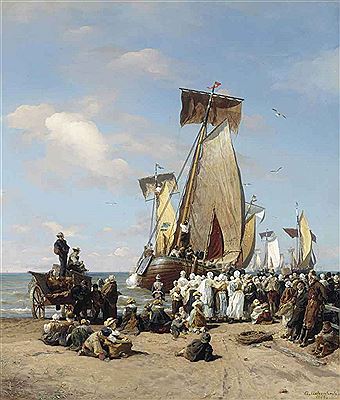
1815 Kassel, Germany - 1910 Dusseldorf, Germany. Known for: Realist, romantic landscape painting, teaching.
Andreas Achenbach was a German landscape painter, associated with the Dusseldorf School of painting. Born at Kassel, he began his art education in 1827 in Dusseldorf under Friedrich Wilhelm Schadow... Read full biography
Andreas Achenbach was a German landscape painter, associated with the Dusseldorf School of painting. Born at Kassel, he began his art education in 1827 in Dusseldorf under Friedrich Wilhelm Schadow at the Dusseldorf Academy of Painting*. He studied at St. Petersburg and traveled in Italy, Holland... Read full biography
Andreas Achenbach was a German landscape painter, associated with the Dusseldorf School of painting. Born at Kassel, he began his art education in 1827 in Dusseldorf under Friedrich Wilhelm Schadow at the Dusseldorf Academy of Painting*. He studied at St. Petersburg and traveled in Italy, Holland and Scandinavia. In his early work he followed the pseudo-idealism of the German romantic school, but on removing to Munich in 1835, the stronger influence of Louis Gurlitt turned his talent into new... Read full biography
Andreas Achenbach was a German landscape painter, associated with the Dusseldorf School of painting. Born at Kassel, he began his art education in 1827 in Dusseldorf under Friedrich Wilhelm Schadow at the Dusseldorf Academy of Painting*. He studied at St. Petersburg and traveled in Italy, Holland and Scandinavia. In his early work he followed the pseudo-idealism of the German romantic school, but on removing to Munich in 1835, the stronger influence of Louis Gurlitt turned his talent into new channels, and he became the founder of the German realistic school. Although his landscapes evince too much of his aim at picture-making and lack personal temperament, he is a master of technique, and is historically important as a reformer. He... Read full biography
Andreas Achenbach was a German landscape painter, associated with the Dusseldorf School of painting. Born at Kassel, he began his art education in 1827 in Dusseldorf under Friedrich Wilhelm Schadow at the Dusseldorf Academy of Painting*. He studied at St. Petersburg and traveled in Italy, Holland and Scandinavia. In his early work he followed the pseudo-idealism of the German romantic school, but on removing to Munich in 1835, the stronger influence of Louis Gurlitt turned his talent into new channels, and he became the founder of the German realistic school. Although his landscapes evince too much of his aim at picture-making and lack personal temperament, he is a master of technique, and is historically important as a reformer. He received a medal of the first class in Paris in 1855, and was named a Chevalier of the French Legion of Honor. The Chambers Biograp... Read full biography
Artist Biography
Biography page for Andreas Achenbach ((1815 - 1910)), known for Realist, romantic landscape painting, teaching. Showing 4 biographical entries and 0 sample artworks.
Andreas Achenbach - Artist Info
About Andreas Achenbach
Name variants
Andreas Aschenbach
Biography from the Archives of askART
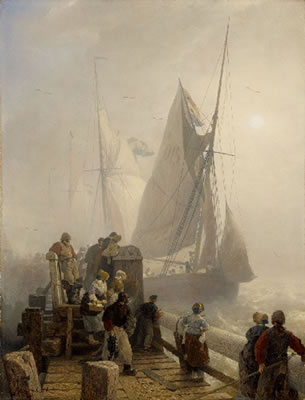 Andreas Achenbach was a German landscape painter, associated with the Dusseldorf School of painting. Born at Kassel, he began his art education in 1827 in Dusseldorf under Friedrich Wilhelm Schadow at the Dusseldorf Academy of Painting*. He studied at St. Petersburg and traveled in Italy, Holland and Scandinavia.
In his early work he followed the pseudo-idealism of the German romantic school, but on removing to Munich in 1835, the stronger influence of Louis Gurlitt turned his talent into new channels, and he became the founder of the German realistic school. Although his landscapes evince too much of his aim at picture-making and lack personal temperament, he is a master of technique, and is historically important as a reformer.
He received a medal of the first class in Paris in 1855, and was named a Chevalier of the French Legion of Honor.
The Chambers Biographical Dictionary has written of him that "he was regarded as the father of 19th century German landscape painting."
A number of his finest works are to be found at the Berlin National Gallery, the New Pinakothek in Munich, and the galleries at Dresden, Darmstadt, Cologne, Düsseldorf, Leipzig and Hamburg. Many of his paintings are in galleries in the United States.
He died in Düsseldorf.
His brother, Oswald Achenbach (1827-1905), was also a painter.
Source:
Wikipedia, http://en.wikipedia.org/wiki/Andreas_Achenbach
* For more in-depth information about these terms and others, see AskART.com Glossary http://www.askart.com/AskART/lists/Art_Definition.aspxBiography from Auktionshaus Stahl
A. was one of the most important landscape and marine painters of the Düsseldorf painting school. He studied at the local academy under J. W. Schirmer. After travelling extensively and living in Munich and Frankfurt he became professor in Düsseldorf in 1859.Biography from Karl & Faber Kunstauktionen
Andreas Achenbach, born in 1815, belongs to that generation of German painters for whom Italy was no longer the goal of their artistic aspirations. Unlike his brother Oswald, who had a decisive influence on the image of Italy in the second half of the 19th century, Andreas did visit Italy, but his experience of Italy remained an episode.
Instead, he became the "ruler of land and sea," as one reviewer called him in 1861, became a chronicler of the Nordic landscape, and achieved fame with his dramatic Marinen early in the 1830s. More intimate and quiet, still touched by the spirit of Romanticism, Achenbach presents his heath landscape in Evening Red. The fading sky, with clouds drifting through it, occupies more than half of the painting ground, while below it a hilly landscape characterized by sandy greens stretches to the horizon. Red and ochre tones, with sky blue mixed in at times, dominate the upper half of the painting; the sky is contrastingly lit in a manner Andreas expressed to his brother Oswald in August 1845: "One must seek to bring out the illumination more by contrast than by darkness alone, for black and white make no effect."
Precise in execution and brilliant in lighting, this small painting is an early example of Achenbach's virtuoso painting and his ability to render plein air effects and moods, which was particularly appreciated by his contemporaries. Drawing brilliance and coloristic uniformity condense into a depiction of atmospheric phenomena, which have poetic moods "that penetrate deeply into the soul of the beholder," as Wolfgang Müller von Königswinter noted in 1854 in his treatise on Düsseldorf artists. It is a barren stretch of land that tells of abandonment and loneliness - the hiker in the foreground, behind him the old woman and houses bear witness to a landscape that is still filled with Romantic props - such as the figure of the lonely hiker and the atmospheric chiaroscuro effects - but their symbolic meaning has given way to a subjective description of the experience of nature, though without Achenbach striving for or taking the step toward making light and color independent.
In those years before and around 1840, Scandinavian motifs predominated in Achenbach's landscapes - he had visited Denmark, Norway, and Sweden with his father in 1835: "Great, especially Nordic journeys early enriched his imagination and soon gave his works the convincing truth of the view of nature" in which "the spirit of poetry accompanies him," wrote a contemporary in 1845 (Betrachtungen von Lorenz Clasen, in: Correspondenzblatt 1, no. 5, July 1845, p. 51). This "convincing truth of the view of nature" also underlies our heath landscape, which, however, does not reflect a motif from Scandinavia but from native regions.
Source:
Peter PrangeBiography from Auctionata
Andreas Achenbach (1815-1910) received his artistic training at the Academy of Art in Düsseldorf, where he attended, among others, the classes of Wilhelm von Schadow (1788-1862) and Heinrich Christoph Kolbe (1771-1836). From 1832 to 1833 the young painter traveled to Rotterdam, Scheveningen, Amsterdam and Riga, where he intensively studied Dutch and Flemish landscape and marine painting. This finally led to the artist’s decision to specialize in seascapes.
Around 1835, Achenbach moved from Düsseldorf to Munich and became a co-founder of German Realism. In the following years the artist went on further study trips to Denmark, Norway, Sweden and Italy. In 1846, he finally returned to Düsseldorf and joined the artist group ‘Künstlerverein Malkasten’.
Works by Andreas Achenbach are now in major collections such as the Neue Pinakothek in Munich, the Staatliche Kunsthalle in Karlsruhe and the Neue Nationalgalerie in Berlin. (hth)