Page loaded successfully. Showing biography for Andreas Schelfhout.
Andreas Schelfhout BIOGRAPHY
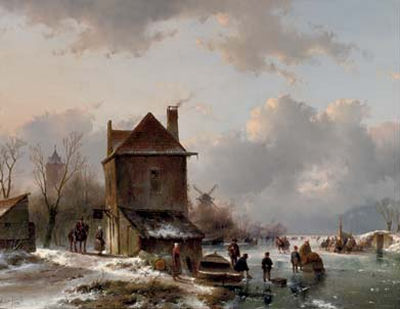
1787 The Hague, Holland - 1870 The Hague, Holland. Known for: Romantic landscape-snowscene painting, etching, lithography.
Andreas Schelfhout (February 16, 1787, The Hague - April 19, 1870, The Hague) was a Dutch painter, etcher* and lithographer*, known for his landscape paintings. He belongs to the Romantic* movement.... Read full biography
Andreas Schelfhout (February 16, 1787, The Hague - April 19, 1870, The Hague) was a Dutch painter, etcher* and lithographer*, known for his landscape paintings. He belongs to the Romantic* movement. His Dutch winter scenes and frozen canals with skaters were already famous during his lifetime. He... Read full biography
Andreas Schelfhout (February 16, 1787, The Hague - April 19, 1870, The Hague) was a Dutch painter, etcher* and lithographer*, known for his landscape paintings. He belongs to the Romantic* movement. His Dutch winter scenes and frozen canals with skaters were already famous during his lifetime. He became one of the most influential Dutch landscape artists of his century. He started as a house painter in the framing business of his father. He already started painting pictures in his spare time.... Read full biography
Andreas Schelfhout (February 16, 1787, The Hague - April 19, 1870, The Hague) was a Dutch painter, etcher* and lithographer*, known for his landscape paintings. He belongs to the Romantic* movement. His Dutch winter scenes and frozen canals with skaters were already famous during his lifetime. He became one of the most influential Dutch landscape artists of his century. He started as a house painter in the framing business of his father. He already started painting pictures in his spare time. After a well-received first exhibition in The Hague, his father sent him to receive proper training to Joannes Breckenheimer (1772-1856), a stage designer, in The Hague. He learned not only the technical aspects of painting, but also made detailed... Read full biography
Andreas Schelfhout (February 16, 1787, The Hague - April 19, 1870, The Hague) was a Dutch painter, etcher* and lithographer*, known for his landscape paintings. He belongs to the Romantic* movement. His Dutch winter scenes and frozen canals with skaters were already famous during his lifetime. He became one of the most influential Dutch landscape artists of his century. He started as a house painter in the framing business of his father. He already started painting pictures in his spare time. After a well-received first exhibition in The Hague, his father sent him to receive proper training to Joannes Breckenheimer (1772-1856), a stage designer, in The Hague. He learned not only the technical aspects of painting, but also made detailed studies of the 17th-century Dutch landscape artists Meindert Hobbema en Jacob van Ruisdael. In 1815 he started his own workshop and b... Read full biography
Artist Biography
Biography page for Andreas Schelfhout ((1787 - 1870)), known for Romantic landscape-snowscene painting, etching, lithography. Showing 2 biographical entries and 0 sample artworks.
Andreas Schelfhout - Artist Info
About Andreas Schelfhout
Name variants
Andreas Shelfhout
Biography from the Archives of askART
 Andreas Schelfhout (February 16, 1787, The Hague - April 19, 1870, The Hague) was a Dutch painter, etcher* and lithographer*, known for his landscape paintings.
He belongs to the Romantic* movement. His Dutch winter scenes and frozen canals with skaters were already famous during his lifetime. He became one of the most influential Dutch landscape artists of his century.
He started as a house painter in the framing business of his father. He already started painting pictures in his spare time. After a well-received first exhibition in The Hague, his father sent him to receive proper training to Joannes Breckenheimer (1772-1856), a stage designer, in The Hague. He learned not only the technical aspects of painting, but also made detailed studies of the 17th-century Dutch landscape artists Meindert Hobbema en Jacob van Ruisdael.
In 1815 he started his own workshop and became a member of the Pulchri studio. Through his technical excellence and sense of composition and his use of naturalistic colours, he soon became famous also outside The Hague. In 1819 he was awarded the Gold Medal at the exhibition in Antwerp. In 1818 he became a member of the Royal Academy for Visual Arts of Amsterdam. He reputation continued to grow, and in 1822 he was given the rank of Fourth Class Correspondent of the Royal Dutch Institute. From then on, one exhibition followed after another.
Initially he painted mainly summer scenes, beach scenes, and animal paintings. But as his initial winter scenes even had more success, he began to include them in his exhibitions. He was mainly a studio artist, relying on his sketches done en plein-air*. His sketchbook Liber Veritatis (Book of Truth) shows that he made about twenty paintings a year, among them a few foreign views. This indicated that he traveled abroad around 1825. In later years he visited France in 1833, England in 1835 (especially to study the works of Constable) and Germany. In 1839 he was awarded the title Ridder in de orde van de Nederlandse Leeuw, and in 1844 he was awarded an honorary membership in Kunst zij ons doel.
He provided training to several painters who would become famous in their own right : Johan Hendrik Weissenbruch, Johan Jongkind (one of the forerunners of the Impressionists), Charles Leickert, Johannes Josephus Destree, Jan Willem van Borselen, Nicholas Roosenboom, Willem Troost, the American Hudson River School* Painter Louis Rémy Mignot and his son-in-law Wijnand Nuyen.
At the end of his career he put together a series of eighty landscape drawings, mainly recordings of previous paintings and watercolours. They were drawn in chalk and lightly coloured.
His death marked the end of the Romantic period in Holland. He is considered a precursor of the Hague School*.
His paintings are on display in several top museums :
• Rijksmuseum, Amsterdam
• Museum Boymans-van Beuningen, Rotterdam
• Dordrechts museum, Dordrecht
• Teylers Museum, Haarlem,
• Museum Jan Cunen, Oss
• KMSK, Antwerp
• MSK, Gent
• Groeningemuseum, Brugge
• National Gallery, London
• The Wallace Collection, London
• Tyne and Wear Museums
Source:
Wikipedia, http://en.wikipedia.org/wiki/Andreas_Schelfhout
* For more in-depth information about these terms and others, see AskART.com Glossary http://www.askart.com/AskART/lists/Art_Definition.aspxBiography from Kunsthaus Lempertz
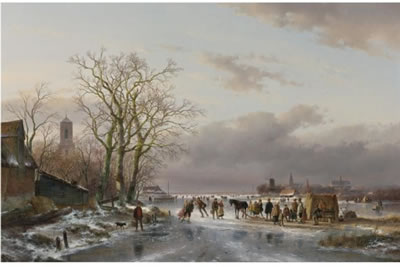
Andreas Schelfhout was one of the most important Dutch landscape painters of the 19th century. The present painting, "A Frozen River Course with Skaters," and the following lot, "View from a Hill with a Castle into a Wide, Summer River Valley," are outstanding examples of his unsurpassed mastery. He excelled in the exceptionally fine and detailed rendering of the varied landscape of his homeland, whose light and weather effects he captured in all shades. In 1845, when Schelfhout painted this winter picture, his work was shown in many exhibitions. The artist was praised not only for his craftsmanship, with which he captured all the characteristics of the Dutch landscape in his paintings. His contemporaries perceived the "simplicity" and "truth" of his paintings as the best possible representation and explanation of God's nature. Andreas Schelfhout's depictions of winter delights are admired to this day for their naturalness and quiet poetry, prompting one critic to exclaim in 1852, "One could not paint more beautifully." Andreas Schelfhout was the leading painter of Dutch Romantic landscape painting. His famous compatriot and fellow painter Barend Cornelis Koekkoek (1803-1862) recognized his great talent as early as 1841, and referred to "the great Schelfhout" in his book Herinneringen en Mededeelingen ven eenen Landschapschilder (Kleve, 1841). Koekkoek admired the grace and truthful depiction of nature in Schelfhout's winter scenes and wrote: "Would you like to see how beautiful and charming a flat, simple rural scene can be when it bears the stamp of nature, the stamp of truth (...) then look at the works of our great Schelfhout." A similar winter landscape is in the collection of the Rijksmuseum, Amsterdam: "Ice Landscape with Windmill" (inv. no. SK-A-1127). The work of Andreas Schelfhout is presented by many Dutch museums, such as the Amsterdams Historisch Museum, the Stedelijk Museum, the Rijksmuseum, Amsterdam, the Teylers Museum, Haarlem, the Gemeindemuseum, The Hague, the Dordrechts Museum and the Museum Boymans-van Beuningen, Rotterdam.