Page loaded successfully. Showing biography for Anselm Kiefer.
Anselm Kiefer BIOGRAPHY
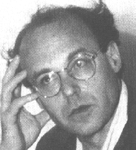
Born 1945 Donaueschingen, Germany. Known for: Conceptual painting, sculpture, installation, found objects.
Over the past four decades, Anselm Kiefer has produced a diverse body of work in painting, sculpture and installation that has made him among the most important artists of his generation. Kiefer... Read full biography
Over the past four decades, Anselm Kiefer has produced a diverse body of work in painting, sculpture and installation that has made him among the most important artists of his generation. Kiefer studied with Joseph Beuys in the early 1970s, but soon began to develop his own, deliberately indigenous... Read full biography
Over the past four decades, Anselm Kiefer has produced a diverse body of work in painting, sculpture and installation that has made him among the most important artists of his generation. Kiefer studied with Joseph Beuys in the early 1970s, but soon began to develop his own, deliberately indigenous set of subjects and symbols that he used to explore the fraught territory of German history and identity. In his muscular artistic language, physical materiality and visual complexity enliven his... Read full biography
Over the past four decades, Anselm Kiefer has produced a diverse body of work in painting, sculpture and installation that has made him among the most important artists of his generation. Kiefer studied with Joseph Beuys in the early 1970s, but soon began to develop his own, deliberately indigenous set of subjects and symbols that he used to explore the fraught territory of German history and identity. In his muscular artistic language, physical materiality and visual complexity enliven his themes and content with a rich, vibrant tactility. His subject-matter ranges over sources as diverse as Teutonic mythology and history, alchemy and the nature of belief, all depicted in a bewildering variety of materials, including oil paint, dirt,... Read full biography
Over the past four decades, Anselm Kiefer has produced a diverse body of work in painting, sculpture and installation that has made him among the most important artists of his generation. Kiefer studied with Joseph Beuys in the early 1970s, but soon began to develop his own, deliberately indigenous set of subjects and symbols that he used to explore the fraught territory of German history and identity. In his muscular artistic language, physical materiality and visual complexity enliven his themes and content with a rich, vibrant tactility. His subject-matter ranges over sources as diverse as Teutonic mythology and history, alchemy and the nature of belief, all depicted in a bewildering variety of materials, including oil paint, dirt, lead, models, photographs, woodcuts, sand, straw and all manner of organic material. By adding found materials to the painted s... Read full biography
Artist Biography
Biography page for Anselm Kiefer ((Born 1945)), known for Conceptual painting, sculpture, installation, found objects. Showing 2 biographical entries and 0 sample artworks.
Anselm Kiefer - Artist Info
About Anselm Kiefer
Biography from the Archives of askART
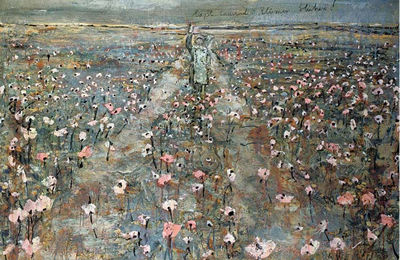 Over the past four decades, Anselm Kiefer has produced a diverse body of work in painting, sculpture and installation that has made him among the most important artists of his generation.
Kiefer studied with Joseph Beuys in the early 1970s, but soon began to develop his own, deliberately indigenous set of subjects and symbols that he used to explore the fraught territory of German history and identity. In his muscular artistic language, physical materiality and visual complexity enliven his themes and content with a rich, vibrant tactility. His subject-matter ranges over sources as diverse as Teutonic mythology and history, alchemy and the nature of belief, all depicted in a bewildering variety of materials, including oil paint, dirt, lead, models, photographs, woodcuts, sand, straw and all manner of organic material.
By adding found materials to the painted surface of his immense tableaux, he invents a compelling third space between painting and sculpture. Recent work has broadened his range yet further, and in 2006 he showed a series of paintings based around the little-known work of modernist poet Velimir Chlebnikov (1885-1922). Few contemporary artists match Kiefer's epic reach, and his work consistently balances powerful imagery with acute critical analysis.
Anselm Kiefer was born in Donaueschingen, Germany in 1945. He lives and works in Provence, France. He has exhibited widely, including solo shows at MoMA, New York (1987), Neue Nationalgalerie, Berlin (1991), The Metropolitan Museum, New York (1998), Royal Academy, London (2001), Fort Worth Museum of Art, Fort Worth (2005) and the San Francisco Museum of Modern Art (2006), Mass MoCA, Massachusetts, Guggenheim Museum, Bilbao and the Royal Academy of Arts, London (2007), Louisiana Museum of Modern Art, Denmark (2010) and the Rijksmuseum, Amsterdam (2011).
Source:
White Cube GalleryBiography from the Archives of askART
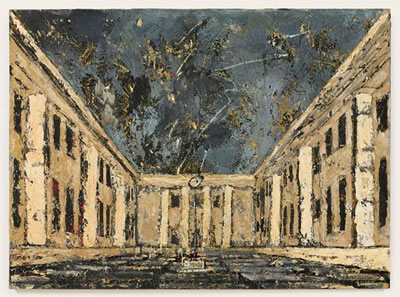 Anselm Kiefer, known for abstract paintings of charred-seeming, symbolical landscapes referencing Germany's history, was born in 1945 in Donaueschingen (Baden-Württemberg), Germany. When he was six years old, he moved with his family to Otterdorf where he attended grammar school. In 1965, he began the study of law and Romance languages at the Albert Ludwigs University, in Freiburg in Breisgau and also spent time in Paris.
From 1966 to 1970, he studied art with Peter Dreher and Horst Antes at the Staatliche Hochschule der Bildenden Künste, Freiburg and Karlsruhe, and from 1970 - 1972 studied with Joseph Beuys at the Dusseldorf Academy. From 1991 - 1993, he travelled to India, Mexico and China and the U.S.A., and then settled in Barjac, France where he established a studio.
MAJOR EXHIBITIONS
1978 - First one-man show in Switzerland at the Kunsthalle Bern
1980 - German pavilion at the Venice Biennale provoked considerable controversy
1984 - One-man show at the Stadtische Kunsthalle, Dusseldorf and the Israel Museum, Jerusalem)
1987 - 1989 - A travelling exhibition in the U.S.A.
1988 - Acquired a former brickworks in Höpfingen (near Heidelberg in the Odenwald); planned to install his major project Zweistromland there
1991 - One-man show at the Nationalgalerie in Berlin; presentation of his Books,
1969-1990, in the Kunsthalle Tübingen, the Kunstverein München and the Kunsthaus Zürich
1997 - Himmel-Erde (Heaven-Earth), Museo Correr, Venice
1999 - Works on Paper in the Metropolitan Museum of Art, New York
2000 - Chevirat Ha-Kelim (Breaking of the Vessels), an installation of his works created specially for the Chapelle de La Salpêtrière, Paris
Source:
http://www.leninimports.com/anselm_kiefer_bio.html