Page loaded successfully. Showing biography for Archibald Knox.
Archibald Knox BIOGRAPHY
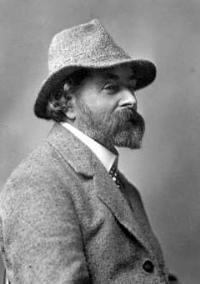
1864 Cronkbourne, Isle of Man - 1933 Douglas, Isle of Man. Known for: Art nouveau designs, metal artwork, teaching, landscape painting.
Archibald Knox, (born 9 April 1864 in Cronkbourne near Tromode, Isle of Man – died 22 February 1933 in Douglas, Isle of Man), was a Manx designer of Scottish descent. He is best known as being... Read full biography
Archibald Knox, (born 9 April 1864 in Cronkbourne near Tromode, Isle of Man – died 22 February 1933 in Douglas, Isle of Man), was a Manx designer of Scottish descent. He is best known as being Liberty's primary designer at the height of their success and influence upon UK and International design... Read full biography
Archibald Knox, (born 9 April 1864 in Cronkbourne near Tromode, Isle of Man – died 22 February 1933 in Douglas, Isle of Man), was a Manx designer of Scottish descent. He is best known as being Liberty's primary designer at the height of their success and influence upon UK and International design (to the extent that in Italy, Art Nouveau* was known as Stile Liberty). Knox's work bridged the Arts and Crafts Movement*, Celtic Revival, Art Nouveau, and Modernism*. He is seen as a leading figure of... Read full biography
Archibald Knox, (born 9 April 1864 in Cronkbourne near Tromode, Isle of Man – died 22 February 1933 in Douglas, Isle of Man), was a Manx designer of Scottish descent. He is best known as being Liberty's primary designer at the height of their success and influence upon UK and International design (to the extent that in Italy, Art Nouveau* was known as Stile Liberty). Knox's work bridged the Arts and Crafts Movement*, Celtic Revival, Art Nouveau, and Modernism*. He is seen as a leading figure of the Modern Style movement. Knox's hundreds of designs for Liberty made his style widely known, though not his name, as Liberty kept their designers anonymous. Most of his work for Liberty was for the Tudric (pewter) and Cymric (precious metals)... Read full biography
Archibald Knox, (born 9 April 1864 in Cronkbourne near Tromode, Isle of Man – died 22 February 1933 in Douglas, Isle of Man), was a Manx designer of Scottish descent. He is best known as being Liberty's primary designer at the height of their success and influence upon UK and International design (to the extent that in Italy, Art Nouveau* was known as Stile Liberty). Knox's work bridged the Arts and Crafts Movement*, Celtic Revival, Art Nouveau, and Modernism*. He is seen as a leading figure of the Modern Style movement. Knox's hundreds of designs for Liberty made his style widely known, though not his name, as Liberty kept their designers anonymous. Most of his work for Liberty was for the Tudric (pewter) and Cymric (precious metals) ranges. The gravestone of Liberty founder, Arthur Lasenby Liberty, was designed by Knox. His design talent covered a wide range of objects,... Read full biography
Artist Biography
Biography page for Archibald Knox ((1864 - 1933)), known for Art nouveau designs, metal artwork, teaching, landscape painting. Showing 1 biographical entries and 0 sample artworks.
Archibald Knox - Artist Info
About Archibald Knox
Biography from the Archives of askART
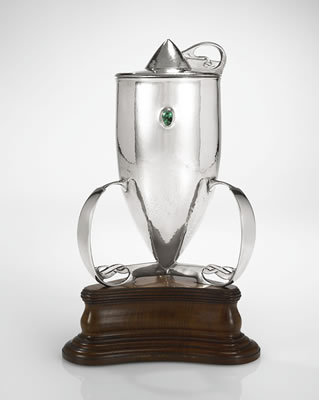 Archibald Knox, (born 9 April 1864 in Cronkbourne near Tromode, Isle of Man – died 22 February 1933 in Douglas, Isle of Man), was a Manx designer of Scottish descent. He is best known as being Liberty's primary designer at the height of their success and influence upon UK and International design (to the extent that in Italy, Art Nouveau* was known as Stile Liberty).
Knox's work bridged the Arts and Crafts Movement*, Celtic Revival, Art Nouveau, and Modernism*. He is seen as a leading figure of the Modern Style movement. Knox's hundreds of designs for Liberty made his style widely known, though not his name, as Liberty kept their designers anonymous. Most of his work for Liberty was for the Tudric (pewter) and Cymric (precious metals) ranges. The gravestone of Liberty founder, Arthur Lasenby Liberty, was designed by Knox.
His design talent covered a wide range of objects, ornamental and utilitarian, and included silverware and pewter ware, jewellery, inkwells, boxes, gravestones, watercolours, graphic designs, calligraphy, a house design, fonts and even bank cheques. Some sources estimate that he produced around 5,000 designs.
Knox's father, William Knox, was living in Kilbirnie when he married Ann Carmichael from Lismore Island in 1853. Lismore was a centre of the medieval Celtic Christian church in the Western Isles. The Knoxes had moved to the Isle Of Man in 1856 with their firstborn, Robert, where William "an exceptionally ingenious cabinet and machine-maker, joined Moore’s Tromode Works, makers of high quality herring nets and sailcloth."
William Knox later started his own firm "William Knox’s Engineering Works" and was joined in his enterprise by four of his sons - Archibald pursuing his own career in art. Besides running a successful steamboat and ferry business, the Knox family mechanised the local fishing fleet, were pioneers in industrial electric lighting on Man and introduced the first motor car to the island. Knox's engineering background may have influenced his design process in that his metalwork designs were produced in the style of ready-to-engineer blueprints.
Archibald, the Knoxs' 5th child (and 5th son), started his education at St. Barnabas Elementary School, and then attended Douglas Grammar School. The Knox family lived and worked on Douglas harbour and quayside and the teenage Knox started sketching around the area. At the age of 16 in 1880, Knox enrolled at the newly opened and innovative Douglas School of Art. The students there considered themselves 'venturesome modernists'. In 1889 Knox was awarded his Art Master's Certificate. During his youth, Knox developed a lifelong interest in Celtic art, particularly the carved Celtic and Norse stone crosses on the Isle of Man, which date from c.500AD to c.1200AD. In 1893 The Builder published Knox's article, "Ancient Crosses in the Isle of Man".
Knox starting teaching at Douglas School of Art in 1884, while still a student. The Arts and Crafts architect Baillie Scott started classes at the Art School while Knox was teaching there, and Knox worked with him on some interiors. In 1896 or 1897 Knox was working for / studying with the pioneering designer Christopher Dresser in London. In 1897 he started teaching at Redhill School of Art where his friend from art school A. J. Collister was principal, leaving with him for the Kingston School of Art in 1899.
In 1897 Knox also began designing for the Silver Studio, who were designing for Liberty (Art Nouveau Italy) Then, from 1900 to 1904 Knox returned to the Isle of Man, and produced over 400 designs directly for Liberty of London, most notably for the Cymric and Tudric ranges. Knox returned to teach at Kingston School of Art (and Wimbledon Art School 1906/7), again following his friend A. J. Collister.
Knox resigned from his post as Head of Design at Kingston School of Art in 1912 following criticism of his teaching. About twenty of his students also quit and set up the Knox Guild of Design and Crafts. Knox was the Master of the Guild and would return to Kingston to exhibit with them. In 1913 he spent a year in the United States, and on his return to Man acted as a censor of internees' letters during World War I.
In 1919, after the War, he again took up teaching art at some of the Isle of Man's schools until his death. Knox also produced a variety of design work on the Island for publications, illuminations, and gravestones.
Knox's great late work was an illuminated manuscript titled The Deer's Cry. This was a personal project for over 20 years and an intricate visual meditation on the Irish prayer of St Patrick known as 'The Deer's Cry' or 'Saint Patrick's Breastplate'. Each page is a complex interlaced illumination of a line of the prayer. The style, imagery, and colouring of each page reflects the content of each line of the prayer.
Knox told his students a large number of maxims that give an insight into his design principles. Perhaps the primary one was “Aim at order, hope for beauty”. Knox wrote on the blackboard for new students, “Never be ordinary, better be nothing than that”. Another maxim was, “Art is in everything if we choose to put it there”. In 1912 Knox wrote to a student “Don’t slacken in your work: work and think – think and work: that is the royal road: there is no other through the forest of art”.
Knox had an innovative method of teaching art: he collected a set of three thousand glass slides, of examples of design work, to show his students. While showing these he encouraged the students to consider the design principles involved in each, and whether the design met the functional requirements.
Knox has been described as modest and monk-like: "almost Cistercian in his silence". He has also been described as gruff and stubborn. However he did have close friendships, such as with Canon John Quine and A. J. Collister. He was an active member of various societies such as the Isle of Man Antiquarian Society and the Freemasons. He was a sidesman at his local high Anglican Church, St Matthew's. He also wrote a number of articles in journals to communicate his ideas.
Knox had a profound and intertwining interest in the natural world and landscape, the spiritual life, and the history and art of the Isle of Man and particularly the early Celtic Christian Church. Knox became interested in early Manx and Celtic history while a student. As a young teacher at Douglas he befriended the headmaster, Canon Quine, and they would go on regular expeditions to explore sites.
On Sundays Knox would go to the countryside to paint. He would often wait for hours for the right effect of light and weather, and would then catch the effect rapidly in watercolour. He has been described as "The man who could paint the wind". While living in Sulby, Knox wrote of his watercolours that 'the places painted are within short walks from my home, passed often; one day something never seen before; some new appearance of colour and the bends of the sky. It may not be seen again; shortly it will fade and disappear, and in an hour forgotten. Such sights as they, as men over unimaginable centuries have looked at and learned to know their land is beautiful.
Knox died of heart failure in 1933 and was buried in Braddan Cemetery. His epitaph reads "Archibald Knox. Artist. A humble servant of God in the ministry of the beautiful".
In 1975 the V&A Museum staged an exhibition of Liberty's designs. This started a slow increase in awareness of Knox and his work. To celebrate the 150th Anniversary of Knox's birth, the Isle of Man Post Office issued a set of 10 stamps featuring his designs, released in April 2014.. An exhibition of Knox's work was held at the 42nd Olympia International Art & Antiques Fair in London in 2014. In 2019 Knox was added to the Manx Patriot's Roll of Honour for his role in reviving the Island's culture. A spokesperson for the awarding committee said, "He took the Isle of Man's Celtic and Norse art history and brought it back to life, revamping and reinvigorating it almost a millennium after the original artists had passed.
Source:
Wikipedia, 2021
* For more in-depth information about these terms and others, see AskART.com. Glossary http://www.askart.com/AskART/lists/Art_Definition.aspx