Page loaded successfully. Showing biography for Auguste Herbin.
Auguste Herbin BIOGRAPHY
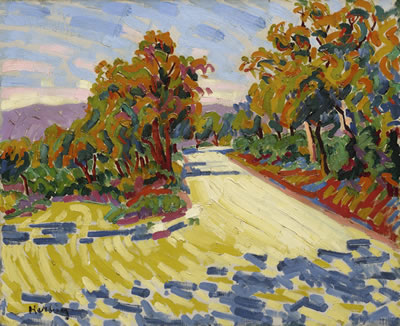
1882 Quievy, Nord, France - 1960 Paris, France. Known for: Cubist, geometric abstract, constructivist painting.
Auguste Herbin (1882 - 1960). The son of a workman, he was born in a small village near the Belgian border on April 29, 1882. This background is reflected in the northern French artist's painting... Read full biography
Auguste Herbin (1882 - 1960). The son of a workman, he was born in a small village near the Belgian border on April 29, 1882. This background is reflected in the northern French artist's painting with its rational approach and explicit working class character. Before settling in Paris, where he... Read full biography
Auguste Herbin (1882 - 1960). The son of a workman, he was born in a small village near the Belgian border on April 29, 1882. This background is reflected in the northern French artist's painting with its rational approach and explicit working class character. Before settling in Paris, where he first joined the Impressionists and later the Fauves, Herbin attended the Ecole des Beaux Arts in Lille from 1900 onwards. His studio was situated directly next to Braque's and Picasso's, allowing a... Read full biography
Auguste Herbin (1882 - 1960). The son of a workman, he was born in a small village near the Belgian border on April 29, 1882. This background is reflected in the northern French artist's painting with its rational approach and explicit working class character. Before settling in Paris, where he first joined the Impressionists and later the Fauves, Herbin attended the Ecole des Beaux Arts in Lille from 1900 onwards. His studio was situated directly next to Braque's and Picasso's, allowing a close study of Cubism, which resulted in first Cubist paintings in 1913. In 1917 he moved on to an abstract, geometric phase before gradually discovering Constructivism. There was a short interruption in this development in 1922 when the painter briefly... Read full biography
Auguste Herbin (1882 - 1960). The son of a workman, he was born in a small village near the Belgian border on April 29, 1882. This background is reflected in the northern French artist's painting with its rational approach and explicit working class character. Before settling in Paris, where he first joined the Impressionists and later the Fauves, Herbin attended the Ecole des Beaux Arts in Lille from 1900 onwards. His studio was situated directly next to Braque's and Picasso's, allowing a close study of Cubism, which resulted in first Cubist paintings in 1913. In 1917 he moved on to an abstract, geometric phase before gradually discovering Constructivism. There was a short interruption in this development in 1922 when the painter briefly returned to figurative painting. In 1929 Herbin was a co-founder of the 'Salon des Surindépendants'... Read full biography
Artist Biography
Biography page for Auguste Herbin ((1882 - 1960)), known for Cubist, geometric abstract, constructivist painting. Showing 4 biographical entries and 0 sample artworks.
Auguste Herbin - Artist Info
About Auguste Herbin
Biography from the Archives of askART
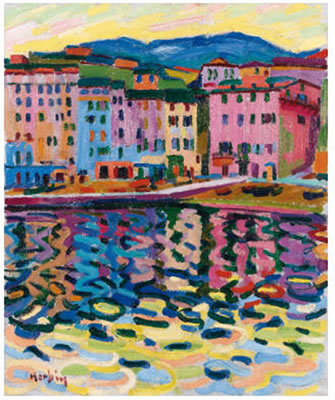 Auguste Herbin (1882 - 1960)
The son of a workman, he was born in a small village near the Belgian border on April 29, 1882. This background is reflected in the northern French artist's painting with its rational approach and explicit working class character.
Before settling in Paris, where he first joined the Impressionists and later the Fauves, Herbin attended the Ecole des Beaux Arts in Lille from 1900 onwards. His studio was situated directly next to Braque's and Picasso's, allowing a close study of Cubism, which resulted in first Cubist paintings in 1913. In 1917 he moved on to an abstract, geometric phase before gradually discovering Constructivism. There was a short interruption in this development in 1922 when the painter briefly returned to figurative painting.
In 1929 Herbin was a co-founder of the 'Salon des Surindépendants'. Two years later he founded the artist association 'Abstraction-Création' together with Vantongerloo with whom he published the group's Almanach until 1937. After the war the artist was the co-founder and vice president - from 1955 also the president - of the 'Salon des Réalites Nouvelles'. From 1938 his interest in the Italian Trecento led Herbin to a more concrete, strictly two-dimensional painting style with simple geometric forms. In 1946 he developed the 'alphabet plastique', a compositional system based on the structure of letters. He published this compositional system as well as his color theories - partly derived from Goethe's Farbenlehre - in his L'art non-figuratif non-objectif in 1949.
A lateral paralysis in 1953 forced the artist to learn painting with his left hand. Herbin's typical architectural approach and his color effects made his pre-war work widely known in the international art world - a success which continued after the war. Herbin exhibited works at the Documenta (Kassel, Germany) in the years 1955 to 1972. There was a large show at the Guggenheim Museum in New York in 1979 and he had works in the exhibition 'Positionen unabhängiger Kunst in Europa um 1937' at the Kunstsammlung Nordrhein-Westfalen in Düsseldorf in 1987.
Herbin died in Paris on 31 January 1960. One painting remained unfinished - it was called Fin.
Source:
Information courtesy of the Kendall CollectionBiography from the Archives of askART
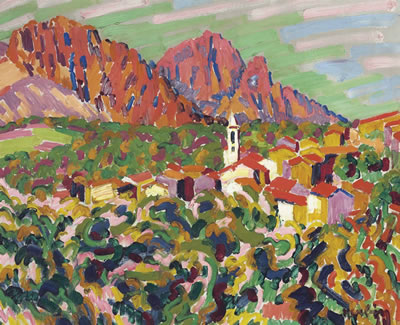 Auguste Herbin was born in 1882 in Quievy, Nord, France. He was a painter who always remained on the fringe of ideologies of the twentieth century without committing himself to any one of them. He brought order to Cubism and his intense and unruly color through geometry and away from figurative painting.
He founded the Abstraction-Creation group; his color became pure energy and he was able to create an idiom of greatest precision.
In Octoer 1914, he was drafted into the auxiliary force of the French army, and was asked to decorate the military chapel in Mailly-en-Champagne and then design camouflage materials for the the Air Force.
Herbin died in Paris in 1960.
Sources:
Phaidon Encyclopedia of Art and Artists
Roy Behrens, Camoupedia, p. 185Biography from Schiller & Bodo European Paintings
French, 1882-1960
Active among those artists who helped to shape the development of Modernism at the beginning of the 20th century, Auguste Herbin began his studies at the Ecole des Beaux-Arts de Lille in 1901. He moved to Paris two years later and exhibited his Neo-Impressionist style paintings at the Salon des Indépendents. In 1909 he moved to the Bateau-Lavoir, a block in Montmartre famous for the outstanding group of modern artists who lived there, including Picasso, Gris, Braque and Modigliani. Here Herbin was immersed in the heart of the burgeoning Cubist movement: he very quickly began to integrate Cubist elements into his production and as early as 1910 his work was hung in the same room at the Salon des Indépendents as Metzinger, Gleizes, and Léger. In 1917 he moved on to an abstract, geometric phase before gradually discovering Constructivism.
In 1929 Herbin was a co-founder of the 'Salon des Surindépendants' and two years later he founded the artist association 'Abstraction-Création' together with Vantongerloo, with whom he published the group's Almanach until 1937. After the war the artist was the co-founder and vice president - from 1955 also the president - of the 'Salon des Réalites Nouvelles'.
Herbin's typical architectural approach and his color effects made his pre-war work widely known in the international art world. There was a large show at the Guggenheim Museum in New York in 1979 and he had works in the exhibition 'Positionen unabhängiger Kunst in Europa um 1937' at the Kunstsammlung Nordrhein-Westfalen in Düsseldorf in 1987.Biography from Kunsthaus Lempertz
Auguste Herbin, a French painter, progressed from late Impressionism to Fauvism and Cubism, heavily influenced by Paul Cézanne's landscapes and the works of artists like Picasso, Braque, and Juan Gris. His exploration of Cubism from 1908 to 1912 was a significant stage in his artistic development. In his landscape "Le Pont" from 1910, Herbin showcased Cubist fragmentation of form, combining elements of Fauvism with Cubism. He used intense colors like dark green, yellow, and blue in his landscapes, deviating from the subdued palette of his contemporaries. The motif of the bridge in his work symbolized the connection between different styles and provided a visually stimulating experience for the viewer.