Page loaded successfully. Showing biography for Ayman Baalbaki.
Ayman Baalbaki BIOGRAPHY
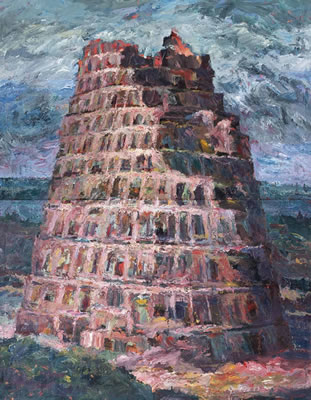
Born 1975 Odesse, Lebanon. Known for: Large scale expressive portrait painting, warrior images, installations.
Ayman Baalbaki (born in 1975 in Odeisse, Lebanon) is a Lebanese painter. He studied at the Lebanese University and at the École nationale supérieure des arts décoratifs in Paris. His large-scale... Read full biography
Ayman Baalbaki (born in 1975 in Odeisse, Lebanon) is a Lebanese painter. He studied at the Lebanese University and at the École nationale supérieure des arts décoratifs in Paris. His large-scale expressionist portraits of fighters made him one of the most popular young Arab artists. Born the year... Read full biography
Ayman Baalbaki (born in 1975 in Odeisse, Lebanon) is a Lebanese painter. He studied at the Lebanese University and at the École nationale supérieure des arts décoratifs in Paris. His large-scale expressionist portraits of fighters made him one of the most popular young Arab artists. Born the year the civil war started in Lebanon, Ayman Baalbaki draws most of his inspiration from these events. His paintings often depict destroyed buildings, sometimes occupied by refugees who were forced to leave... Read full biography
Ayman Baalbaki (born in 1975 in Odeisse, Lebanon) is a Lebanese painter. He studied at the Lebanese University and at the École nationale supérieure des arts décoratifs in Paris. His large-scale expressionist portraits of fighters made him one of the most popular young Arab artists. Born the year the civil war started in Lebanon, Ayman Baalbaki draws most of his inspiration from these events. His paintings often depict destroyed buildings, sometimes occupied by refugees who were forced to leave their homes during the combats. After the 2006 Lebanon War, he drew series of scattered structures related to the demolitions consecutive to the bombings of Beirut's southern suburbs. Ayman Baalbaki's most popular series depict warriors bearing... Read full biography
Ayman Baalbaki (born in 1975 in Odeisse, Lebanon) is a Lebanese painter. He studied at the Lebanese University and at the École nationale supérieure des arts décoratifs in Paris. His large-scale expressionist portraits of fighters made him one of the most popular young Arab artists. Born the year the civil war started in Lebanon, Ayman Baalbaki draws most of his inspiration from these events. His paintings often depict destroyed buildings, sometimes occupied by refugees who were forced to leave their homes during the combats. After the 2006 Lebanon War, he drew series of scattered structures related to the demolitions consecutive to the bombings of Beirut's southern suburbs. Ayman Baalbaki's most popular series depict warriors bearing veils or casks. These portraits of anonymous figures became a symbol of the endless conflicts in the Middle East. These paintings have been w... Read full biography
Artist Biography
Biography page for Ayman Baalbaki ((Born 1975)), known for Large scale expressive portrait painting, warrior images, installations. Showing 2 biographical entries and 0 sample artworks.
Ayman Baalbaki - Artist Info
About Ayman Baalbaki
Biography from the Archives of askART
 Ayman Baalbaki (born in 1975 in Odeisse, Lebanon) is a Lebanese painter. He studied at the Lebanese University and at the École nationale supérieure des arts décoratifs in Paris. His large-scale expressionist portraits of fighters made him one of the most popular young Arab artists.
Born the year the civil war started in Lebanon, Ayman Baalbaki draws most of his inspiration from these events. His paintings often depict destroyed buildings, sometimes occupied by refugees who were forced to leave their homes during the combats. After the 2006 Lebanon War, he drew series of scattered structures related to the demolitions consecutive to the bombings of Beirut's southern suburbs.
Ayman Baalbaki's most popular series depict warriors bearing veils or casks. These portraits of anonymous figures became a symbol of the endless conflicts in the Middle East. These paintings have been widely exhibited worldwide, including the 2011 Venice Biennale. In 2012, Baalbaki participated in Hoods for Heritage, a project consisting of 16 Porsche 911 hoods transformed into art works by artists and designer and auctioned on benefit of the Beirut National Museum.
Although better known as a painter, Ayman Baalbaki produced notable installation works. While at École nationale supérieure des arts décoratifs, he presented Les Frigos (2001) a container enclosing a luggage. Nomadism is a recurrent theme in his work and will appear in more recent works such as Destination X, that was featured in Arabicity (2010) an exhibition curated by Rose Issa in Liverpool's Bluecoat and Beirut's Beirut Exhibition Center. Destination X is an old Mercedes Benz red car, reminding of Lebanon's antique taxis service, loaded with a mountain of luggage as a symbol of the upheaval caused by the war.
Awards
• Empreintes (first prize), organized by Maraya Gallery and Lebanese Ministry of Culture and Higher Education, Beirut, Lebanon, 1996
• Cm ³(first prices), CIUP, France, 2003
• Jeux de la francophonie 2005 Silver Medal (painting), Niamey, Niger
Publications
• Ayman Baalbaki, Transfiguration Apocalyptique, Agial Art Gallery 2008
• Can one man save the (art world), Georges Rabbath and Nayla Tamraz, Alarm Editions 2009
• Beirut and Again and Again, edited by Rose Issa, Beyond Art Productions, 2012
Solo Exhibitions
• Transfiguration Apocalyptique, Agial Art Gallery, Beirut 2008
• Ceci n'est pas la Suisse, Rose Issa Projects, London, 2009
• Beirut Again and Again, Rose Issa Projects, London, 2011
Group Exhibitions
• Contemporary Art Encounter: Imagining the Book, Bibliotheca Alexandrina, Alexandria, 2002.
• CM3, Cité Internationale Universitaire, Paris, 2003
• Thirty: Ayman Baalbaki and Sheelagh Colcough, Studio 4-11, Belfast, 2005
• Bos Iaf, Sabanci University, Kasa Art Gallery, Istanbul 2008
• Rafia Gallery, Damascus, 2009
• Arabicity, Bluecoat Arts Center, Liverpool and Beirut Exhibition Center, 2010
• Nujoom: Constellations of Arab art, The Farjam Collection at Dubai International Financial Centre, Dubai, 2010
• The Future of a Promise, 54th Venice Biennale, 2012
• Traits d'Union - Paris et l'art contemporain arabe, Villa Emerige, Paris, 2011
• Art is the answer! Contemporary Lebanese artists and designers, Villa Empain, Brussels, 2012
Source:
Ayman Baalbaki, Wikipedia, http://en.wikipedia.org/wiki/Ayman_Baalbaki (Accessed 10/2/2014)Biography from Sotheby's Doha
Ayman Baalbaki was born in Lebanon in 1975; the year the Civil War began that eventually led to the displacement of his family. As eyewitness to numerous brutal, war-inflicted years spent in Beirut, many of the artist's traumatic experiences have, unsurprisingly, provided the inspiration and subjects behind his most powerful work.
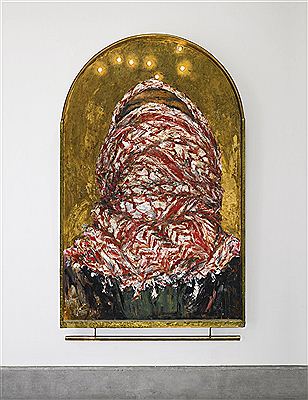
Depicting the shrouded face of a lone, heroic figure gazing up to the skies, Ya'illahi is without question one of Baalbaki's most poignant and powerful paintings to ever come to auction. Realised in explosive swathes of thick red and white impasto, the impenetrable visage of the subject rises forcibly up the picture plane, towering above the viewer in a vertical crescendo of expressionistic brushstrokes. The characteristically ridged vigour of Baalbaki's thick mark-making intensifies the sculptural physicality of the portrait; which the artist here sets in dramatic contrast against a lustrous gold leaf panel whose delicate surfaces and curved top draw their inspiration from Byzantine religious icons.
However, close inspection reveals the tomb-shaped gold panel to be the antithesis of a religious altarpiece. For in its former life, it was the top of a lowly wooden vegetable cart - a clever Dadaist twist that adds to the acute physicality and authenticity of his subject. Baalbaki further breaks with the conventions governing traditional portraiture by denying the viewer access to the subject's face. Looking up to the skies, perhaps in prayer, possibly despair or even defiance, here only a glimmer of the eyes and forehead are left exposed to examination. The viewer is therefore forced to speculate as to the sitter's emotions, searching instead for a possible meaning amongst the methods and materials constituting this monolithic composition. One such clue is found beneath the curved upper edge of the panel where Baalbaki has set into the golden sky seven light bulbs that together form the outline of the Big Dipper constellation.
Recalling a famous story from Arabic mythology of a funeral procession, hovering suspended above the figure's gaze, the pan of the Big Dipper symbolically portrays the Father, dead in the coffin, followed by his three sons, the three stars of the handle, as they head toward his murderer, the North Star, to seek retribution for his death.
Painted with such expressionistic force that it almost seems to implicate the hidden identity of the sitter, Ya'illahi is a powerfully charged portrait saturated with ambiguity, nostalgia, controversy and hope. Dominated by the traditional red and white kaffiyeh headdress, a garment worn by men throughout the Arab world as protection against sun exposure and sandstorms, Baalbaki's monumental portrait evokes a broad spectrum of interpretations and responses ranging from the political to the emotional.
Viewers often misread Baalbaki's kaffiyeh portraits as specific references to the fighters in Palestine's civil war. However in reality, the artist's intentions are far broader and further reaching. By focusing upon the kaffiyeh, he seeks to explore the acute tension and ambiguity within this everyday garment which has, through war, conflict and the media, morphed from a traditional utilitarian object into a powerful symbol of turmoil in the Middle East today. Examining its function, meaning and misinterpretation both as metaphor and mask, the artist tackles universal issues of identity, prejudice, and tradition. Most importantly, the work remains essentially introspective, posing the personal question to the viewer, "How has war shaped who I am?"