Page loaded successfully. Showing biography for Behjat Sadr.
Behjat Sadr BIOGRAPHY
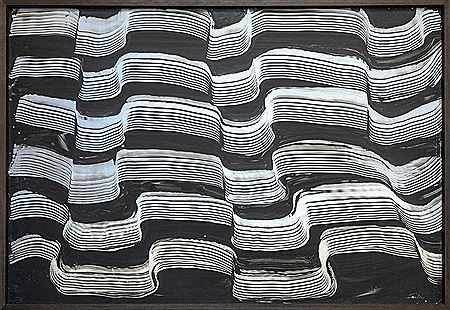
1924 Arak, Iran - 2009 Corsica, France. Known for: Abstract, leading edge modern art painting, collages, teaching.
"SADR, BEHJAT pioneer modernist painter and educator, notable in the development of Iranian modern art movement.". SADR, BEHJAT (Behjat Sadr Mahallati, b. Arak, 29 May 1924; d. Corsica France, 11... Read full biography
"SADR, BEHJAT pioneer modernist painter and educator, notable in the development of Iranian modern art movement.". SADR, BEHJAT (Behjat Sadr Mahallati, b. Arak, 29 May 1924; d. Corsica France, 11 August 2009), . Daughter of Mohammad Sadr Mahallati and Qamar Amini Sadr, Behjat was the younger sister... Read full biography
"SADR, BEHJAT pioneer modernist painter and educator, notable in the development of Iranian modern art movement.". SADR, BEHJAT (Behjat Sadr Mahallati, b. Arak, 29 May 1924; d. Corsica France, 11 August 2009), . Daughter of Mohammad Sadr Mahallati and Qamar Amini Sadr, Behjat was the younger sister of Nosrat-Allah Amini, the mayor of Tehran during the tense period of Mohhamad Mossadeq's Premier from 1951 to 1953 and his personal lawyer through the 1970s. Her family moved to Hamadan and later... Read full biography
"SADR, BEHJAT pioneer modernist painter and educator, notable in the development of Iranian modern art movement.". SADR, BEHJAT (Behjat Sadr Mahallati, b. Arak, 29 May 1924; d. Corsica France, 11 August 2009), . Daughter of Mohammad Sadr Mahallati and Qamar Amini Sadr, Behjat was the younger sister of Nosrat-Allah Amini, the mayor of Tehran during the tense period of Mohhamad Mossadeq's Premier from 1951 to 1953 and his personal lawyer through the 1970s. Her family moved to Hamadan and later Mazandaran before settling in Tehran in 1930. Behjat spent her summers in a small family estate near Arak, where she was first introduced to art and craft. In 1941 she attended Tehran's Teachers Training School and, to prepare for the university... Read full biography
"SADR, BEHJAT pioneer modernist painter and educator, notable in the development of Iranian modern art movement.". SADR, BEHJAT (Behjat Sadr Mahallati, b. Arak, 29 May 1924; d. Corsica France, 11 August 2009), . Daughter of Mohammad Sadr Mahallati and Qamar Amini Sadr, Behjat was the younger sister of Nosrat-Allah Amini, the mayor of Tehran during the tense period of Mohhamad Mossadeq's Premier from 1951 to 1953 and his personal lawyer through the 1970s. Her family moved to Hamadan and later Mazandaran before settling in Tehran in 1930. Behjat spent her summers in a small family estate near Arak, where she was first introduced to art and craft. In 1941 she attended Tehran's Teachers Training School and, to prepare for the university entrance exam, attended Petgar painting studio in 1947. She entered the Faculty of Fine Arts at Tehran University in 1948, where sh... Read full biography
Artist Biography
Biography page for Behjat Sadr ((1924 - 2009)), known for Abstract, leading edge modern art painting, collages, teaching. Showing 4 biographical entries and 0 sample artworks.
Behjat Sadr - Artist Info
About Behjat Sadr
Name variants
Sadr Behjat
Biography from the Archives of askART
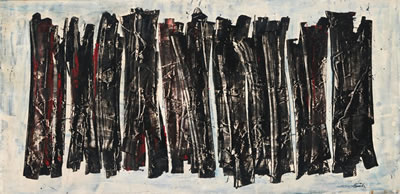 "SADR, BEHJAT pioneer modernist painter and educator, notable in the development of Iranian modern art movement."
SADR, BEHJAT (Behjat Sadr Mahallati, b. Arak, 29 May 1924; d. Corsica France, 11 August 2009),
Daughter of Mohammad Sadr Mahallati and Qamar Amini Sadr, Behjat was the younger sister of Nosrat-Allah Amini, the mayor of Tehran during the tense period of Mohhamad Mossadeq's Premier from 1951 to 1953 and his personal lawyer through the 1970s. Her family moved to Hamadan and later Mazandaran before settling in Tehran in 1930. Behjat spent her summers in a small family estate near Arak, where she was first introduced to art and craft.
In 1941 she attended Tehran's Teachers Training School and, to prepare for the university entrance exam, attended Petgar painting studio in 1947. She entered the Faculty of Fine Arts at Tehran University in 1948, where she met Sadeq Hedayat, who at the time worked as a librarian, as well as Sohrab Sepehri and many other artists who later became prominent figures in the Iranian art scene. Hosayn Zendehrudi (b. 1937), Bahman Mohasses (b. 1931), Parviz Tanavoli (b. 1937), and Marco Grigorian were among her friends, who welcomed modern trends and experimented with new artistic techniques. She was also a close friend of Forug Farrokzad, who stayed for a long time with her in Rome.
While attending Tehran University, Behjat married Abu'l-assan, whom she divorced in 1952. Behjat graduated in 1954 with special mention, and won two major scholarships offered by the Faculty of Fine Arts, one of which was a grant to study in Italy. She left for Rome in 1956 where, upon recommendation of Marco Grigorian, she met with Roberto Melli (1885-1958), who liked her work and became her mentor (Ešraq, 2009). In the same year, she attended Roberto Melli Academy, Academia di Belle Arti, and later the Naples Academy of Fine Arts (Mojabi, et al, P. 30). Melli introduced her to several prominent gallery owners and critics, and she was able to hold major exhibitions in Europe. Meanwhile her work, along with the works of a few young Iranians, was selected for the Venice Biennial XXVIII. Behjat received positive reviews from many influential critics, among them Lionello Venturi, Pierre Gueguen, Emilio Villa, Michel Ragon, and Michel Tapie.
In 1958 Behjat married Morteza Hannaneh (1923-1989), a well-known Iranian composer who was living in Italy at the time. Upon graduation they returned back to Tehran, and in 1960 Behjat started teaching at the Faculty of Fine Arts as an associate professor. Two years later, in 1962, Behjat exhibited her works at The Venice Biennial, Sao Paolo Biennial in Brazil and the 3rd Tehran Biennial, where she was awarded the Royal Grand Prize. Her only daughter Kakuti (Mitra) was born in 1963. However, her marriage ended in divorce in 1965.
American audiences were first introduced to Iranian modern art in 1962 when a contemporary exhibition, including Behjat Sadr's work, traveled around the United States (Balaghi, p. 23). In 1966 Behjat Sadr traveled to Paris on a sabbatical and became Gustave Singier's assistant. Singier, a Belgian non-figurative painter, was also a teacher at Ecole Nationale Superieure des Beaux-Arts, and taught Behjat many novel techniques. Inspired and excited, Behjat returned home in 1968 and became the Chair of The Department of Visual Arts at Tehran University, while exhibiting her works internationally. Her circle of friends expanded and included such prominent figures as Ebrahim Golestan (b. 1922), Jalal Al-e Amad, Simin Danešvar (1921-2012) and Nader Naderpour, who admired Sadr as the greatest Iranian modernist painter (Ragon, p. 132). Behjat continued teaching at Tehran University until 1980 and held numerous exhibitions during the 1970s, 1980s, and 1990s.
Behjat Sadr was diagnosed with breast cancer in the late 1990s and died of a heart attack at 85 in Corsica, south of France. Her last exhibition in Tehran was a group show at the Museum of Contemporary Art in 2007, titled "Manifestations of Contemporary Art in Iran" (Mehrnews, 2009). Behjat's work was last exhibited in a group show in Paris a few months before her death in 2009.
WORKS
Behjat Sadr's non-representational canvases, produced with thick brush strokes of paint, layer upon layer, created semi-disciplined grids of color, which became one of the most important elements of her work. Her abstract style embraced a balance between painterly control and spontaneity, using a strategy of simplification and avoiding the literal depiction of the visible world. "The spectator looking at Behjat's work approaches a chaotic world with indescribable dimensions, out of a turbulent time with innovative shapes" (Melli, Exhibition Brochure, 1957). As was commented by Emilio Villa, the art critic and chief editor of Appia art magazine, "Sadr gives special priority to spatial depth as specification of our time, to signify the importance of our psyche, the totality of human experience and its spontaneous creativity" (Villa, Exhibition Catalogue, 1958). Sadr's gestural strokes later expanded into a flawless anonymity of execution. Crisscrossing the paint vertically and horizontally with her tools and brushes, Sadr diminished her physical and manual controls and created new visual vistas.
Sadr's canvases were inspired by an anti-aesthetic skepticism, dominant among many European modernists of the time, avoiding serial repetition that involved the traditional definition of ornament. "Sadr still shows no trace of femininity in her work. Painting on wood with a hard texture, applying thick oil and using mechanical drapes, her work possesses a very strong structure" (Nicole Van DeVen, p. 10).
In many of her collages, Sadr incorporated photographic images in the center of her painterly abstractions, creating tension between the abstracted background and the intentional photos in the core. The simultaneous use of scenery in the center of her work as a representational element, along with an abstract background signified neither pure intention nor pure process.
During the seventies and eighties, utilizing various media and techniques, Sadr expanded her unique approach to light, movement, and equilibrium, catching audiences by surprise. She experienced different styles of painting, but mostly preferred to work in abstract style (Golestan, 2009) "Using her whole hand instead of mere fingers, along with different size spatulas instead of traditional brush, Behjat was able to go beyond many traditional techniques of painting" (Ešraq, 2009).
Behjat Sadr's works are held in the collections of Tehran's Museum of Contemporary Art, Paris's Contemporary Arts Foundation, Cultural Division of Paris Municipality, UNESCO, Grey Art Collection at New York University, and many private collections.
Selected Exhibitions:
Solo Exhibitions.
1958 - "Pardis," Bussola Gallery, Rome
1967 - "Pardaha," (Drapes) Installation, Seyhoun Gallery
1983 - Cité Internationale Des Arts, Salon Du 2 Etage, Paris
1985 - "Lisières et Mixtes," Noroit, Arras, France
1990 - "Behjat Sadr," Sandoz Salon, Cité Internationale des Arts," Paris
1994 - "Moruri bar aar-e Behjat Sadr," (Review of Behjat Sadr's works)," Niavaran Cultural Center, Tehran
Group Exhibitions.
1956 - The Venice Biennial, Italy
1957 - Galleria Il Pincio, Rome
1962 - The Venice Biennial, Italy
- Sao Paolo Biennial, Brazil
- The 3rd Tehran Painting Biennial
1987 - Iranian Contemporary Art: Four Women, Foxley Leach Gallery,
Washington, D.C.
1994 - "Tajalli-e ehsas" (Revelation of emotions), Niavaran Cultural Center, Tehran
2000 - First International Painting Biennial of Islamic World, Museum of
Contemporary Art, Tehran
- "Iran, Les Jardins Cachés (The hidden gardens), Hall des Chars,
Strasbourg
2002 - "Between World and Image, Modern Iranian Visual Culture," Grey Art
Gallery, NYU, New York
2009 - "14/21: Art Contemporain Perse" (Contemporary Art of Iran), Kiron Espace, Paris
Submitted by Dr. Mehrdad Noorani
Source:
Encyclopedia IranicaBiography from the Archives of askART
 Following is an obituary of the artist by William Pym from Nov/Dec 2009, submitted by Dr. Mehrdad Noorani
Iranian painter Behjat Sadr died from a heart attack, aged 85, at her home in Southern France on August 11. She will be remembered as an artist, teacher, traveler and peerless pioneer for women in the Iranian arts diaspora.
Born in Arak, Iran, in 1924, Sadr's studies at the Faculty of Fine Arts of the University of Tehran led to a scholarship to the Accademia di Belle Arti in Florence and further studies at the Naples Academy of Fine Arts. She was featured in the 1956 Venice Biennale, and returned to teach at the University of Tehran a year later, holding a position there for almost 20 years.
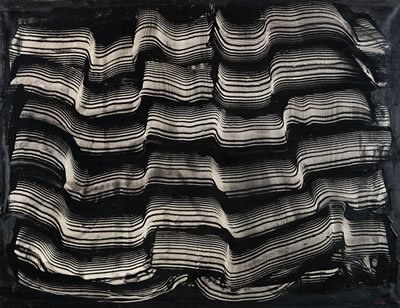
Sadr developed her signature style, working with a palette knife on canvases placed on the floor, during her years in Italy. She had a singular command of her chosen tool, generating effects ranging from the robustly geometrical to the optical or poetically impressionistic, from the assertive to the serene. Despite what she called a "good knowledge" of Persian writing and calligraphy, Sadr preferred to think of her fluid, graphic mark-making technique as "capturing moments," a means of couching emotion within gestural snapshots, moving, she said, from "interior to exterior." She experimented tirelessly throughout her career, collaging photographs and found materials into her later canvases.
Sadr left Iran following the 1979 Islamic Revolution, moving to Paris with her teenage daughter Kakouti. She worked steadily during her second European period, even painting and mounting exhibitions of new work through a protracted battle with breast cancer in the 1990s. Her work from the 1960s and 1970s was revived in "Between World and Image, Modern Iranian Visual Culture," organized by New York University in 2002, and "Manifestations of Contemporary Art in Iran" (2007), in which Sadr's paintings were shown alongside works by 24 international artists at the Museum of Contemporary Art in Tehran. The artist was consistently supported by galleries in her adopted France from the 1980s onward, and exhibited as recently as February 2009 at the Galerie Frédéric Lacroix in Paris. Without question an underdocumented artist, the definitive record of Sadr's accomplishments may be 34-year-old Iranian filmmaker Mitra Farahani's 2006 documentary Behjat Sadr: Time Suspended, which includes footage of the then-82-year-old artist at work, as well as extensive interviews in which Sadr reflects on her process, history, influences and the mysteries of fame and mortality.
During a memorial held at the Iranian Artist's Forum in Tehran on August 16, painter and Iranian arts figure Aydin Aghdashloo spoke mostly of Sadr's peaceful manner. "As one of her students, I always envied her cheerfulness, freshness and easy way of life." Earlier in the service, renowned poet and literary critic Javad Mojabi had taken particular care to point out the added hardships Sadr faced as a female artist in Iran, and lament the lack of support she received in her homeland. "It is hard to judge in a society where criticism is not welcomed. Most artists are not in their rightful position. We even despise ourselves or others, and then after we are gone, we are highly respected. If an artist like Sadr had been introduced to the upcoming generations during her lifetime, our youth would have been able pick up her methods instead of only repeating her experiences."Biography from Bonhams Bond Street
Behjat Sadr is remembered as one of the founding artists of abstract art in Iran, and for some time, one of its sole accomplished protagonists. Meticulous, erudite and supremely perceptive, her work is characterized by a mastery of the painterly aesthetic, using the visual vocabulary of abstract and gestural art in depiction of spontaneous patterned compositions. Born in 1924 in Iran, Sadr was the younger sister of No?rat-Allah Amini, the mayor of Tehran during the tense period of Mo?ammad Mo??adeq's premiership from 1951 to 1953. She was enrolled in the Faculty of Fine Arts at Tehran University in 1948.
After graduating, she left for Rome in 1956 where, upon recommendation of Marco Grigorian, she met with Roberto Melli (1885-1958), who liked her work and became her mentor. In the same year, she attended Roberto Melli Academy, Academia di Belle Arti, and later the Naples Academy of Fine Arts Melli introduced her to several prominent gallery owners and critics, and she was able to hold major exhibitions in Europe. Meanwhile her work, along with the works of a few young Iranians, was selected for inclusion at the Venice Biennale.
In 1958 Behjat married Morteza Hannaneh, a well-known Iranian composer who was living in Italy at the time. Upon graduation they returned back to Tehran, and in 1960 Behjat started teaching at the Faculty of Fine Arts as an associate professor. In 1966 Behjat Sadr travelled to Paris on a sabbatical and became Gustave Singier's assistant. Singier, a Belgian non-figurative painter, was also a teacher at Ecole Nationale Superieure des Beaux-Arts, and taught Behjat many novel techniques.
Inspired and excited, Behjat returned home in 1968 and became the Chair of The Department of Visual Arts at Tehran University. Behjat Sadr was diagnosed with breast cancer in the late 1990s and died of a heart attack at 85 in the South of France. Sadr's work occupied a unique space in the landscape of twentieth century Iranian art.
The dominant trend in the 1950's was movement away from the European inspired academic formalism of the Qajar era and a drive towards the discovery of an indigenous modern aesthetic but one whose key ingredients were popular religious imagery and neo-traditionalist motif's. Sadr's work crushed these parochial boundaries; unconcerned with pursuing a nationalistic artistic agenda she embraced a visual language that was dedicated to expression and technique.Biography from Millon & Associes
Sadr Behjat (Iran 1924-2009)
Considered one of the pioneers of Iranian abstraction, Behdjat Sadr did the first part of her studies at the School of Fine Arts in Tehran, and then went to Rome where she turned from geometric painting to abstraction.
After her studies, and on her return to Tehran, she chose to place various painting supports (canvas, paper, cardboard, aluminum and glass) on the floor of her studio to then manipulate line and color with a palette knife. . Black oil paint predominates in her work.
Curator Fabrice Hergott wrote: "If the black, present in many of her paintings, represents oil, it symbolizes the immense task, the indelible slick of oil like a parison that this oil represents in the history of Iran, through which this country has been restored to the rank of producer, arousing the lust and the darkest passions of the human soul. "
The work we are presenting depicts the characteristic and fundamental traits of her work where she abandons the frame and traditional colors to seize the synthetic paints used in the building that she pours on supports placed on the floor. She then proceeds by remodeling the material, with a large spatula, thus producing traces, in negative, of her own gestures.
Behjat Sadr has exhibited her works in numerous institutions in France and abroad, including:
Musée d'Art moderne de la Ville de Paris, 1963, then in 2014
Gray Foundation, Saint Paul, Minnesota, USA, 1971
Museum of Fine Arts in Brussels, 1972
Le Noroît Art Center, Arras, 1985
Gray Art Gallery, New York, 2010
Asia Society, New York, 2013-2014
MAXXI Rome, 2015
She also participated in the Venice Biennale in 1962. In 2004, the Museum of Contemporary Art in Tehran devoted an important retrospective to her as part of exhibitions dedicated to the pioneers of modern art in Iran. Of this exhibition, she said: “Today I really understood what I wanted. I want there to be in the history of world art, in the history of painters around the world, the name of at least one woman. Then she adds this: "I am ready to put everything I have, my comfort, my happiness, all that in addition ..." Sadr, March 1957