Page loaded successfully. Showing biography for Ben Shahn.
Ben Shahn BIOGRAPHY
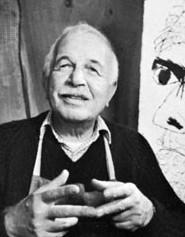
1898 Kovno, Lithuania - 1969 New York City. Known for: Social-realist painting, illustration, lithography, photography.
BENJAMIN SHAHN (1898 - 1969) . Large eyes and big heads dominate Ben Shahn’s insightful paintings, prints, drawings, and murals. Often the narrative is sardonic, while at other times humorous, but... Read full biography
BENJAMIN SHAHN (1898 - 1969) . Large eyes and big heads dominate Ben Shahn’s insightful paintings, prints, drawings, and murals. Often the narrative is sardonic, while at other times humorous, but always intuitive and compassionate about humankind. Throughout his life he was politically aware,... Read full biography
BENJAMIN SHAHN (1898 - 1969) . Large eyes and big heads dominate Ben Shahn’s insightful paintings, prints, drawings, and murals. Often the narrative is sardonic, while at other times humorous, but always intuitive and compassionate about humankind. Throughout his life he was politically aware, often selecting current topics, many of which were controversial. From his mid-career onwards, he was a figurative artist with a distinctive style at a time when abstraction was all the rage. Shahn was... Read full biography
BENJAMIN SHAHN (1898 - 1969) . Large eyes and big heads dominate Ben Shahn’s insightful paintings, prints, drawings, and murals. Often the narrative is sardonic, while at other times humorous, but always intuitive and compassionate about humankind. Throughout his life he was politically aware, often selecting current topics, many of which were controversial. From his mid-career onwards, he was a figurative artist with a distinctive style at a time when abstraction was all the rage. Shahn was born in Kaunas (previously known in English as Kovno), Lithuania, in 1898, when it was part of the Russian Empire. His father, a woodworker, was banished to Siberia for demanding workers’ rights, and in 1906 his family immigrated to Brooklyn, New York.... Read full biography
BENJAMIN SHAHN (1898 - 1969) . Large eyes and big heads dominate Ben Shahn’s insightful paintings, prints, drawings, and murals. Often the narrative is sardonic, while at other times humorous, but always intuitive and compassionate about humankind. Throughout his life he was politically aware, often selecting current topics, many of which were controversial. From his mid-career onwards, he was a figurative artist with a distinctive style at a time when abstraction was all the rage. Shahn was born in Kaunas (previously known in English as Kovno), Lithuania, in 1898, when it was part of the Russian Empire. His father, a woodworker, was banished to Siberia for demanding workers’ rights, and in 1906 his family immigrated to Brooklyn, New York. Later the artist recollected: “The first thing I can remember I drew.” He copied Biblical texts and developed a keen interest in... Read full biography
Artist Biography
Biography page for Ben Shahn ((1898 - 1969)), known for Social-realist painting, illustration, lithography, photography. Showing 3 biographical entries and 0 sample artworks.
Ben Shahn - Artist Info
About Ben Shahn
Biography from The Johnson Collection
BENJAMIN SHAHN (1898 - 1969)
Large eyes and big heads dominate Ben Shahn’s insightful paintings, prints, drawings, and murals. Often the narrative is sardonic, while at other times humorous, but always intuitive and compassionate about humankind. Throughout his life he was politically aware, often selecting current topics, many of which were controversial. From his mid-career onwards, he was a figurative artist with a distinctive style at a time when abstraction was all the rage.
Shahn was born in Kaunas (previously known in English as Kovno), Lithuania, in 1898, when it was part of the Russian Empire. His father, a woodworker, was banished to Siberia for demanding workers’ rights, and in 1906 his family immigrated to Brooklyn, New York. Later the artist recollected: “The first thing I can remember I drew.” He copied Biblical texts and developed a keen interest in lettering which he used frequently in his art. On occasion he was bullied by other boys who forced him to make drawings on the sidewalk.
Between 1913 and 1917 he worked for his uncle’s commercial lithography firm and attended classes at night for high school. Until 1930 lithography was a critical means of support. Beginning in 1919 he studied biology at New York University, but in 1921 shifted to the City College of New York, followed by art lessons at the National Academy of Design. On visits to the Metropolitan Museum of Art he encountered paintings by Giotto and other early Italian masters which led to trips abroad in 1925 and 1927—to France, Italy, Spain, and North Africa. He came to admire several more contemporary artists, specifically Georges Rouault, Raoul Dufy as well as Henri Matisse, and Pablo Picasso.
In his own work, Shahn gravitated toward art that was socially conscious. During the 1930s he was actively involved in artist and leftist organizations. He said, “To me the word ‘propaganda’ is a holy word when it is something I believe in.” In 1933 he served as an assistant to Diego Rivera who was at work on murals in the lobby of the RCA building at Rockefeller Center that represented socialism and capitalism. The inclusion of a portrait of Vladimir Lenin created a virulent controversy which led to the mural’s destruction. From this experience Shahn experienced censorship firsthand and also learned how to paint in fresco which he enjoyed, stating “I would have taught fresco anywhere; Catholic, Jewish, Communist, Republican; anything. I loved fresco so much.”
Throughout the Great Depression Shahn was involved in Roosevelt’s New Deal programs, even though he did not concur with the President’s policy on immigration. Several proposals for murals did not come to fruition due to their subject matter and point of view; for instance, the one for the prison on Rikers Island in New York City addressed the poor conditions that the incarcerated suffered. More positive was the commission for the Jersey Homesteads in New Jersey, a utopian cooperative Jewish agro-industrial community sponsored by the Resettlement Administration and Farm Security Administration (RA/FSA).
Measuring twelve by forty-five feet, the mural presented Shahn’s most explicit Jewish subject matter, and possibly was the only New Deal project to deal with Jewish life. Using montaged, multi-level, and deep perspective compositions, Shahn incorporated portraits of contemporary figures like Albert Einstein, and overt symbols such as menorahs and the American flag. Shahn worked on it during 1936–1938, lived on the premises, and eventually settled there for the remainder of his life.
For the Treasury Department’s Section of Painting and Sculpture, Shahn developed designs for other murals. During 1938–1939 he created thirteen panels for the Bronx Central Post office called Resources of America, which illustrate the nobility of labor; the theme was based on Walt Whitman’s poem “I Hear America Singing.” He was less successful in the competition for the St. Louis Post Office where the guidelines suggested themes relating to mail delivery and the history of Missouri. Shahn instead mapped out panels about immigration, constitutional freedoms, and only some of the state’s history. However, Shahn reworked some of his ideas for the Woodlawn branch post office in Queens, 1939–1941, which resulted in a large-scale depiction, The First Amendment, which is dominated by the Statue of Liberty’s hand wielding a torch.
At the recommendation of noted photographer Walker Evans, his one-time studio mate, Shahn joined the Farm Security Administration’s team of photographers. Their mission was to canvass the country and document people’s living conditions. During 1935 to 1938 at four-to five-month intervals, Shahn took six thousand photographs and traveled across the South: the Carolinas, Tennessee, Arkansas, Kentucky, West Virginia, and Louisiana. “I had crossed and re-crossed many sections of the country and had come to know so many people of all kinds of belief and temperament indifferent to their lot in life…. My own painting then had turned from what is called ‘social realism’ into a sort of ‘personal realism.’”
Another turning point came in July 1951 when Shahn was on the faculty at Black Mountain College near Asheville. The session was called “Vital Contemporary Art Forms,” and Shahn, as a realist, contrasted greatly with Robert Motherwell who would succeed him during the second half of the summer. Dan Rice was also on the faculty and among the students were Jo Sandman, Kenneth Noland, and Nicolas Cernovich, a dancer who asked Shahn to collaborate on a project. This resulted in a design on the young man’s torso, and two elongated figures rendered with heavily gestured black lines, highlighted with colors resembling stained glass. Emerging from this endeavor was a backdrop and costumes Shahn did for Jerome Robbins’ ballet Events about disaffected urban youth.
With a few exceptions, Shahn’s role as an art educator was limited, though he received honorary degrees from both Princeton University and Harvard University, where he became a professor in 1956. Instead he worked on various commissions, choosing only those to his liking. During World War II (1942–1943) he was employed by the Office of War Information, but only two of his posters met the patriotic inclinations of that department.
He was a commercial artist for CBS, Fortune, Harper’s and Time, which published his portrait of Martin Luther King on its cover. From 1961 to 1967, he created designs for the large stained glass window of Temple Beth Zion, a synagogue in Buffalo, New York. Along with Willem deKooning he represented the United States at the 1954 Venice Biennale. In addition, he published two books: The Biography of Painting (1956) and The Shape of Content (1960), a series of six essays in which he argued in favor of form and content working together.
The Johnson Collection, Spartanburg, South Carolina
thejohnsoncollection.orgBiography from ACME Fine Art
Ben Shahn
1898-1969
EDUCATION
National Academy of Design
New York University
City College of New York
Academie de la Grand Chaumiere, Paris
SELECTED EXHIBITIONS
Salons of America, 1930,'32-'33
Whitney Museum of American Art, 1932-'67(biennials)
Art Institute of Chicago
Corcoran Gallery of Art, 1941-'63(biennials)
Pennsylvania Academy of Fine Art, 1940-'64(annuals)
Museum of Modern Art, 1947(retrospective)
Fogg Art Museum, 1956(retrospective)
Selected Collections:
Brooklyn Museum
Whitney Museum of American Art
Metropolitan Museum of Art
Museum of Modern Art
Fogg Art Museum
Pennsylvania Academy of Fine Art
Wadsworth Atheneum
National Gallery of Art
National Portrait Gallery
Smithsonian Museum of American Art
Art Institute of Chicago
Addison Gallery of American Art
Baltimore Museum of Art
Carnegie Institute
Norton Museum of Art
Butler Institute
Munson Williams Proctor InstituteBiography from The Artisfun Gallery
A painter, teacher, graphic artist, and photographer, Ben Shahn was devoted to the figurative tradition and was one of the more significant social critics among painters of the 20th century.
He was born in Kaunus, Lithuania on September 12, 1898, and emigrated with his family to the United States in 1906. From the ages of 15 to 18, Shahn was apprenticed to a New York lithographer. In 1919, he enrolled at New York University, completing his studies at the City College of New York in 1924. After 2 years studying at the National Academy of Design, Shahn traveled in Europe and North Africa. Returning to America, he had his first one-man show in 1929.
Shahn's mature style and his emphasis on specific social themes date from the 1930s. His art was influenced by photographer Walker Evans, with whom he shared quarters. In 1931-1932, Shahn painted 23 gouaches and 2 mural panels based on the Sacco and Vanzetti case. The best known is the Passion of Sacco and Vanzetti, executed in tempera, with elongated bodies and slight caricature of the faces, the work is a masterpiece of understatement. This style remains consistent throughout his work. Fifteen gouache studies (1932-1933) dealing with labor leader Tom Mooney aroused the interest of Mexican mural painter Diego Rivera, and Shahn became Rivera's assistant on the murals for the RCA Building in Rockefeller Center, New York City.
In the eight paintings on the theme of prohibition for the Public Works Arts Project, Shahn used techniques learned from Rivera in murals and panel paintings commissioned by numerous Federal agencies. The one titled W.C.T.U. Parade
(1933-1934) is best known. His mural for the Community Center of the Federal Housing Development in Roosevelt, N.J. (1937-1938), is the most typical.
Shahn's themes reflected a variety of topical problems from anti-semitism to unfair labor conditions. He framed them into a continuous wall plane that is subdivided by architectural devices. Though he borrowed the organizing motifs from Rivera, Shahn's murals are regarded as generally more readable and less crowded. Not as well known are his photographs for the Farm Security Administration. A typical photograph is the one titled Arkansas Share Cropper's Family.
During the 1940s Shahn executed graphics for the Office of War Information and, later, for the Congress of Industrial Organizations (CIO). Register, Vote, a 1944 employment poster for the CIO, shows his concern with social equality and his ability to integrate language and visual form in a coherent design.
He had a retrospective exhibition at the Museum of Modern Art in New York in 1947.
After the 1940s Shahn moved from what he called "social realism" to a "personal realism." He also increasingly turned to tempera painting and graphics. Yet his iconography was never "personal" or autobiographical. Rather, he reached a universal expression through the devices of symbolism and allegory, the stylized line, and the colorful palette, which are hallmarks of his style. Whether his subject was music or a theme after the Spanish artist Francisco Goya, it is said that he could evoke worlds with a single pen stroke or color overlay. Blind Botanist, a drawing for a painting (1954), demonstrates Shahn's ability to express the poignant, often tragic, state of mankind.
Shahn's Lucky Dragon series (1960-1962) visualizes the tragedy of the Japanese fishing vessel that sailed into an atomic testing area in 1954. Perhaps his greatest honor was his appointment as Charles Eliot Norton professor of poetry at Harvard University (1956-1957). He then continued to work prolifically and with social responsibility. He taught and lectured at a variety of educational institutions.
His work is represented in many prestigious public and private collections including over 60 museums such as the Smithsonian American Art Museum, the Metropolitan Museum of Art, the Art Institute of Chicago, the National Gallery of Art, the Pennsylvania Academy of the Fine Arts, the Brooklyn Museum of Art, the Museum of Modern Art, and the Whitney Museum of American Art.
Ben Shahn died in New York City on March 14, 1969.
Sources:
Who Was Who In American Art
Encyclopedia of World Biography
Other Internet Sites