Page loaded successfully. Showing biography for Benjamin Benno.
Benjamin Benno BIOGRAPHY
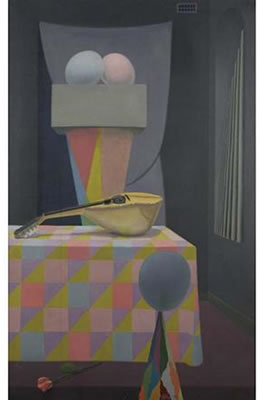
1901 London, England - 1980. Known for: Abstract imagery painting, still life, figurative.
". Benno (Benjamin Benno) was born in America of Russian-Jewish heritage and on the death of his mother in 1905 was sent to Russia. He was raised there by his maternal grandparents until his father... Read full biography
". Benno (Benjamin Benno) was born in America of Russian-Jewish heritage and on the death of his mother in 1905 was sent to Russia. He was raised there by his maternal grandparents until his father brought him to New York in 1912. Benno's father was an anarchist and promptly placed his already... Read full biography
". Benno (Benjamin Benno) was born in America of Russian-Jewish heritage and on the death of his mother in 1905 was sent to Russia. He was raised there by his maternal grandparents until his father brought him to New York in 1912. Benno's father was an anarchist and promptly placed his already recalcitrant son in the Ferrer Modern School*, which was run by Emma Goldman and affiliated with anarchist movement in New York. There Benno had the opportunity to study art with Robert Henri and George... Read full biography
". Benno (Benjamin Benno) was born in America of Russian-Jewish heritage and on the death of his mother in 1905 was sent to Russia. He was raised there by his maternal grandparents until his father brought him to New York in 1912. Benno's father was an anarchist and promptly placed his already recalcitrant son in the Ferrer Modern School*, which was run by Emma Goldman and affiliated with anarchist movement in New York. There Benno had the opportunity to study art with Robert Henri and George Bellows and to become immersed in the art community that flourished around the Ferrer Center. That community included members of the Alfred Stieglitz Circle such as Abraham Walkowitz and Man Ray. Benno's first one-man exhibition at the New Gallery in... Read full biography
". Benno (Benjamin Benno) was born in America of Russian-Jewish heritage and on the death of his mother in 1905 was sent to Russia. He was raised there by his maternal grandparents until his father brought him to New York in 1912. Benno's father was an anarchist and promptly placed his already recalcitrant son in the Ferrer Modern School*, which was run by Emma Goldman and affiliated with anarchist movement in New York. There Benno had the opportunity to study art with Robert Henri and George Bellows and to become immersed in the art community that flourished around the Ferrer Center. That community included members of the Alfred Stieglitz Circle such as Abraham Walkowitz and Man Ray. Benno's first one-man exhibition at the New Gallery in 1923 resulted in his gaining the patronage of the gallery's president, George S. Hellman. In 1926, w... Read full biography
Artist Biography
Biography page for Benjamin Benno ((1901 - 1980)), known for Abstract imagery painting, still life, figurative. Showing 3 biographical entries and 0 sample artworks.
Benjamin Benno - Artist Info
About Benjamin Benno
Name variants
Benno, Benjamin Greenstein
Biography from Aaron Galleries
". . . .Benno (Benjamin Benno) was born in America of Russian-Jewish heritage and on the death of his mother in 1905 was sent to Russia. He was raised there by his maternal grandparents until his father brought him to New York in 1912.
Benno's father was an anarchist and promptly placed his already recalcitrant son in the Ferrer Modern School*, which was run by Emma Goldman and affiliated with anarchist movement in New York. There Benno had the opportunity to study art with Robert Henri and George Bellows and to become immersed in the art community that flourished around the Ferrer Center.
That community included members of the Alfred Stieglitz Circle such as Abraham Walkowitz and Man Ray. . . Benno's first one-man exhibition at the New Gallery in 1923 resulted in his gaining the patronage of the gallery's president, George S. Hellman.
In 1926, with the help of Hellman and other collectors, Benno was able to travel to Paris, where he remained until 1939. In Paris, Benno made important contacts: artists such as Jacques Lipchitz, Marcel Duchamp, and Julio Gonzalez (who introduced him to Picasso) were part of his circle.
By 1930 Benno's work began to reveal his exposure to artists such as Picasso, Redon, and Arp. He experimented with Picasso's blue-and pink-period works, the soft modulated colors of Redon, and the biomorphism of Arp. He also looked carefully at de Chirico's spatial and iconographical poetry. Benno's open-mindedness was seemingly without limit. . . .
Thus, when Duchamp introduced Benno to Kandinsky in 1935, Benno responded not just to the potential of Kandinsky's spatial concepts to loosen the rigid cubist* framework of his abstract* work, but also to Kandinsky's early improvisational linear effects. . . Benno's synthesis of the extemporaneous and the geometric aspects of Kandinsky's work is unique for the period and indeed prefigures similar breakthroughs by Gorky and Pollock."
Source:
Gail Leven and Marianne Lorenz, Theme & Improvisation: Kandinsky & the American Avant-Garde, 1912-1950, 1992, Dayton Art Institute, pages 187-188).
* For more in-depth information about these terms and others, see AskART.com Glossary http://www.askart.com/AskART/lists/Art_Definition.aspxBiography from Leland Little Auctions
Born in London, Greenstein studied art under and alongside Robert Henri, George Bellows, Edward Hopper, and Man Ray at the Ferrer Center in New York City. He traveled to Europe and Paris on a Guggenheim grant, but returned to New York following WWII. His earlier figural work morphing into the cubist and surrealist styles he was exposed to by Picasso, Braque, de Chirico, and others. His works are in numerous museum collections including the Harvard Art Museums and the Brooklyn Museum.Biography from Auctionata, Inc. (CLOSED)
Influenced by the principles of Surrealism, Cubism and Constructivism, prodigious artist Benjamin Benno is best known for his avant-garde paintings. Benno studied at the Ferrer School, after which he traveled the world for eight years. Financed by collectors, Benno moved to Paris in 1926 where he exhibited with significant artists including Paul Klee, Max Ernst, Joan Miro, Salvador Dali and Fernand Leger.
In 1939, Benno returned to New York where his work was harshly received.