Page loaded successfully. Showing biography for Bernice Johnson Sims.
Bernice Johnson Sims BIOGRAPHY
1926 Alabama - 2014 Pensacola, Florida. Known for: Naive, folk art style painting, political, racial themes.
Born on Christmas Day, 1926, Bernice Sims lived all her life in rural and small town southern Alabama. She said she did not notice the racial divisions in the American South when she was a child,... Read full biography
Born on Christmas Day, 1926, Bernice Sims lived all her life in rural and small town southern Alabama. She said she did not notice the racial divisions in the American South when she was a child, because “everybody was just poor.” As she grew up though, her eyes were opened and she became a witness... Read full biography
Born on Christmas Day, 1926, Bernice Sims lived all her life in rural and small town southern Alabama. She said she did not notice the racial divisions in the American South when she was a child, because “everybody was just poor.” As she grew up though, her eyes were opened and she became a witness to social injustice and a participant in the Civil Rights Movement of the 1960’s. Although she had an early interest in painting, there was no time for it until relatively late in life. After years... Read full biography
Born on Christmas Day, 1926, Bernice Sims lived all her life in rural and small town southern Alabama. She said she did not notice the racial divisions in the American South when she was a child, because “everybody was just poor.” As she grew up though, her eyes were opened and she became a witness to social injustice and a participant in the Civil Rights Movement of the 1960’s. Although she had an early interest in painting, there was no time for it until relatively late in life. After years of working hard to earn a living and single-handedly raising her six children, Sims resolved to continue her education at the local community college. She began to paint & found her own style with the encouragement of an art instructor at the school.... Read full biography
Born on Christmas Day, 1926, Bernice Sims lived all her life in rural and small town southern Alabama. She said she did not notice the racial divisions in the American South when she was a child, because “everybody was just poor.” As she grew up though, her eyes were opened and she became a witness to social injustice and a participant in the Civil Rights Movement of the 1960’s. Although she had an early interest in painting, there was no time for it until relatively late in life. After years of working hard to earn a living and single-handedly raising her six children, Sims resolved to continue her education at the local community college. She began to paint & found her own style with the encouragement of an art instructor at the school. Her brightly colored paintings illustrate her memories, from scenes of children playing with homemade toys, to scenes of demonstrators being... Read full biography
Artist Biography
Biography page for Bernice Johnson Sims ((1926 - 2014)), known for Naive, folk art style painting, political, racial themes. Showing 3 biographical entries and 0 sample artworks.
Bernice Johnson Sims - Artist Info
About Bernice Johnson Sims
Biography from the Archives of askART
 Born on Christmas Day, 1926, Bernice Sims lived all her life in rural and small town southern Alabama. She said she did not notice the racial divisions in the American South when she was a child, because “everybody was just poor.” As she grew up though, her eyes were opened and she became a witness to social injustice and a participant in the Civil Rights Movement of the 1960’s.
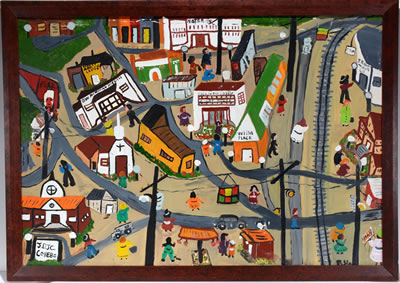
Although she had an early interest in painting, there was no time for it until relatively late in life. After years of working hard to earn a living and single-handedly raising her six children, Sims resolved to continue her education at the local community college. She began to paint & found her own style with the encouragement of an art instructor at the school. Her brightly colored paintings illustrate her memories, from scenes of children playing with homemade toys, to scenes of demonstrators being attacked with fire hoses. In the years that followed, her work gained national attention and her paintings were included in many exhibits and museum collections.
In 2005 the United States Postal Service honored Bernice Sims by issuing a postage stamp featuring her painting of the Edmund Pettus Bridge in Selma, AL, the iconic site of a violent confrontation in the civil rights struggle. The stamp is one of ten in the series entitled “To Form A More Perfect Union” chosen to commemorate the 40th anniversary of the Voting Rights Act.
Although her health had begun to fail, in recent months Sims had been feeling well and had been in good spirits. Working from her bed, she collaborated with writer LaVender Shedrick Williams to put her life story onto the printed page, and she was delighted to have been able to see the project through. She celebrated the publication of The Struggle: My Life and Legacy with a crowd of fans at a local book-signing event. Sims passed away unexpectedly at the long-term care facility where she had been staying.
A strong and independent woman, Bernice Sims not only leaves us her beautiful paintings, but also her hard-won wisdom.
By Karen Mack
Source:
"Bernice Sims," Rawvision, Web, November 8, 2017Biography from The Johnson Collection
BERNICE JOHNSON SIMS (1926-2014)
Bernice Johnson Sims’s subject matter spans the extraordinary to the quotidian and includes formative civil rights marches, lively family gatherings, and Sunday school picnics. Her paintings utilize flat patches of bright colors—punctuated by strong linework and circular mark making—to depict her rural Alabama upbringing. Sims once remarked: “I paint pictures of everyday, but in the past, like it used to be. I have to wait. Everything I paint I form it in my mind. It comes back to me.” Indeed, Sims’s memories are conveyed through a distinctive painterly style, in which figures appear to move and gesticulate among their surroundings. Active in the civil rights movement of the 1960s, she participated in voter registration drives and took part in the famous Selma-Montgomery march. Many of her images reflect these historic events, serving as visual reminders of African American history and the struggle for racial equity.
Sims’s colorful paintings are predominately biographical, drawing inspiration from both her childhood in Alabama and time spent as an activist. Born in Georgiana, a rural community known as the hometown of country music singer Hank Williams, she was the oldest of eight children. Money was often in short supply for the Sims family, and a young Bernice went to reside with her grandparents in the neighborhood of Hickory Hill. Unlike her hometown, her grandparents’ community was less racially segregated, which provided Sims an expansive network of friends and peers. Sims observed her next-door neighbor, Hattie, using a brush and paint to construct pictures on canvas. She inquired about learning, and soon began taking lessons. Over the next few months, newly equipped with an understanding of canvas, paint, and brush, Sims would utilize found and gifted materials to produce her own artworks.
While her bucolic childhood allowed time for Sims to pursue various passions, she was quickly thrust into adult responsibilities as a teenager when she left formal schooling and married. In 1945, Sims and her new husband moved to his hometown of Brewton, Alabama. They lived happily over the next decade, raising six children with family nearby for support. However, when Sims’s husband abruptly left his family and responsibilities behind in the late 1950s, she found herself a single parent without a high school diploma. Steadfast and determined to provide for her family, Sims worked various jobs, which included cleaning homes, sewing clothing, and selling insurance.
The 1960s was a turbulent time in the American South, and as a black woman living in Alabama, Sims faced both prejudice and kindness from her neighbors. In one instance, she was chased away from a voting station by members of the Ku Klux Klan. Later, her children were among the first to attend integrated schools in Brewton. These events inspired Sims to take part in the civil rights movement, and she quickly found her acquired skillsets a major asset to Brewton’s chapter of The National Association for the Advancement of Colored People (NAACP). The state of Alabama had deemed the NAACP illegal, therefore Sims had to manage a clandestine operation that allowed for open communication without drawing attention to the organization’s members. Sims remained active in politics even after the 1960s, as she held minor political offices in her county and helped register others to vote.
It would be almost twenty years later before Sims renewed her interest in art making. When her youngest child left for the Job Corps, Sims began attending General Education Development (GED) courses, finally earning her degree in 1978. She pursued nursing and eventually worked in the healthcare sector, but a knee replacement surgery rendered a physically demanding job nearly impossible. Never fearful of a major life change, Sims took this opportunity to enroll in Jefferson Davis Community College in Brewton. There, she took studio art and art history courses, and ventured with her classmates to local museums. Through her college’s field trip program, Sims connected with fellow Alabama artist Mose Tolliver, whose boldly painted wood canvases had recently been exhibited at the Corcoran Gallery in Washington, D.C. Although she graduated with an associate degree in 1984, Sims’s artistic rebirth had only just begun.
Until her death in 2014, Sims continued to paint—she expanded her materials to include canvas, masonite, mailboxes, and furniture. After her inclusion in the 1994 exhibition Passionate Visions of the American South: Self Taught Artists from 1940 to the Present, which opened at the New Orleans Museum of Art, she achieved national attention for her portrayals of black southern life. Her paintings of seminal moments in African American history have earned her great acclaim, including from the United States Postal Service. In 2005, to commemorate the 40th anniversary of the Voting Rights Act, the postal service featured Sims’s painting of peaceful protesters crossing the Edmund Pettus Bridge in Selma, Alabama.
The Johnson Collection, Spartanburg, South Carolina
thejohnsoncollection.orgBiography from Neal Auction Company
As a single mother of six children, Bernice Sims worked in offices to support her family. In the 1960s, Sims was active in the Civil Rights Movement and participated in voter registration drives.
In 1965, she took part in the Selma-Montgomery March and witnessed the events of "Bloody Sunday" between protesters and police on the Edmund Pettus Bridge, which would inspire this later canvas.