Page loaded successfully. Showing biography for Bertram Charles (BC) Binning.
Bertram Charles (BC) Binning BIOGRAPHY
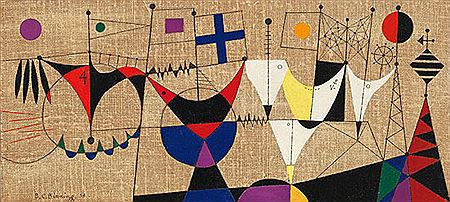
1909 Medicine Hat, Alberta, Canada - 1976 West Vancouver, British Columbia, Canada. Known for: Geometric abstract painting, graphics, murals, decoration, teaching.
Bertram Charles Binning (AKA: B.C. Binning) was a draughtsman, painter, graphic artist, muralist, architectural decorator, printmaker and influential educator who was born in Medicine Hat, Alberta,... Read full biography
Bertram Charles Binning (AKA: B.C. Binning) was a draughtsman, painter, graphic artist, muralist, architectural decorator, printmaker and influential educator who was born in Medicine Hat, Alberta, Canada. In 1913 his family moved to Vancouver, British Columbia, which is where he lived and worked... Read full biography
Bertram Charles Binning (AKA: B.C. Binning) was a draughtsman, painter, graphic artist, muralist, architectural decorator, printmaker and influential educator who was born in Medicine Hat, Alberta, Canada. In 1913 his family moved to Vancouver, British Columbia, which is where he lived and worked for the rest of his life. He died in West Vancouver, which is where his home was for the last 35 years of his life. (1). His mediums were pen and ink, graphite, coloured pencil, gouache, oil (2),... Read full biography
Bertram Charles Binning (AKA: B.C. Binning) was a draughtsman, painter, graphic artist, muralist, architectural decorator, printmaker and influential educator who was born in Medicine Hat, Alberta, Canada. In 1913 his family moved to Vancouver, British Columbia, which is where he lived and worked for the rest of his life. He died in West Vancouver, which is where his home was for the last 35 years of his life. (1). His mediums were pen and ink, graphite, coloured pencil, gouache, oil (2), acrylic, silkscreen, mosaic tiles and mixed mediums. His subjects were boats, the sea, nautical elements and coastal scenes. He also did pure abstraction and semi abstraction. His ultimate subjects were spatial ideas, texture, colour, line and pattern... Read full biography
Bertram Charles Binning (AKA: B.C. Binning) was a draughtsman, painter, graphic artist, muralist, architectural decorator, printmaker and influential educator who was born in Medicine Hat, Alberta, Canada. In 1913 his family moved to Vancouver, British Columbia, which is where he lived and worked for the rest of his life. He died in West Vancouver, which is where his home was for the last 35 years of his life. (1). His mediums were pen and ink, graphite, coloured pencil, gouache, oil (2), acrylic, silkscreen, mosaic tiles and mixed mediums. His subjects were boats, the sea, nautical elements and coastal scenes. He also did pure abstraction and semi abstraction. His ultimate subjects were spatial ideas, texture, colour, line and pattern (formalism). His styles were precisionism, geometric abstraction and decorative semi abstraction. Mo... Read full biography
Artist Biography
Biography page for Bertram Charles (BC) Binning ((1909 - 1976)), known for Geometric abstract painting, graphics, murals, decoration, teaching. Showing 1 biographical entries and 0 sample artworks.
Bertram Charles (BC) Binning - Artist Info
About Bertram Charles (BC) Binning
Name variants
B C (Bertram Charles) Binning, Bertram Charles
Biography from the Archives of askART
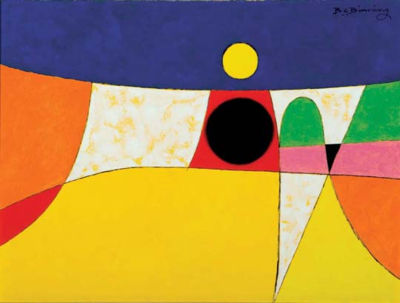 Bertram Charles Binning (AKA: B.C. Binning) was a draughtsman, painter, graphic artist, muralist, architectural decorator, printmaker and influential educator who was born in Medicine Hat, Alberta, Canada. In 1913 his family moved to Vancouver, British Columbia, which is where he lived and worked for the rest of his life. He died in West Vancouver, which is where his home was for the last 35 years of his life. (1)
His mediums were pen and ink, graphite, coloured pencil, gouache, oil (2), acrylic, silkscreen, mosaic tiles and mixed mediums. His subjects were boats, the sea, nautical elements and coastal scenes. He also did pure abstraction and semi abstraction. His ultimate subjects were spatial ideas, texture, colour, line and pattern (formalism). His styles were precisionism, geometric abstraction and decorative semi abstraction. Most of his work is identified by clean lines, flat planes, geometric shapes, controlled balance, a rich sense of colour, a humanization of the object and whimsy. There is a cubist influence evident and a resemblance in spirit to the works of Miro and Klee. Quote: "Canadian art need not be only grim, rugged and forbidding".
In 1927 he enrolled in the Vancouver School of Decorative and Applied Arts (3), and studied under Charles H. Scott, Frederick Varley and Jock MacDonald (see all in AskART). He graduated in 1932. In the late 1930's he also studied at the University of Oregon (1936) under Eugen Steinhof (see AskART), the Art Students League (NYC) under Yasuo Kuniyoshi (see AskART), at the Central School of Art (London, England) under Bernard Meninsky (see AskART) and at the Westminster School of Art (London, England) under Mark Gertler (see AskART). He also studied under Henry Moore (see AskART) in England and Amedee Ozenfant (see AskART) in New York.
His teaching career included: instructor at the Vancouver School of Art (1934 - 39), assistant Professor at the University of British Columbia (UBC) School of Architecture (1949 - 55), associate Professor and department head, UBC Fine Arts Department (which he helped found) (1955 - 61), and full Professor (UBC) from 1961 until he retired in 1974. He was also Director/Curator of the UBC's Fine Arts Gallery (1955-68). His former students include Alistair Bell (See AskART), Joe Plaskett (See AskART) and Don Jarvis (see AskART).
Among his associates and friends were Lawren Harris (See AskART), Bill Reid (See AskART), Harry Adaskin (1901 -1994) (famous Canadian violinist and broadcaster), Toni Onley (See AskART), Bruno Bobak (See AskART), Molly Bobak (See AskART), Arthur Erikson (famous architect), Gordon Smith (See AskART), Jack Shadbolt (See AskART) and John Koerner (See AskART).
Binning had also travelled extensively in Europe, the U.S.A. and several times to Japan.
He was a member of the British Columbia Society of Artists (1935), the Canadian Society of Graphic Artists (1940), the Federation of Canadian Artists (1943) and the Canadian Group of Painters (1948). He was elected an Associate of the Royal Canadian Academy of Arts in 1954 and a full member in 1966. He was also on the advisory panel of the Canada Council for the Arts (1965-67).
In addition to exhibiting with the above artist organizations, he exhibited at the Brooklyn Museum's 11th Biennial International Watercolor Exhibition (1941), the Canadian Biennial (1954), the Venice Biennale (1954), the Milan Triennial (1957) and the National Gallery of Canada's "300 Years of Canadian Art" (1967). He has also exhibited in Australia (1957), Brussels (1958) and Mexico (1960). The Vancouver Art Gallery had solo shows for him in 1944, 1946,1961, 1974 and 2007.
His work is in many private, corporate and public collections. Some of the public collections are the National Gallery of Canada (Ottawa), the Art Gallery of Ontario (Toronto), the Vancouver Art Gallery, the Greater Victoria Art Gallery and the Tate (London). An example of his mosaic murals can be seen at the The Electra in Vancouver (formerly the B.C. Hydro Building).
He has won many awards and honours including the Beatrice Stone Medal for Drawing (1941) and the Royal Architectural Institute's Allied Arts Award (1962). In 1971 he was made an Officer of the Order of Canada (OC), one of the countries highest honours. He received an honorary Doctorate from UBC in 1974. In 1980 UBC created the B. C. Binning Memorial Scholarship.
As a prominent artist his work is discussed in many books about Canadian art history. There are also numerous magazine and newspaper articles. He is listed in A Dictionary of Canadian Artists (1974), by Colin S. MacDonald; in The Collector's Dictionary of Canadian Artists at Auction (2001), by Anthony R. Westbridge and Diana L. Bodnar; in Falk's Who Was Who in American Art; in the Encyclopedia of British Columbia (2000), edited by Daniel Francis; and in The Canadian Encyclopedia (1985), Hurtig Publishers Ltd.
His work is discussed and illustrated in The Development of Canadian Art (1964), by R.H. Hubbard; in From Desolation to Splendour - Changing Perceptions of the British Columbia Landscape (1977), by Maria Tippett and Douglas Cole; in Vancouver Art and Artists 1931 - 1983 (1983), by Luke Rombout and various contributors; in Four Decades (1972) by Paul Duval; in Painting in Canada: A History (1966) by J. Russell Harper; in Art Gallery of Ontario - the Canadian Collection (1970), by Helen Pepall Bradfield; in Canadian Drawings and Prints (1952), by Paul Duval; in A Concise History of Canadian Painting (1973), by Dennis Reid; in Great Canadian Painting - A Century of Art (1966), by Elizabeth Kilbourn; in Three Hundred Years of Canadian Art (1967), by R.H.Hubbard and J.R. Ostiguay; in Canadian Art Today (1970), by William Townsend; in Visions - Contemporary Art in Canada (1983), various authors and editors; in Art and Man - The Modern World (1964) by P.H.Brieger, G.S.Vickers and F.E.Winter; in Contemporary Canadian Art (1983), by David Burnett and Marilyn Schiff; in A Speaking Likeness (1999), by Joseph Plaskett; and in Abstract Painting in Canada (2008), by Roald Nasgaard. There is also B.C. Binning (2006), by Abraham J. Rogatnick, Ian M. Thom, and Adele Weder, published by Douglas & McIntyre (180 pgs, colour) in conjuction with the 2007 Vancouver Art Gallery retrospective of the same title.
Footnotes:
(1) His wife Jessie Wyllie lived there until she died in 2007. The house, which was designed by Binning in 1941 and considered a foremost example of West Coast Residential Modernism, has been designated a National Historic Site. It and its furnishings are being preserved by The Land Conservancy. The author, who in the process of research learned that the home was only 8 blocks from where he lived, made a visit. It is secluded by trees and hardly visible from the narrow road. The house is a modest ( 1540 square foot) flat roof, asymmetrical bungalow. The living room has a wall of floor to ceiling widows that open to a patio with a view across English Bay, to the south side of Vancouver and UBC.
(2) Until 1948 he was almost exclusively a graphic artist. He did not begin painting in oil until then.
(3) It became the Vancouver School of Art in 1937 and in 1995, the Emily Carr Institute of Art and Design.
Prepared and contributed to askART by M.D. Silverbrooke