Page loaded successfully. Showing biography for Bertram Richard Brooker.
Bertram Richard Brooker BIOGRAPHY
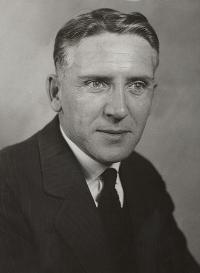
1888 Croydon, England - 1955 Toronto, Ontario, Canada. Known for: Easel painting-abstraction, commercial art, illustration.
Bertram Richard Brooker (AKA: Bertram Brooker, AKA: Richard Surrey, AKA: Huxley Herne) was a painter, graphic artist, commercial artist, illustrator, writer, novelist, playwright, advertising... Read full biography
Bertram Richard Brooker (AKA: Bertram Brooker, AKA: Richard Surrey, AKA: Huxley Herne) was a painter, graphic artist, commercial artist, illustrator, writer, novelist, playwright, advertising executive and a pioneer of Canadian abstraction. He was born in Croydon, Surrey, England (now a part of... Read full biography
Bertram Richard Brooker (AKA: Bertram Brooker, AKA: Richard Surrey, AKA: Huxley Herne) was a painter, graphic artist, commercial artist, illustrator, writer, novelist, playwright, advertising executive and a pioneer of Canadian abstraction. He was born in Croydon, Surrey, England (now a part of London). His family emigrated to Portage la Prairie, Manitoba (50 miles west of Winnipeg) in 1905. In 1921, he moved to Toronto, Ontario where he lived the rest of his life and died. His mediums were... Read full biography
Bertram Richard Brooker (AKA: Bertram Brooker, AKA: Richard Surrey, AKA: Huxley Herne) was a painter, graphic artist, commercial artist, illustrator, writer, novelist, playwright, advertising executive and a pioneer of Canadian abstraction. He was born in Croydon, Surrey, England (now a part of London). His family emigrated to Portage la Prairie, Manitoba (50 miles west of Winnipeg) in 1905. In 1921, he moved to Toronto, Ontario where he lived the rest of his life and died. His mediums were oil, watercolour, tempera*, pencil, and pen and ink. His most famous early works (1925 - 1929) were complex hard-edge geometric abstractions inspired by music and focusing on colour, shape, perspective and rhythm. His styles were Vortecism*, Futurism*,... Read full biography
Bertram Richard Brooker (AKA: Bertram Brooker, AKA: Richard Surrey, AKA: Huxley Herne) was a painter, graphic artist, commercial artist, illustrator, writer, novelist, playwright, advertising executive and a pioneer of Canadian abstraction. He was born in Croydon, Surrey, England (now a part of London). His family emigrated to Portage la Prairie, Manitoba (50 miles west of Winnipeg) in 1905. In 1921, he moved to Toronto, Ontario where he lived the rest of his life and died. His mediums were oil, watercolour, tempera*, pencil, and pen and ink. His most famous early works (1925 - 1929) were complex hard-edge geometric abstractions inspired by music and focusing on colour, shape, perspective and rhythm. His styles were Vortecism*, Futurism*, Surrealism* and Art Deco*. After 1930 his subject content expanded to include landscap... Read full biography
Artist Biography
Biography page for Bertram Richard Brooker ((1888 - 1955)), known for Easel painting-abstraction, commercial art, illustration. Showing 1 biographical entries and 0 sample artworks.
Bertram Richard Brooker - Artist Info
About Bertram Richard Brooker
Biography from the Archives of askART
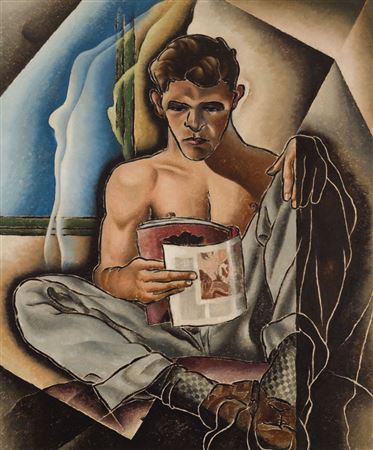 Bertram Richard Brooker (AKA: Bertram Brooker, AKA: Richard Surrey, AKA: Huxley Herne) was a painter, graphic artist, commercial artist, illustrator, writer, novelist, playwright, advertising executive and a pioneer of Canadian abstraction. He was born in Croydon, Surrey, England (now a part of London). His family emigrated to Portage la Prairie, Manitoba (50 miles west of Winnipeg) in 1905. In 1921, he moved to Toronto, Ontario where he lived the rest of his life and died.
His mediums were oil, watercolour, tempera*, pencil, and pen and ink. His most famous early works (1925 - 1929) were complex hard-edge geometric abstractions inspired by music and focusing on colour, shape, perspective and rhythm. His styles were Vortecism*, Futurism*, Surrealism* and Art Deco*. After 1930 his subject content expanded to include landscapes, still life, nudes, portraits, dreams, religion, mysticism, spirituality, allegory, metaphorical allusions, fantasy, and symbolism. His style repertoire grew to include Cubism*, Fauvism* and Realism*.
Quote: "A proper understanding of the real function of art is more necessary today that it has ever been. Now that the orthodox religions are losing their hold, especially on the imaginations of the younger generation, art is more significant than ever before as the only unifying experience that remains to us - the only experience that approximates to the religious in its ability to make us feel at one with the universe." - Bertram Brooker.
Brooker was a self-taught artist who began painting in about 1924 when he was 36 years old (1). However, two friends, Lawren Harris and Lionel Lemoine Fitzgerald (see both in AskART) had an influence on his work. Fitzgerald, the Principal of the Winnipeg School of Art, whom he met in 1929, helped Brooker with his fundamental technical skills and realistic style. Brooker in turn seems to have inspired greater stylization in Fitzgerald's work. With Harris the influence, seen in Brooker's fauvist landscapes, also appears reciprocal when comparing many of Harris' abstracts with Brooker's which were done years before. Other influences were Russian artist Wassily Kandinsky (see AskART), through his book Concerning the Spiritual in Art (1912), which proposed 'music as a model for the artist seeking to express his inner soul', and British philosopher Clive Bell, in his book Art (1914), which proposed 'significant form over representational content as the essential source of the aesthetic experience in a work of art.'(2)
Brooker joined the Arts and Letters Club of Toronto*(3) in 1923, and was a charter member of the Canadian Group of Painters* in 1933. He was also a member of the Canadian Society of Painters in Watercolour* (1935) and the Ontario Society of Artists* (1936). Brooker who was a commercial artist and advertising executive most of his life, joined J. J. Gibbons Advertising in 1930, and moved to MacLaren Advertising in about 1937 where he was vice-president and worked until 1955.
In addition to exhibiting with the above artist associations, he also exhibited with the Group of Seven* in 1928 (see Sounds Assembling in AskART Images), the Royal Canadian Academy of Arts* from 1930 to 1950, with the Art Association of Montreal (4) in 1931, and at the Canadian National Exhibition (1948).
Posthumously, his works have been included in "Canadian Painting in the Thirties" at the National Gallery of Canada in 1975; "Permeable Border: Art of Canada and the United States 1920 -1940" at the Art Gallery of Ontario in 1989; "Origins of Abstraction in Canada: Modernist Pioneers" at the Robert McLaughlin Gallery, Oshawa, Ontario in 1994; "The Group of Seven - Art For A Nation" at the National Gallery of Canada in 1995; "A Collectors Vision: J.S. McLean and Modern Painting in Canada" at the Art Gallery of Ontario in 1999; "Painted in Peel: the Peel Landscape by the Group of Seven & Their Contemporaries" at the Art Gallery of Ontario in 2004; and "The Invisible Landscape: Revealing Our Place in the World" at the Museum of Contemporary Canadian Art, Toronto in 2006. Currently (December 2009), his work is included in "The Nude in Modern Canadian Art" at the Museum of Quebec from October 8, 2009 to January 4, 2010.
The public venues for his solo shows include the Arts and Letters Club of Toronto (1927, 1947); the Art Gallery of Toronto (5) (1929); and Hart House, University of Toronto (1931, 1937, 1942, 1949).
Posthumously, the Art Gallery of Toronto had a memorial exhibition in 1956; the Arts and Letters Club had an exhibition in 1968; the National Gallery of Canada (Ottawa) had a retrospective in 1972; the Winnipeg Art Gallery, Manitoba had "Lionel Lemoine Fitzgerald, Bertram Brooker: Their Drawings" in 1974; and the MacLaren Art Centre, Barrie, Ontario had "Assembling Sounds: the Drawings and Illustrations of Bertram Brooker" in 1996.
Recently, there was "Bertram Brooker: A Beautiful Hypothesis" at the Art Gallery of Windsor, Ontario from January 10 to March 8, 2009. Currently, there is "It's Alive! Bertram Brooker and Vitalism" showing at the Agnes Etherington Art Centre Kingston, Ontario from November 7, 2009 to March 7, 2010.
Two of his exhibitions are frequently recalled as historic; first, he is said to have had the first solo show in Canada devoted entirely to abstraction (the Arts and Letters Club, 1927). And in 1931, his nude painting titled Figures in Landscape was removed from the Ontario Society of Artists show at the Art Gallery of Toronto. It caused a public uproar and inspired his controversial essay Nudes and Prudes in which he criticized Toronto's hypocritical attitude toward nudity in art and defended explicit nude paintings on the grounds that they were educational for children.
Quote: "The tendency today is to tell children in a clean, straightforward, natural way about the functions of sex, so that they do not get their knowledge of it, half-guessed, from the filth they hear whispered in corners. And art is one method of acquainting children with the organs and functions of the body in an atmosphere of candour and beauty." - Bertram Brooker
His works are avidly collected. They are also in numerous public collections including the Agnes Etherington Art Centre (Kingston, Ontario), the Art Gallery of Alberta (Edmonton), the Art Gallery of Greater Victoria (B.C.), the Art Gallery of Hamilton (Ontario), the Art Gallery of Ontario, the Confederation Centre Art Gallery & Museum (Charlottetown, P.E.I.), the McMichael Canadian Art Collection (Kleinburg, Ontario), the Robert McLaughlin Gallery (Oshawa, Ontario), the Tom Thomson Memorial Art Gallery (Owen Sound, Ontario), the Mendel Art Gallery (Saskatoon, Saskatchewan), Museum London (Ontario), the Ottawa Art Gallery (Ontario), Owens Art Gallery (Sackville, N.B.), the Winnipeg Art Gallery (Manitoba), the Nickle Arts Museum (Calgary, Alberta), the Vancouver Art Gallery (B.C.), the Montreal Museum of Fine Arts, the Montreal Museum of Contemporary Art and the National Gallery of Canada. According to the Canadian Heritage Information Network there are 116 Brooker works in museums across Canada.
The University of Manitoba is the home of archival material deposited by the Brooker family. It includes: diaries, correspondence, unpublished manuscripts, accounts books, photographs, thirty-five plays, portions of novels, seventy-five short-stories, essays (most of which are unpublished), and a considerable amount of poetry. It also contains Brooker's private research library consisting of approximately 300 volumes, many of which are carefully annotated.
Examples of his illustrations are in special editions of The Ancient Mariner by Walt Whitman, Crime and Punishment by Dostoyevsky, Les Miserables by Victor Hugo, and Elijah, published by William Edwin Rudge, New York (1930).
As a writer he authored the books: Subconscious Selling (1923); Layout Technique in Advertising (1929) [as R.W. Surrey]; Copy Technique in Advertising (1930) [as R.W. Surrey]; Think of the Earth (1936); Tangled Miracle (1936) [as Huxley Herne]; and The Robber (1949).
Posthumously, there is: Sounds Assembling: The Poetry of Bertram Brooker (1980), edited by Birk Sproxton; and The Wrong World: Selected Stories and Essays of Bertram Brooker (2009), edited by Gregory Betts (see AskART book references).
He also wrote radio plays for the Canadian Broadcasting Corporation and the movie scenario for the Vitagraph Company of America (6) crime drama The Adventure of the Thumb Print (1912). He gave lectures at the National Gallery of Canada and the Art Gallery of Toronto, and from 1928 to 1930, he wrote a syndicated column The Seven Arts, where he analyzed theatre, music, visual arts and poetry.
His awards include the first Governor General's Award for fiction in 1936 for Think of the Earth, published by Thomas Nelson & Sons Toronto.
Footnotes:
(1) His papers dating back to 1913 indicate he was aware of the Armoury Show*, thought about modern art, and had done designs then based on works and artists in that exhibition. Source: Page 21 Abstract Painting in Canada (2007) by Roald Nasgaard (see AskART book references).
(2) Sources: Page 183 A Concise History of Canadian Painting (1973) by Dennis Reid, and Page 26 of Abstract Painting in Canada (2007) by Roald Nasgaard (see AskART book references).
(3) The Arts and Letters Club was a hangout for the Group of Seven throughout the 1920s, most of whom became friends of Brooker, who was a major supporter of theirs in his syndicated columns about art. Arthur Lismer (see AskART) a G7 member, was the sponsor of Brooker's 1927 solo show at the club. Their early friendship didn't however prevent later criticism, J.E.H. Macdonald (see AskART) commented that, in Brooker's abstracts "intellect is squeezing the life out of art", and Brooker in a letter to Lemoine Fitzgerald wrote: "The experimentation is over, the old aggressiveness has declined. The Group of Seven has become orthodoxy and now, I suppose, the public will start buying their pictures."
(4) The AAM became the Montreal Museum of Fine Arts in 1948.
(5) Renamed the Art Gallery of Ontario in 1966.
(6) Purchased by Warner Brothers in 1925.
* For more in-depth information about these terms and others, see AskART.com Glossary http://www.askart.com/AskART/lists/Art_Definition.aspx
Prepared and contributed to askART by M.D. Silverbrooke