Page loaded successfully. Showing biography for Beverly (Stoll) Pepper.
Beverly (Stoll) Pepper BIOGRAPHY
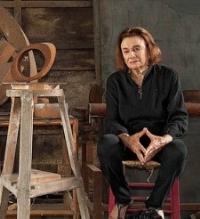
1922 Brooklyn, New York - 2020 Todi, Italy. Known for: Modernist cast iron sculpture, obelisk shapes, abstract painting.
"Beverly Pepper, Sculptor of Monumental Lightness, Dies at 97: An American artist who long worked in Italy, she created towering forms whose evanescence belied their giant scale." Online Obituary,... Read full biography
"Beverly Pepper, Sculptor of Monumental Lightness, Dies at 97: An American artist who long worked in Italy, she created towering forms whose evanescence belied their giant scale." Online Obituary, The New York Times, By Margalit Fox, Feb. 5, 2020. Beverly Pepper, an acclaimed American sculptor... Read full biography
"Beverly Pepper, Sculptor of Monumental Lightness, Dies at 97: An American artist who long worked in Italy, she created towering forms whose evanescence belied their giant scale." Online Obituary, The New York Times, By Margalit Fox, Feb. 5, 2020. Beverly Pepper, an acclaimed American sculptor whose work was suffused with a quicksilver lightness that belied its gargantuan scale, died on Wednesday at her home in Todi, Italy. She was 97. Her daughter, the poet Jorie Graham, confirmed the death.... Read full biography
"Beverly Pepper, Sculptor of Monumental Lightness, Dies at 97: An American artist who long worked in Italy, she created towering forms whose evanescence belied their giant scale." Online Obituary, The New York Times, By Margalit Fox, Feb. 5, 2020. Beverly Pepper, an acclaimed American sculptor whose work was suffused with a quicksilver lightness that belied its gargantuan scale, died on Wednesday at her home in Todi, Italy. She was 97. Her daughter, the poet Jorie Graham, confirmed the death. After beginning her artistic life as a painter, Ms. Pepper was known from the 1960s on as a sculptor of towering forms of iron, steel, earth and stone, often displayed outdoors. Her art is in the collections of the Metropolitan Museum of Art in New... Read full biography
"Beverly Pepper, Sculptor of Monumental Lightness, Dies at 97: An American artist who long worked in Italy, she created towering forms whose evanescence belied their giant scale." Online Obituary, The New York Times, By Margalit Fox, Feb. 5, 2020. Beverly Pepper, an acclaimed American sculptor whose work was suffused with a quicksilver lightness that belied its gargantuan scale, died on Wednesday at her home in Todi, Italy. She was 97. Her daughter, the poet Jorie Graham, confirmed the death. After beginning her artistic life as a painter, Ms. Pepper was known from the 1960s on as a sculptor of towering forms of iron, steel, earth and stone, often displayed outdoors. Her art is in the collections of the Metropolitan Museum of Art in New York, the Brooklyn Museum, the Museum of Fine Arts in Boston, the Hirshhorn Museum in Washington, the Barcelona... Read full biography
Artist Biography
Biography page for Beverly (Stoll) Pepper ((1922 - 2020)), known for Modernist cast iron sculpture, obelisk shapes, abstract painting. Showing 4 biographical entries and 0 sample artworks.
Beverly (Stoll) Pepper - Artist Info
About Beverly (Stoll) Pepper
Name variants
Beverly Stoll
Biography from the Archives of askART
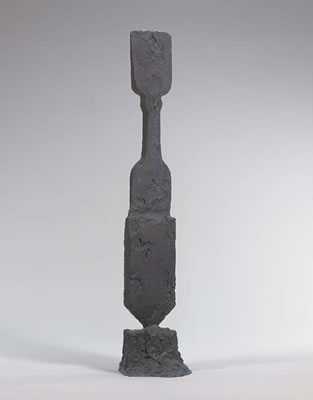 "Beverly Pepper, Sculptor of Monumental Lightness, Dies at 97: An American artist who long worked in Italy, she created towering forms whose evanescence belied their giant scale." Online Obituary, The New York Times, By Margalit Fox, Feb. 5, 2020
Beverly Pepper, an acclaimed American sculptor whose work was suffused with a quicksilver lightness that belied its gargantuan scale, died on Wednesday at her home in Todi, Italy. She was 97.
Her daughter, the poet Jorie Graham, confirmed the death.
After beginning her artistic life as a painter, Ms. Pepper was known from the 1960s on as a sculptor of towering forms of iron, steel, earth and stone, often displayed outdoors.
Her art is in the collections of the Metropolitan Museum of Art in New York, the Brooklyn Museum, the Museum of Fine Arts in Boston, the Hirshhorn Museum in Washington, the Barcelona Museum of Contemporary Art and elsewhere. It also graces public spaces throughout the world.
Ms. Pepper, who had lived and worked principally in Italy since the 1950s, “today is one of the most serious and disciplined American artists of her generation,” the art critic Robert Hughes wrote in Time magazine in 1975.
At times the mirroring was literal. In the 1960s and later, Ms. Pepper was known for creating immense geometric pieces of polished steel with enameled interior surfaces. One was her emblematic 1967 sculpture Zig-Zag, comprising three square frames conjoined at angles; it functions as a many-planed reflective surface, variously revealing viewer and surrounding
Among her best-known outdoor installations are Manhattan Sentinels, a group of four cast-iron columns in front of 26 Federal Plaza in Lower Manhattan; Sol i Ombra Park in Barcelona, which features undulating tiled pyramids in a landscaped setting; and The Todi Columns, four steel uprights first erected in 1979 and reproduced and reinstalled in 2019 in the Piazza del Popolo in Todi, the Umbrian town where she had long made her home.
For structures that could rise to more than 30 feet and whose weight was measured in tons, Ms. Pepper’s sculptures possessed an unexpected ethereal quality.
“The logic of solid forms is everywhere contradicted by the logic of reflection,” The Christian Science Monitor wrote of her work in 1969.
She created each piece, she often said, with few preconceptions about its meaning, preferring to have interpretation arise as the viewer confronted it.
Her mirrored steel sculptures, for instance, were meant to set off a shifting contrapuntal duet between the piece and the reflected observer. A third contrapuntal part was played by the sculpture’s interaction with the land from which it arose.
Such works, Ms. Pepper said, “relate to the mystery of the unseen inside of things.”
Perhaps none of her monumental work, and none of its mystery, would have arisen at all, had it not been for an incident more than 50 years ago, when, drawing on her inborn Brooklyn moxie, she lied about being able to weld.
The daughter of Irwin and Beatrice (Hornstein) Stoll, Beverly Stoll was born in Brooklyn on Dec. 20, 1922, and grew up in the Flatbush neighborhood there. Her father sold carpet and linoleum and later fur coats; her mother took in laundry and was an activist for the N.A.A.C.P.
Beverly wanted to make art from the time she was a child. After graduating from James Madison High School in Brooklyn, she entered the Pratt Institute, in the same borough, where she studied industrial and advertising design.
Already fascinated with construction, she tried to enroll in an engineering course there but was denied: Engineering, she was told, was no fit subject for a woman.
After earning a bachelor’s degree from Pratt, she worked, miserably, as an art director for New York advertising agencies. She took night classes at Brooklyn College, studying art theory with the painter Gyorgy Kepes.
In the late 1940s, after an early marriage, to Lawrence Gussin, had ended in divorce, and unable to endure advertising any longer, she decamped to Europe.
In Paris, she studied cooking at Le Cordon Bleu and painting in the ateliers of André Lhote and Fernand Léger. Her arrival in Paris “was an amazing experience,” she said in an interview with The New York Times magazine in 2019. “I felt like Eve — I had just discovered that I was naked.” She would make her career as a painter for the next decade.
She married Curtis Bill Pepper, a journalist, in 1949, and in the early 1950s settled with him in Rome, where he became Newsweek’s Mediterranean bureau chief. In Rome, the couple’s luminous social circle included Gore Vidal and Federico Fellini.
Ms. Pepper’s early paintings were largely in the social realist vein. One lauded work, inspired by her immigrant Jewish grandparents and hung in the 1953 Rome exhibition, portrayed an elderly man and woman eating from the same dish. Yet she came to find the medium unfulfilling.
“Once, as a painter, I tried to portray social problems,” she told Sculpture magazine in 2013. “It was a failure.”
In 1960, visiting Angkor Wat, the vast temple complex in Cambodia, Ms. Pepper became enthralled by the possibilities of monumental sculpture. Her earliest pieces were carved out of fallen trees from her Rome garden.
Not long after, she was asked to take part in the Festival of Two Worlds, to be held in Spoleto, Italy, in 1962. The festival would include an exhibition of work by major sculptors, among them Mr. Smith, Henry Moore and Alexander Calder.
There was one condition: She had to know how to weld so that she could fabricate work with the other artists in a participating Italian steel plant.
Ms. Pepper had never welded in her life.
“I was terrified,” she told The Sunday Telegraph. “But one thing I learned growing up in Brooklyn is that if you’re offered an opportunity, take it. You don’t have to be qualified. You just have to have the chutzpah to face all the possible downfalls.”
She took an apprenticeship in an Italian metal foundry and learned to weld.
Il Dono di Icaro (“The Gift of Icarus”) — an iron-and-steel piece comprising a slender standard crowned by a horizontal band of airy, abstract scrollwork — was entered in the exhibition, and it made her reputation. It stands outdoors in Spoleto to this day.
In the early 1970s, Ms. Pepper and her husband moved to Umbria, where they bought and restored a derelict 14th-century castle near Todi, a medieval hill town. The land, the architecture and the stillness, she said, helped make her work possible, as did the hangar-like studio, staffed with local workmen, that she was able to erect nearby.
“I am committed to permanence in my work as part of defying the violent world of alienation and threat,” she told The Los Angeles Times in 1976. “I need the sense of permanence in my life — and Umbria has that quality of history fused into the future.”
Over the coming decades she divided her time between Italy and a home and studio in the TriBeCa neighborhood of Manhattan. She made work in factories on both sides of the Atlantic, including the Steel and Alloy Tank Company in Newark and the United States Steel Plant in Conshohocken, Pa., just northwest of Philadelphia.
Her art from these years also includes Alpha, an outdoor sculpture of orange-painted steel encompassing sharply angled, interleaved tentlike forms, displayed at the Laumeier Sculpture Park in St. Louis. She also made small sculptures designed for the tabletop.
“You have to listen to the materials,” she told T magazine. “Bronze is very controlled; metal — anything you can bend to your will — you have to figure out how to make warmth come to it. Each material has its own kind of aliveness.”
Aging but Still Working
Some critics dismissed Ms. Pepper’s art as derivative, comparing her large geometric pieces to those of Mr. Smith, a close friend, and her later columnar sculptures to the work of Brancusi.
But most praised her spatial daring, among them Mr. Hughes, who in his 1975 article described Alpha as “arguably one of the most successful pieces of monumental sculpture produced by an American in the past decade.”
He added: “No photograph can convey the peculiar intricacy of space that it develops from what seems a simple formula of two skewed triangular prisms, one inside the other.”
Ms. Pepper’s husband died in 2014. In addition to her daughter, Ms. Graham, who won the 1996 Pulitzer Prize in poetry, she is survived by a son, John Randolph Pepper, an actor, director and photographer; three grandchildren; and a great-granddaughter.
Among Ms. Pepper’s many laurels was a Lifetime Achievement Award from the International Sculpture Center.
She also wrote several cookbooks, rooted both in her Cordon Bleu training and in the perennial insolvency that is the artist’s lot. (“She figured out that to test recipes,” the publisher “would have to pay for the food for about a year,” Ms. Graham said in an interview for this obituary in 2017.)
They include The Glamour Magazine After Five Cookbook (1952); See Rome and Eat (1960), with John Hobart; and The Myra Breckinridge Cookbook (1970), written with Mr. Vidal’s companion, Howard Austen, and inspired by Mr. Vidal’s salacious satirical novel of 1968.
Ms. Pepper continued making sculpture well into old age, including immense curvilinear forms of rust-colored Cor-Ten, though she left the actual fabrication to younger assistants.
Early last year, the Kayne Griffin Corcoran gallery in Los Angeles featured a retrospective of Ms. Pepper’s smaller-scale early work, and an exhibition of more recent Cor-Ten works opened at Marlborough’s downtown New York gallery. In September, the Beverly Pepper Sculpture Park opened in Todi, featuring works donated by the artist.
She also completed construction of a new, sculptural amphitheater for the city of L’Aquila, in the Abruzzo region of Italy, which was devastated by an earthquake in 2009.
It was precisely this kind of work, she told The Sunday Telegraph in 2014, that she felt she had been born to do.
“Other women want diamonds and fur coats,” Ms. Pepper said. “I just want to live in a factory.”Biography from Leslie Sacks Fine Art
Beverly Pepper was born in Brooklyn, New York in 1922. She studied advertising design, industrial design and photography at the Pratt Institute, New York. Pepper also attended classes in painting and art theory at the Art Students League, New York and the Académie de la Grande Chaumière, Paris.
In the 1960s, Pepper turned from painting to sculpture and her work began receiving serious international attention. She began carving in wood, using power tools instead of a hand chisel, before moving into the medium of steel.
In the 1970s, Pepper started experimenting with what she called "earthbound sculptures," creating site-specific pieces that were physically encompassed by the earth. The artist has eventually come to be known for her large-scale, powerful land art pieces.
Beverly Pepper's work can be found in major international museum collections, including the Metropolitan Museum of Art, New York; Whitney Museum of American Art, New York; the Hirshhorn Museum and Sculpture Garden, Washington, D.C.; the Smithsonian Institute, Washington, D.C.; Nasher Sculpture Center, Dallas, Texas; Walker Art Center, Minneapolis, Minnesota; Centre George Pompidou, Museu d'Art Contemporari de Barcelona, Barcelona; and the Palazzo degli Uffizi, Florence.Biography from Auctionata, Inc. (CLOSED)
Beverly Pepper (b.1922) is an influential outdoor sculptor and land artist working in wood, polished stainless, and Cor-ten steel. In parallel with artists such as Richard Serra, Pepper furthered the exploitation of industrial manufacturing techniques by contemporary artists from her studio in Umbria, Italy.
In 1991 she was the subject of a solo exhibition at The Metropolitan Museum of Art, and in 2003 she was awarded the Alexander Calder Prize for Sculpture.Biography from Rago Arts and Auction Center
This sculpture by Beverly Pepper was purchased in New York in the late 1960s by Marie Stokes Jemison, a Birmingham-based patron of the arts. Jemison lived in an award-winning modernist home designed by architect Fritz Woehle where the work remained until now. This is the first time this sculpture has come to market since it was purchased over fifty years ago.