Page loaded successfully. Showing biography for Billy Al Bengston.
Billy Al Bengston BIOGRAPHY
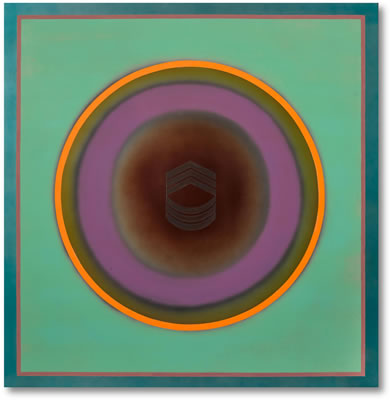
1934 Dodge City, Kansas - 2022 Venice, Califiornia. Known for: Abstraction, pop imagery painting-chevrons.
"Billy Al Bengston, Painter Who Channeled California Cool, Dies at 88," Obituary, The New York Times, by Alex Williams, October 20, 2022. A former motorcycle racer and stuntman, he helped put Los... Read full biography
"Billy Al Bengston, Painter Who Channeled California Cool, Dies at 88," Obituary, The New York Times, by Alex Williams, October 20, 2022. A former motorcycle racer and stuntman, he helped put Los Angeles on the art world map with paintings inspired by the West Coast’s surf and surf culture of... Read full biography
"Billy Al Bengston, Painter Who Channeled California Cool, Dies at 88," Obituary, The New York Times, by Alex Williams, October 20, 2022. A former motorcycle racer and stuntman, he helped put Los Angeles on the art world map with paintings inspired by the West Coast’s surf and surf culture of mid-century Los Angeles, and was part of a 1960s movement, known as L.A. Cool School, that helped transform the city from an art-world afterthought into a hub of contemporary art, died on Oct. 8 at his... Read full biography
"Billy Al Bengston, Painter Who Channeled California Cool, Dies at 88," Obituary, The New York Times, by Alex Williams, October 20, 2022. A former motorcycle racer and stuntman, he helped put Los Angeles on the art world map with paintings inspired by the West Coast’s surf and surf culture of mid-century Los Angeles, and was part of a 1960s movement, known as L.A. Cool School, that helped transform the city from an art-world afterthought into a hub of contemporary art, died on Oct. 8 at his home in Venice, Calif. He was 88. His wife, Wendy Al, confirmed the death, of unspecified cause. A surfer, a motorcycle racer and briefly a Hollywood stuntman, Mr. Bengston found prominence in the late 1950s as part of a new wave of Southern California... Read full biography
"Billy Al Bengston, Painter Who Channeled California Cool, Dies at 88," Obituary, The New York Times, by Alex Williams, October 20, 2022. A former motorcycle racer and stuntman, he helped put Los Angeles on the art world map with paintings inspired by the West Coast’s surf and surf culture of mid-century Los Angeles, and was part of a 1960s movement, known as L.A. Cool School, that helped transform the city from an art-world afterthought into a hub of contemporary art, died on Oct. 8 at his home in Venice, Calif. He was 88. His wife, Wendy Al, confirmed the death, of unspecified cause. A surfer, a motorcycle racer and briefly a Hollywood stuntman, Mr. Bengston found prominence in the late 1950s as part of a new wave of Southern California artists aligned with the pioneering Ferus Gallery in West Hollywood, founded by Walter Hopps and the artist Ed Kienholz.... Read full biography
Artist Biography
Biography page for Billy Al Bengston ((1934 - 2022)), known for Abstraction, pop imagery painting-chevrons. Showing 4 biographical entries and 0 sample artworks.
Billy Al Bengston - Artist Info
About Billy Al Bengston
Biography from the Archives of askART
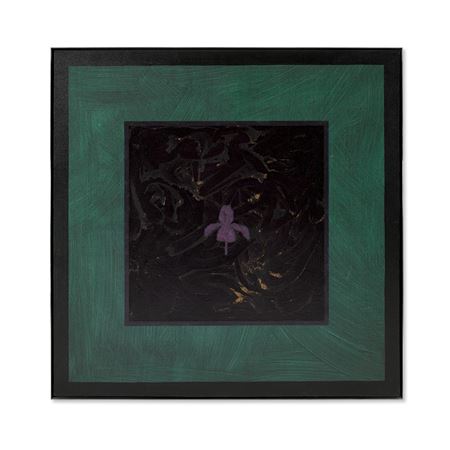 Family moved to California in 1948. Studied at Los Angeles City College, Los Angeles State College, California College of Arts and Crafts and Los Angeles County Art Institute. He spent six months in Europe in 1958-59. He taught at Chouinard Art Institute in 1961, at the University of California at Los Angeles from 1962-63, at the University of Oklahoma in 1967, and at the University of Colorado in 1969. Bengston was part of the 1960s California Pop-Art movement, and pioneered the use of industrial and spray paint techniques in his fine art painting, creating dazzling optical effects. In 1996, he joined with Westfall Interior Systems to supply art as part of a total interior package.
Exhibitions: Ferus Gallery, Los Angeles, 1958, 1960, 1961, 1962, 1963; Martha Jackson Gallery, New York, 1962; Oakland Art Museum, 1963; Sao Paulo Bienal, 1965; Seattle Art Museum, 1966; Los Angeles County Museum of Art, 1968; Pasadena Art Museum, 1969; Contemporary Arts Museum, Houston, 1973, 1988; Corcoran Gallery of Art, 1981; and more.
Awards: National Council of Arts, 1967; Tamarind Fellowship, 1968, 1982, 1987; Guggenheim Fellowship, 1975.
Collections: Phoenix Art Museum; Whitney Museum of American Art; Guggenheim Museum; Museum of Modern Art; Los Angeles County Museum of Art; Contemporary Arts Museum, Houston; Art Gallery of Ontario; San Francisco Museum of Modern Art; and more.Biography from the Archives of askART
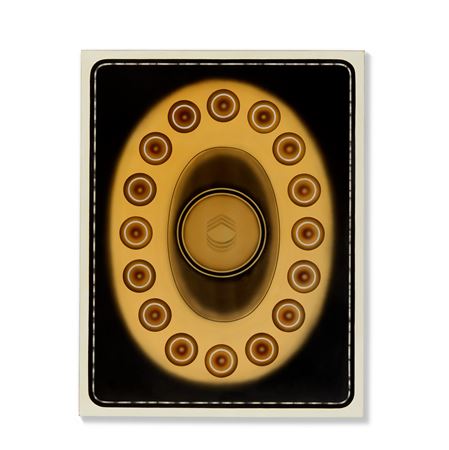 "Billy Al Bengston, Painter Who Channeled California Cool, Dies at 88," Obituary, The New York Times, by Alex Williams, October 20, 2022
A former motorcycle racer and stuntman, he helped put Los Angeles on the art world map with paintings inspired by the West Coast’s surf and surf culture of mid-century Los Angeles, and was part of a 1960s movement, known as L.A. Cool School, that helped transform the city from an art-world afterthought into a hub of contemporary art, died on Oct. 8 at his home in Venice, Calif. He was 88.
His wife, Wendy Al, confirmed the death, of unspecified cause.
A surfer, a motorcycle racer and briefly a Hollywood stuntman, Mr. Bengston found prominence in the late 1950s as part of a new wave of Southern California artists aligned with the pioneering Ferus Gallery in West Hollywood, founded by Walter Hopps and the artist Ed Kienholz.
Mr. Bengston, with his flamboyant attire and deadpan wit, was a central figure — along with the likes of Ed Ruscha, Kenneth Price, Robert Irwin and Larry Bell — in a swashbuckling art scene that drew international attention and became a cradle of 1960s counterculture in a city then dominated by commerce, Hollywood and conservative politics.
Mr. Ruscha once called him “a sort of Pied Piper” of that scene. “One moment he would be very serious, another moment he would be like a cartoon, a clown,” he said.
Mr. Bengston was known for his abstract, heavily lacquered paintings, sometimes on industrial surfaces like Masonite or dented aluminum sheets. Elegantly minimalist, they were also buoyant with the airiness and vibrant colors of the West. His early paintings, emerging in the Pop Art era, often featured images of motorcycles, sergeant-stripe chevrons and hearts.
During that period he aligned himself with the so-called Finish Fetish approach, adopting new resins, paints and application techniques — like spray painting, borrowed from the automotive industry — to create gleaming works that were ebullient reflections of the petroleum-fueled consumer culture that Southern California had come to epitomize.
“My soft stuff is a lot more serious than it looks, and my serious stuff is a lot more whimsical,” Mr. Bengston was quoted as saying in The Los Angeles Times before a retrospective of his work at the Los Angeles County Museum of Art. “It takes nerve to be lighthearted. You know you’re going to get dinged for it.”
Even so, Mr. Bengston, a flinty contrarian with the soul of a prankster, never allowed himself to be pinned down by any particular style or movement. Forever experimenting with materials and techniques, he had an always evolving style, reflecting a changing array of influences, both artistic and environmental. He produced memorable watercolors in the 1970s after trips to Puerto Escondido, Mexico. After traveling to Oahu, Hawaii, to participate in a grueling rough-water swim, he began producing paintings reflecting the brilliant hues of the islands as well as the local flora and fauna.
“His work more frequently challenges taste than confirms it, and unequivocally declares the open-ended nature of the creative process,” Karen Tsujimoto, an art curator, wrote in a 1988 appraisal of his work.
It also challenged the perception that Los Angeles had nothing more to offer culturally than summer blockbusters. “We wanted to be the best; that was a necessity,” Mr. Bengston was quoted as saying in a 2020 interview with Artworks Magazine, in reference to his Los Angeles art crew. “None of us were going to paint like de Kooning — we just weren’t,” he said. “You don’t punch with the heavyweight champion. So you invent the new fight.”
Billy Al Bengston was born on June 7, 1934, in Dodge City, Kan., during the Dust Bowl years. He was the younger of two sons of Raymond and Sylvia (Elland) Bengston. His mother was a trained opera singer who sang in church choirs. His father was a former professional football player who owned a dry cleaning shop.
As a youth, Billy bounced between Kansas and California as his parents chased job opportunities. “It’s very hard to fit in looking like you do in Kansas if you’re in California, and vice versa,” he recalled in a 2010 video interview. “And both of them at that time liked to beat you up.”
Mr. Bengston, a muscular athlete like his father, was no pushover. While enrolled at Manual Arts High School in Los Angeles, he became an avid surfer and gymnast. He also developed a love of ceramics. The school had a thriving arts curriculum, including nude life drawing classes, the thought of which excited him. “I didn’t know that they were all going to look like mudslides,” he said.
After graduation, Mr. Bengston, a bon vivant who loved fast bikes and women, friends said, took a halfhearted stab at higher education with brief stops at Los Angeles City College and Los Angeles County Art Institute (now the Otis College of Art and Design), where he studied ceramics under Peter Voulkos, a master of that art.
Wearied by the craft overtones of the medium, Mr. Bengston shifted his sights to painting. He grew fascinated by Abstract Expressionists like Franz Kline and Willem de Kooning by reading It Is, an influential New York art publication, the curator Ms. Tsujimoto wrote.
His own work, however, was less austere, invoking images from the natural world, like birds in flight. He was 24 when he had his first solo exhibition, in 1958, at the Ferus Gallery, drawing praise from Art News. His reputation spread nationally, particularly after a watershed solo show at the Martha Jackson Gallery in New York in 1962.
A lifelong peacock who thought nothing of attending a black-tie art function wearing orange Hawaiian-print pants and a vintage couture jacket with pocket square (his high school nickname was “Rainbow”), Mr. Bengston knew how to make a statement with his gallery shows as well. For a 10-year retrospective of his work at the Los Angeles County Museum of Art in 1968, he enlisted Frank Gehry to design a corrugated entrance to the exhibition and commissioned a life-size wax figure of himself from the Hollywood Wax Museum.
For the 2011 Venice Biennale, the New York gallerist Tim Nye asked Mr. Bengston to promote an exhibition of Los Angeles artists called “Venice in Venice.” Mr. Bengston drew on his motor sports roots in transforming two traditional black Venetian gondolas into racing bikes of sorts, with pulse-quickening paint jobs in the signature red and yellow of Ducati motorcycles.
“He loved the irony of the fact that Ducatis are synonymous with speed and gondolas are the slowest means of transportation,” Mr. Nye said in a phone interview.
For an exhibition of his own work, Mr. Nye said, Mr. Bengston insisted that it be lit only by candlelight, which rendered the paintings barely visible but highlighted the sheen and textures of his 1960s Dentos series, which were painted with a high-gloss finish on sheets of aluminum that he had whacked with a ball-peen hammer. “He was an enigma wrapped inside a paradox,” Mr. Nye said.
In addition to his wife, Wendy Al — born Kathryn Wendy Yuri Nakayama, she adopted the last name Al as a whimsical show of unity after they married in 1995 — Mr. Bengston is survived by a daughter, Blue T.I.C.A. Bengston (the initials represent the names of close friends), from a brief marriage in the 1990s; and a granddaughter.
His wife said that Mr. Bengston had lately been experiencing mild cognitive impairment, an early stage of dementia, but that he had remained strong. “I gave him voice lessons for an early Christmas present, and he was crooning the day before he died,” she said. “The day before that, he was at his Pilates class.”
On a Saturday night marked by a brilliant moon, Ms. Al said, she and her husband were snuggling in bed watching television when he turned to her and said, “Something’s not good; this doesn’t feel right.” She moved to rub his back, but shortly afterward he said, “Wendy, this is something different.” And he was gone.Biography from the Archives of askART
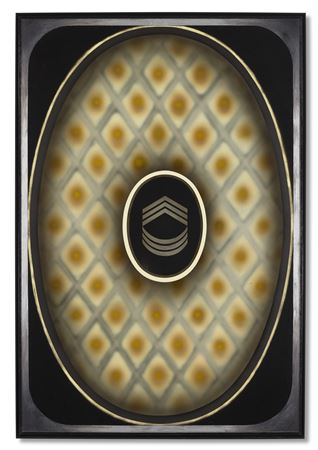 Born in Dodge City, Kansas, Billy Al Bengston became a part of the 1960s California Pop-Art movement and pioneered the use of industrial and spray paint techniques in his fine art painting. He combined this method with symmetrical formal images in centralized composition. He became known for work that created stunning, dazzling optical effects.
Bengston moved to California in 1948 with his family and associated with sculptor Kenneth Price, painter Richard Diebenkorn, and ceramist Peter Voulkos. He attended several art schools in northern and southern California for relatively brief periods of time. This was a period in California artistic history where the artists were forging their own path, seemingly oblivious to any thing going on in New York. Few museums welcomed their work, and so they banded together and did their own exhibitions.
Japanese artist Sabro Hasegawa taught Bengston an intuitive approach to painting; Diebenkorn taught him how to work with paint, and Peter Voulkos excited him with the energy of ceramics. Bengston later rejected ceramics in 1957 because of what he perceived as lack of money-making potential.
He spent six months in Europe in 1958 and 1959 and was strongly influenced by several artists exhibited there at the time including Jacopo Tintoretto's composition from the Renaissance era and the centralized images and flat surfaces of Jasper Johns.
Flying home from Europe, he saw in a magazine a chevron or sargeant-stripe motif, which he incorporated from 1960 into his paintings as a personal insignia instead of a signature. Previously he had used hearts.
He had his first one-man show at age 24 at the Ferus Gallery, a mecca for young artists in Los Angeles and won instant acclaim, and he first showed his chevron paintings in 1962 at the Martha Jackson Gallery in New York. He is a gregarious, witty man who loved his life style as an artist and combined the hard work of that profession with athletics, travel, motorcycle riding and scuba diving.
He was also an early environmentalist with a particular interest in the ocean and sunlight, images that he incorporated into many of his paintings. His titles often reflected his wit and sense of whimsy. He arbitrarily assigned titles after completing the work, such as his Dodge City, in the Phoenix Art Museum collection, which is one of his chevron paintings and bears little relationship to his birthplace.
Source:
Docent Files, The Phoenix Art MuseumBiography from the Archives of askART
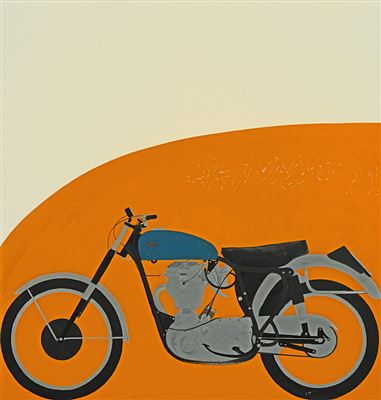 BENGSTON, BILLY AL
Billy Al Bengston was born on June 7, 1934 in Dodge City, Kansas. He studied at Los Angeles City College, Los Angeles State College, California College of Arts and Crafts and Los Angeles County Art Institute. He taught at Chouinard Art Institute 1961, University of California at Los Angeles in 1962-63, University of Oklahoma 1967, University of Colorado 1967. He won an award from National Council of Arts 1967 and a Tamarind Fellowship. In 1969 he had a retrospective circulating from the Los Angeles County Museum of Art.
Many of his large-scaled works depict lush foliage, blue lagoons, brilliant sunsets and yellow moonrises, etc.; the paintings are also unabashadly funny, visual puns abound. A confirmed modernist and an admirer of Matisse, Bengston believes his work is predominantly about line and color. He has worked in many exotic places, in California, Mexico and Hawaii. He seems to be able to do it all: paint full-time, maintain a strenuous physical pace, and find constant new outlets for his whimsical, forthright ideas.
Sources include:
Oxford Companion to Twentieth Century Art, edited by Harold Osborne
Fredericka Hunter in Architectural Digest
Contemporary Artists, 2nd Edition
Compiled and written by Jean Ershler Schatz, artist and researcher from Laguna Woods, California.