Page loaded successfully. Showing biography for Bridget Riley.
Bridget Riley BIOGRAPHY
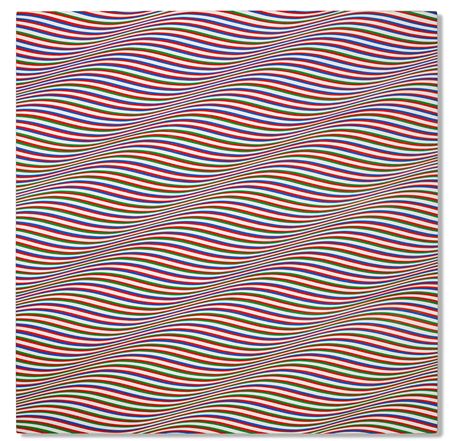
Born 1931 London, England. Known for: Op-art, non-objective, pure abstraction.
"Bridget Riley, Through Her Own Eyes, Art & Design Section", The New York Times, March 17, 2020, by Karen Rosenberg. Britain’s pre-eminent abstract painter looks anew at her career, from her... Read full biography
"Bridget Riley, Through Her Own Eyes, Art & Design Section", The New York Times, March 17, 2020, by Karen Rosenberg. Britain’s pre-eminent abstract painter looks anew at her career, from her black-and-white 1960s Op Art to her contemporary explorations with color. Bridget Riley, who has been... Read full biography
"Bridget Riley, Through Her Own Eyes, Art & Design Section", The New York Times, March 17, 2020, by Karen Rosenberg. Britain’s pre-eminent abstract painter looks anew at her career, from her black-and-white 1960s Op Art to her contemporary explorations with color. Bridget Riley, who has been celebrated in Britain as a national treasure, has gone back to her own beginnings as an artist for a show at the Yale Center for British Art in Connecticut:. Bridget Riley: Perceptual Abstraction: Through... Read full biography
"Bridget Riley, Through Her Own Eyes, Art & Design Section", The New York Times, March 17, 2020, by Karen Rosenberg. Britain’s pre-eminent abstract painter looks anew at her career, from her black-and-white 1960s Op Art to her contemporary explorations with color. Bridget Riley, who has been celebrated in Britain as a national treasure, has gone back to her own beginnings as an artist for a show at the Yale Center for British Art in Connecticut:. Bridget Riley: Perceptual Abstraction: Through July 24 at the Yale Center for British Art, 1080 Chapel Street, New Haven, Conn.; . “I’m always interested in the beginnings of other artists’ work,” Bridget Riley says. “How they start is quite important.”. The abstract painter, who turns 91 in... Read full biography
"Bridget Riley, Through Her Own Eyes, Art & Design Section", The New York Times, March 17, 2020, by Karen Rosenberg. Britain’s pre-eminent abstract painter looks anew at her career, from her black-and-white 1960s Op Art to her contemporary explorations with color. Bridget Riley, who has been celebrated in Britain as a national treasure, has gone back to her own beginnings as an artist for a show at the Yale Center for British Art in Connecticut:. Bridget Riley: Perceptual Abstraction: Through July 24 at the Yale Center for British Art, 1080 Chapel Street, New Haven, Conn.; . “I’m always interested in the beginnings of other artists’ work,” Bridget Riley says. “How they start is quite important.”. The abstract painter, who turns 91 in April, has gone back to her own beginnings for an exhibition at the Yale Center for British Art in New Haven, Conn... Read full biography
Artist Biography
Biography page for Bridget Riley ((Born 1931)), known for Op-art, non-objective, pure abstraction. Showing 2 biographical entries and 0 sample artworks.
Bridget Riley - Artist Info
About Bridget Riley
Biography from the Archives of askART
 "Bridget Riley, Through Her Own Eyes, Art & Design Section", The New York Times, March 17, 2020, by Karen Rosenberg
Britain’s pre-eminent abstract painter looks anew at her career, from her black-and-white 1960s Op Art to her contemporary explorations with color.
Bridget Riley, who has been celebrated in Britain as a national treasure, has gone back to her own beginnings as an artist for a show at the Yale Center for British Art in Connecticut:
Bridget Riley: Perceptual Abstraction: Through July 24 at the Yale Center for British Art, 1080 Chapel Street, New Haven, Conn.;
“I’m always interested in the beginnings of other artists’ work,” Bridget Riley says. “How they start is quite important.”
The abstract painter, who turns 91 in April, has gone back to her own beginnings for an exhibition at the Yale Center for British Art in New Haven, Conn. — the first American museum survey in more than 20 years of an artist who has been celebrated in Britain as a national treasure. (Reviewing her recent retrospective at the Hayward Gallery in London, the critic Adrian Searle called her “as ubiquitous to the history of British art as Henry Moore, though with better reason.”)
Inevitably for Riley, looking at her own early career means revisiting the 1965 show that was both her breakout moment and her albatross: “The Responsive Eye,” an instantly popular group exhibition at the Museum of Modern Art that is credited with ushering in the retina-teasing movement of Op Art but blamed for the fashion and design trends that quickly followed.
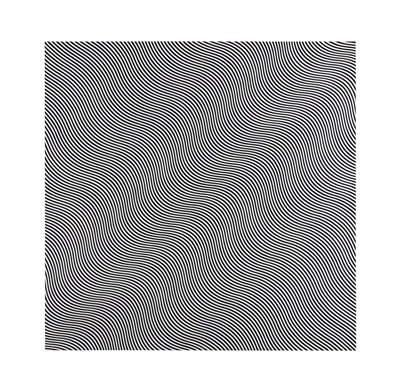
Art critics who had enthused about Abstract Expressionism found Op too cold and clinical; other viewers saw the movement as a sort of groovy application of science. Riley and her 1964 painting Current,” with its black-and-white wavy lines that seem to vibrate in the viewer’s visual field, were at the center of it all; the work was acquired by Philip Johnson for MoMA and used to promote the exhibition.
Riley felt misunderstood to the point that she was moved to write an essay explaining her intentions — “Perception Is the Medium” — in the magazine ARTnews. “‘The Responsive Eye’ was a serious exhibition, but its qualities were obscured by an explosion of commercialism, band-wagoning and hysterical sensationalism,” she wrote. “Most people were so busy taking sides, and arguing about what had or had not happened, that they could no longer see what was actually on the wall.”
The Yale show, “Bridget Riley: Perceptual Abstraction,” may be seen as another corrective to those misapprehensions. Its title refers to a discussion Riley had with the curator of “The Responsive Eye,” William C. Seitz, while he was visiting her London studio in advance of the exhibition. They talked about perception in art history, going as far back as Piero della Francesca. (Riley had an image of his Madonna del Parto pinned to her studio wall, along with a reproduction of Georges Seurat’s “A Sunday Afternoon on the Island of La Grande Jatte.”
“Seitz had a very very good idea which would have saved an awful lot of agony,” Riley recalled during a phone conversation from London, where she is based. “He wanted to show perception in figurative painting and perception in abstract painting.” Somewhere in the process of creating The Responsive Eye, this essential art-historical background to the contemporary artworks’ optical machinations was lost. “I didn’t get a chance with ‘The Responsive Eye’ to actually show my beginnings, so to speak.”
The Yale Center’s director, Courtney J. Martin, who organized the exhibition and invited Riley to select all of the work in it, encouraged the artist to reassess her career from its beginning and create a new context for her early work. “There’s clearly space between what “The Responsive Eye was immediately, what it became art historically, and where she saw that idea of perception going,” Martin said.
Covering two floors of the Yale Center, the new show makes it clear that the early black-and-white Op work with which Riley is still strongly associated — particularly in the United States — was really a starting point for a deep, historically grounded engagement with color. Her progression from one palette to the other has been quite deliberate, and, in Riley’s telling, retraces the steps of her rigorous art school training. “Where you once had a figure standing on a white sheet of paper, you are forced in tonal studies to include the environment, the entire visual scene. It helps you tremendously to relate to color,” she said. “Making abstract paintings, I had to go through the same stages.”
In the works from her transitional gray period, like Deny 1 (1966), floating ovals arranged in a grid pattern appear to shimmer and recede as the eye tries to reconcile warm and cool grays. “This deep exploration of black and white gives way to the tonality of gray — years where she’s just playing with gray. And then the color emerges,” Martin said. “But the color emerges only when she’s exhausted the possibilities with gray.”
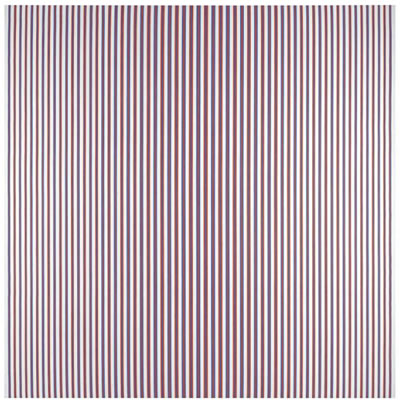
When color does at last emerge, new forms accompany it. The show’s second floor opens with works from another impressive debut, just a few years after The Responsive Eye: Riley’s representation of Britain at the 1968 Venice Biennale, where she was awarded the international prize for painting for her taut, vibrant arrangements of colored stripes. She was the first woman to receive that accolade.
The simplicity of the stripes allowed her to focus intently on color relationships — testing theories of complementary colors against practice, as in Chant 1 and Chant 2, where she learned that “theory is no use, because turquoise should be the opposite of red. … But when I mixed red for Chant 1, in no way could the turquoise stand up to the red at all. So I put it aside and chose a strong blue.”
Later she applied similar discipline to motifs of slanted bars and arabesques — forms that nod to Seurat’s diagonals and Matisse’s cutouts. Seurat is her lodestar, the artist whose clarity of purpose and studies of optical sensation have informed almost everything she does. In his work, she says approvingly, “there is nothing ever casual.”
In conversation and in her prolific writings (including an essay reflecting on “The Responsive Eye” for the exhibition’s digital catalog), Riley roams freely throughout the history of Western painting, making astute, artist-to-artist observations. Often, her analysis is multilayered: You can sense her looking at someone who is, in turn, processing the work of a predecessor. Answering a question about her use of color, she digressed into an anecdote about Seurat and Monet: “When Seurat was asked what he thought of Monet, he said one word: ‘Intuition.’ I think he was absolutely right and it was Monet’s great strength.”
Within the exhibition at Yale, there is a physical example of one of these art-historical asides: a pair of small works by John Constable and Eugène Delacroix, chosen by Riley from the Yale Center’s collection. The Constable is an oil sketch for his famous Suffolk landscape The Hay Wain, the Delacroix a watercolor of a mountain path in the Pyrenees. Neither one on its own would seem to have much to do with Riley’s art, but together they tell a story of one artist shaping another’s whole approach to nature and color. Delacroix never met Constable, but he saw The Hay Wain” at the 1824 Paris Salon and was changed by it: The watercolor Riley has chosen dates from after this encounter and appears, she writes, “like a glass of fresh water after the heady wine of the Romantic Movement.”
As the dates on some of her paintings imply, Riley works through conversations not just with other artists but also with herself — returning to a canvas years, sometimes decades, later, as she did with Vapour 3 (2009/1970) and Lilac Painting 5 (2008/1993). “It’s very important to establish a dialogue with your own work,” she said. “My eyesight, my understanding, changes all the time. No two days are alike. I think all painters have experienced that — you can look at something as though you’ve never seen it before.”Biography from the Archives of askART
 Bridget Riley was born on April 25, 1931 in London, England. She divides her time between a house in London's Holland Park, a studio in Cornwall and a second studio in the Vaucluse district of Southern France, not far from the ruins of the Marquis de Sade's castle at La Coste. She is a second-generation Londoner; one of her grandfathers worked with Edison on the invention of the light bulb and she had a great-uncle who was a founding member of the Socialist Fabian Society.
Riley received a sporadic wartime education in Cornwall. She studied at St. Stephen's College in Taplow from 1944 to 1946 and concluded her secondary studies from 1946-48 at Cheltenham Ladies College where she was allowed to pursue exclusively her interest in art. Following that, she studied at Goldsmith's College of Art in London and the Painting School of the Royal College of Art. She worked briefly in advertising, taught art to children at the Convent of the Sacred Heart in London from 1951 through 1958 and began to exhibit in group shows.
In 1955 Riley left the Royal College to look after her father who was recovering from an auto accident. It was a period of intense personal crisis for her, marked by artistic doubts and misgivings; it led to a mental and physical breakdown. She returned to Cornwall to rest. At the age of twenty-seven she met Maurice de Sausmarez, a painter and teacher. She traveled at his suggestion; they were close, almost inseparable until his death in 1970.
When she first showed her work in the United States, Riley's paintings were almost synonymous with visual assault. Of all the shortest movements that agitated the art world, Op art had the briefest life. After a spurt of success in the 1960s, Riley and other Op-related artists were dismissed by American critics as emotionally shallow and intellectual lightweights. In Britain, however, she maintained her reputation as an important artist; she has moved on to work with saturated color and structure. Her work expresses her belief that repetition and restraint lead an artist to greater freedom and creativity.
Written and submitted by Jean Ershler Schatz, artist and researcher from Laguna Woods, California.
Sources include:
Robert Hughes in Time Magazine, November 16, 1970 and May 12, 1975
ARTnews, January 1987
Catalogue of the National Museum of Women in the Arts
Drawing Now by Bernice Rose, Museum of Modern Art, New York
World Artists 1950-80 by Claude Marks