Page loaded successfully. Showing biography for Bryson (Henry Bryson) Burroughs.
Bryson (Henry Bryson) Burroughs BIOGRAPHY
1869 Hyde Park, Massachusetts - 1934 New York City. Known for: Genre, idyllic figure, and marine painting, drawing.
Bryson Burroughs was born in 1869 in the Boston suburb of Hyde Park. While still young, he moved to Cincinnati, Ohio where he later took art classes at the Cincinnati Museum. In 1889, Burroughs moved... Read full biography
Bryson Burroughs was born in 1869 in the Boston suburb of Hyde Park. While still young, he moved to Cincinnati, Ohio where he later took art classes at the Cincinnati Museum. In 1889, Burroughs moved to New York City and enrolled in the Art Students League where he studied under Kenyon Cox and H.... Read full biography
Bryson Burroughs was born in 1869 in the Boston suburb of Hyde Park. While still young, he moved to Cincinnati, Ohio where he later took art classes at the Cincinnati Museum. In 1889, Burroughs moved to New York City and enrolled in the Art Students League where he studied under Kenyon Cox and H. Siddons Mowbray. After receiving a Chanler Scholarship in 1890, the artist spent the next five years in Europe where he studied at the Academie Julian and traveled extensively through France, England... Read full biography
Bryson Burroughs was born in 1869 in the Boston suburb of Hyde Park. While still young, he moved to Cincinnati, Ohio where he later took art classes at the Cincinnati Museum. In 1889, Burroughs moved to New York City and enrolled in the Art Students League where he studied under Kenyon Cox and H. Siddons Mowbray. After receiving a Chanler Scholarship in 1890, the artist spent the next five years in Europe where he studied at the Academie Julian and traveled extensively through France, England and Italy. While in Paris, Burroughs was greatly influenced by the artist Puvis de Chavannes, renowned for his murals in the Boston Public Library. There is a tremendous similarity between the works of these two artists and ". what [Burroughs]... Read full biography
Bryson Burroughs was born in 1869 in the Boston suburb of Hyde Park. While still young, he moved to Cincinnati, Ohio where he later took art classes at the Cincinnati Museum. In 1889, Burroughs moved to New York City and enrolled in the Art Students League where he studied under Kenyon Cox and H. Siddons Mowbray. After receiving a Chanler Scholarship in 1890, the artist spent the next five years in Europe where he studied at the Academie Julian and traveled extensively through France, England and Italy. While in Paris, Burroughs was greatly influenced by the artist Puvis de Chavannes, renowned for his murals in the Boston Public Library. There is a tremendous similarity between the works of these two artists and ". what [Burroughs] emulated in Puvis' style was an overall simplification of the painted surface, a reduction of modeling to eliminate chi... Read full biography
Artist Biography
Biography page for Bryson (Henry Bryson) Burroughs ((1869 - 1934)), known for Genre, idyllic figure, and marine painting, drawing. Showing 1 biographical entries and 0 sample artworks.
Bryson (Henry Bryson) Burroughs - Artist Info
About Bryson (Henry Bryson) Burroughs
Name variants
Henry Bryson Burroughs
Biography from Childs Gallery
Bryson Burroughs was born in 1869 in the Boston suburb of Hyde Park. While still young, he moved to Cincinnati, Ohio where he later took art classes at the Cincinnati Museum. In 1889, Burroughs moved to New York City and enrolled in the Art Students League where he studied under Kenyon Cox and H. Siddons Mowbray. After receiving a Chanler Scholarship in 1890, the artist spent the next five years in Europe where he studied at the Academie Julian and traveled extensively through France, England and Italy.
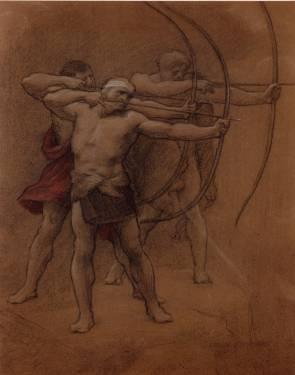
While in Paris, Burroughs was greatly influenced by the artist Puvis de Chavannes, renowned for his murals in the Boston Public Library. There is a tremendous similarity between the works of these two artists and "...what [Burroughs] emulated in Puvis' style was an overall simplification of the painted surface, a reduction of modeling to eliminate chiaroscuro, an emphasis on linear outline to delineate major
passages, a palette of lighter tonality, and a preference for emotionally subdued subjects based on religion and mythology" (Douglas Dreishoon).
In 1906, Burroughs became Assistant Curator of Paintings under Roger Fry at the Metropolitan Museum of Art, serving as chief curator from 1909-1934. Of Burroughs performance in this position, the art critic Forbes Watson commented that "...the Metropolitan Museum has had the greatest good fortune to enjoy the services of the most broadminded, intuitive, sagacious, and informed curator of his day". Freed from economic restraint, Burroughs continued to paint classical works infused with contemporary wit and relevance. This "classicism" (an obsession with narrative content, traditional pictorial perspective, and figuration) was adapted by successive generations of American painters, which included Kenneth Hayes Miller, Thomas Hart Benton, Reginald Marsh, Alexander Brook, Eugene Speicher, and Leon Kroll.
Burroughs exhibited at the Pan-American Exposition, Buffalo, 1901 (medal); Worcester, Massachusetts, 1904 (prize); St. Louis Exposition, 1904, (medal) and was an Associate Member of the National Academy. His paintings can be found in many fine museums including the British Museum, the Metropolitan Museum of Art and the Art Institute of Chicago.