Page loaded successfully. Showing biography for Byron Galvez.
Byron Galvez BIOGRAPHY
1941 Mixquiahuala, Mexico - 2009. Known for: Figurative, abstract painting, sculpture, monumental works, teaching.
Byron Gálvez (October 28, 1941 – October 27, 2009) was a Mexican artist who was primarily known for his painting but also created sculpture, including monumental works. He was born in rural Hidalgo... Read full biography
Byron Gálvez (October 28, 1941 – October 27, 2009) was a Mexican artist who was primarily known for his painting but also created sculpture, including monumental works. He was born in rural Hidalgo state, to a father who played jazz music and read literature, a rarity in 1930s rural Mexico.... Read full biography
Byron Gálvez (October 28, 1941 – October 27, 2009) was a Mexican artist who was primarily known for his painting but also created sculpture, including monumental works. He was born in rural Hidalgo state, to a father who played jazz music and read literature, a rarity in 1930s rural Mexico. However, it exposed Gálvez to culture, even though this led to an interest in visual art rather than musing or writing. He went to Mexico City to study art at both the undergraduate and graduate level, but... Read full biography
Byron Gálvez (October 28, 1941 – October 27, 2009) was a Mexican artist who was primarily known for his painting but also created sculpture, including monumental works. He was born in rural Hidalgo state, to a father who played jazz music and read literature, a rarity in 1930s rural Mexico. However, it exposed Gálvez to culture, even though this led to an interest in visual art rather than musing or writing. He went to Mexico City to study art at both the undergraduate and graduate level, but never completed his degrees, opting instead to begin career after his coursework. Before his first individual exhibition, his work was criticized by Justino Fernández, but all of the paintings were sold in advance to foreign buyers including American... Read full biography
Byron Gálvez (October 28, 1941 – October 27, 2009) was a Mexican artist who was primarily known for his painting but also created sculpture, including monumental works. He was born in rural Hidalgo state, to a father who played jazz music and read literature, a rarity in 1930s rural Mexico. However, it exposed Gálvez to culture, even though this led to an interest in visual art rather than musing or writing. He went to Mexico City to study art at both the undergraduate and graduate level, but never completed his degrees, opting instead to begin career after his coursework. Before his first individual exhibition, his work was criticized by Justino Fernández, but all of the paintings were sold in advance to foreign buyers including American actor Vincent Price, who called Gálvez a “Mexican Picasso.” Gálvez then managed to replace the forty five paintings for the exhibition in... Read full biography
Artist Biography
Biography page for Byron Galvez ((1941 - 2009)), known for Figurative, abstract painting, sculpture, monumental works, teaching. Showing 2 biographical entries and 0 sample artworks.
Byron Galvez - Artist Info
About Byron Galvez
Name variants
Byron Galves
Biography from the Archives of askART
 Byron Gálvez (October 28, 1941 – October 27, 2009) was a Mexican artist who was primarily known for his painting but also created sculpture, including monumental works. He was born in rural Hidalgo state, to a father who played jazz music and read literature, a rarity in 1930s rural Mexico. However, it exposed Gálvez to culture, even though this led to an interest in visual art rather than musing or writing.
He went to Mexico City to study art at both the undergraduate and graduate level, but never completed his degrees, opting instead to begin career after his coursework. Before his first individual exhibition, his work was criticized by Justino Fernández, but all of the paintings were sold in advance to foreign buyers including American actor Vincent Price, who called Gálvez a “Mexican Picasso.” Gálvez then managed to replace the forty five paintings for the exhibition in a week. Since then he had individual and collective exhibitions in Mexico, the United States and other parts of the world. He concentrated on painting, which he is better known for, in the 1970s and 1980s, but moved on to sculpture, including monumental works later in his career. Recognitions for Gálvez's work include membership in the Salón de la Plástica Mexicana, a retrospective at the Palacio de Bellas Artes and two books published about his life.
Gálvez was born in Mixquiahuala, Hidalgo and described his childhood as happy, and would not have changed it. His father, Roberto Gálvez, was a farmer and merchant, who was a music and literature enthusiast, a rarity is 1930s rural Mexico. His father played the violin in the town's jazz band, which had almost all classical instruments, making it similar to bands in New Orleans. They even composed new pieces. The artist was named after Lord Byron, and his brothers, Eliot, Aníbal and Dante, after his father's reading preferences
This meant that Gálvez grew up in an environment that encouraged the enjoyment of the arts. However, instead of music or literature, Gálvez stated that his earliest memories related to his attraction to art and that he always wanted to be a painter. The difficulties of farm life convinced him that he needed an education and would have to move to Mexico City in order to go to school. At age sixteen he left home for the capital to study painting at the Escuela Nacional de Artes Plásticas, not knowing what the study would entail. It was far more rigorous than he expected, with thirteen-hour school days leaving only weekends to earn money to live on.[3] He did his undergraduate studies from 1958 to 1962, then continued with the graduate courses from 1962 to 1964, specializing in painting.
He did much of his studies under teachers such as Luis Nishizawa, Fernando Castro Pacheco, Francisco Moreno Capdevila, Santos Balmori, Antonio Rodríguez Luna and Antonio Ramírez. The last teacher taught him to love his studies above all else and he submitted himself to the academic rigor. This led him to become attracted to the Cubism of Picasso, and felt that the artist has opened roads which could be taken and widened. Although he specialized in painting, his interest in sculpture was also evident at this time as he was a founding member of a metal sculpture workshop at the institution along with Armando Ortega and Baltazar Martinez.[2][5] Although he completed his coursework, he did not finish the other requirements needed for the degree, instead opting to start his career.
Gálvez married once to art dealer Eva Beloglovsky.The couple first met in 1973, but did not meet again until two years later, when Beloglovsky bought one of his paintings and sold two more through her art gallery. At first it was a working relationship, and then evolved into a romantic one. During their marriage, they worked on a number of projects together such as multi-media presentations and charity benefits. The couple remained together until Galvez's death.
Although he began and developed much of his career in Mexico City, in his later life, the artist moved back to his rural hometown. Gálvez constructed a house and studio on the edge of a ravine in which flows the Moctezuma River. The structure has glass walls positioned for maximum light and a privileged view of a local landmark, a hill called El Elefante.
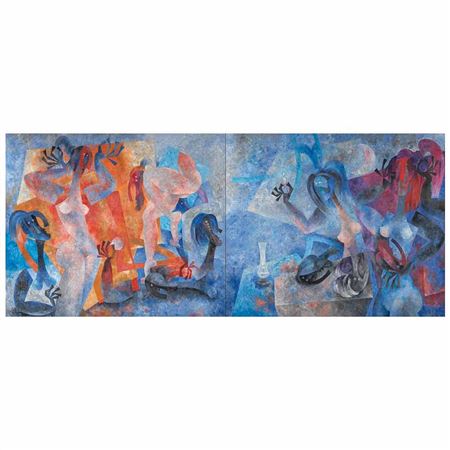
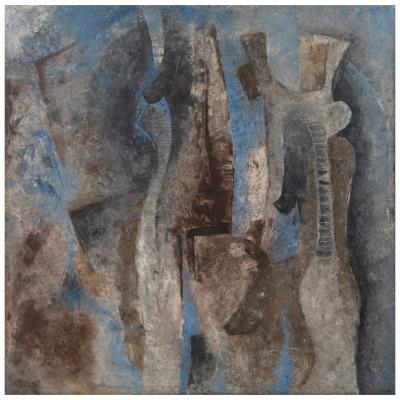
Gálvez's work included painting, sculpture, etching, lithography, and drawing.[4] For Galvez, art was spiritual and disconnected with physical logic, when only aesthetics mattered. Female figures are common, and often are sensual. He work has been influenced by the Cubism of Picasso and Georges Braque, by African and Oceanic folk art and by pre-Columbian sculpture. He preferred large scale works often bigger than seven by seven feet. He painted while listening to classical, jazz and occasionally, rock music.
Galvez's work experienced periods in which different artistic currents dominated including expressionism, abstract art and mixtures of the two. In his work, he tried to achieve a balance between figurative and abstract expression. The first stage of his painting was figurative expressionism, then abstract expressionism, under strong influence of Carlos Mérida, Rufino Tamaho, Santos Balmori, Kandinsky, Wifredo Lam and Picasso, along with some from classical painters such as Rembrandt and Caravaggio. Then for some time, he practiced abstract art, but then felt the need to draw human bodies again, especially female ones because he felt it allowed him better expression. Around 1980, he moved on to geometric figurativism, marked by the “Woman” exhibit at the Museum of Modern Art. This has also been describes as “pure chromatic constructivism. He considered himself primarily a sculptor and painted in that fashion.
Galvez died at age 67 at Inglés Observatorio Hospital from a heart attack. His ashes were deposited a year after his death to the side of one of the sculptures at his home in Mixquiahuala.
Source:
Wikipedia, 2023Biography from Morton Subastas
He studied at the Academy of San Carlos, where he had great teachers, such as Antonio Rodríguez Luna, Francisco Moreno Capdevila, Luis Nishizawa, Santos Balmori and Antonio Ramírez, who exerted an important influence on the artist. His first artistic stage inclined to the Abstract Expressionism with a strong influence of the colors of Rufino Tamayo and Kandinsky, as well as of the compositions of Balmori and Wilfredo Lam.
In life, he presented more than 60 individual exhibitions in the United States and Latin America, as well as many other collective exhibitions. His plastic production is part of various private collections in Mexico and abroad.
Source consulted: official site of the artist www.byrongalvez.com