Page loaded successfully. Showing biography for Jean-Baptiste-Camille Corot.
Jean-Baptiste-Camille Corot BIOGRAPHY
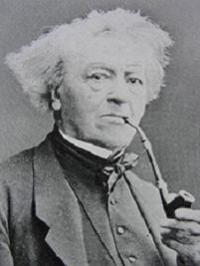
1796 Paris, France - 1875 Ville d'Avray, France. Known for: Tonalist landscape painting.
The following was written and compiled by Jean Ershler Schatz, art researcher from Laguna Woods, California:. Jean Baptiste Camille Corot was born in Paris in 1796 in a house on a corner that looked... Read full biography
The following was written and compiled by Jean Ershler Schatz, art researcher from Laguna Woods, California:. Jean Baptiste Camille Corot was born in Paris in 1796 in a house on a corner that looked out on the bridges that loop the Seine. His father ran a fashionable millinery shop. He was... Read full biography
The following was written and compiled by Jean Ershler Schatz, art researcher from Laguna Woods, California:. Jean Baptiste Camille Corot was born in Paris in 1796 in a house on a corner that looked out on the bridges that loop the Seine. His father ran a fashionable millinery shop. He was twenty-six years old when he entered the studio of landscape painter Achille-Etna Michallon, an artist no older than himself who encouraged him to work en plein air. Michallon died only a few months later,... Read full biography
The following was written and compiled by Jean Ershler Schatz, art researcher from Laguna Woods, California:. Jean Baptiste Camille Corot was born in Paris in 1796 in a house on a corner that looked out on the bridges that loop the Seine. His father ran a fashionable millinery shop. He was twenty-six years old when he entered the studio of landscape painter Achille-Etna Michallon, an artist no older than himself who encouraged him to work en plein air. Michallon died only a few months later, leaving Corot to continue his training with the much older artist Jean-Victor Bertin (who had been Michallon's teacher). After his schooling, Camille was apprenticed to a draper He was sweet and kind but he was also stubborn, He refused to marry the... Read full biography
The following was written and compiled by Jean Ershler Schatz, art researcher from Laguna Woods, California:. Jean Baptiste Camille Corot was born in Paris in 1796 in a house on a corner that looked out on the bridges that loop the Seine. His father ran a fashionable millinery shop. He was twenty-six years old when he entered the studio of landscape painter Achille-Etna Michallon, an artist no older than himself who encouraged him to work en plein air. Michallon died only a few months later, leaving Corot to continue his training with the much older artist Jean-Victor Bertin (who had been Michallon's teacher). After his schooling, Camille was apprenticed to a draper He was sweet and kind but he was also stubborn, He refused to marry the girl his parents had selected for him; he made no effort to succeed in the business in which his father placed him.... Read full biography
Artist Biography
Biography page for Jean-Baptiste-Camille Corot ((1796 - 1875)), known for Tonalist landscape painting. Showing 3 biographical entries and 0 sample artworks.
Jean-Baptiste-Camille Corot - Artist Info
About Jean-Baptiste-Camille Corot
Name variants
Camille Corot
Biography from the Archives of askART
 The following was written and compiled by Jean Ershler Schatz, art researcher from Laguna Woods, California:
Jean Baptiste Camille Corot was born in Paris in 1796 in a house on a corner that looked out on the bridges that loop the Seine. His father ran a fashionable millinery shop. He was twenty-six years old when he entered the studio of landscape painter Achille-Etna Michallon, an artist no older than himself who encouraged him to work en plein air. Michallon died only a few months later, leaving Corot to continue his training with the much older artist Jean-Victor Bertin (who had been Michallon's teacher).
After his schooling, Camille was apprenticed to a draper He was sweet and kind but he was also stubborn, He refused to marry the girl his parents had selected for him; he made no effort to succeed in the business in which his father placed him. His optimism and high spirits were contagious; he liked to dance amd loved music. He became the best known landscape painter of the Barbizon School, which was founded by Theodore Rousseau.
His studio pictures could be weak, dull and sickenly sweet; his paintings direct from nature were often pure and clear. He started off strong. He was blessed with deep feeling for nature, instinctive taste and a large allowance from his family. At twenty-nine he went to Italy and immediately started painting the best landscapes of his career.
After Corot's return to Paris, others kept urging him to paint big, neo-classical scenes stuffed with the literary allusions then popular. Amiability was perhaps Corot's greatest fault as an artist. He gave in, gained critical success with such pictures, then proceeded to make a critical success with watered-down studio versions of his landscapes.
He never sold a single painting until he was past fifty. From his late forties until his death at seventy-eight, Corot painted thousands of such canvases to fill a vast and continuing demand. Only now and then did he rise again to the heights of his youth.
Corot was the first French painter to wrongly attempt to rival the camera. After 1850, a suggestion of light became his subject. Paintings became the silvery color of photographs, a technique that was at once successful. He was forced to return to studio painting in 1870 but he profited by that change when he went back to landscape.
Corot gave a large part of his earnings to other artists. He generally thought his friends better painters than himself. In both his life and his art he was the epitome of contentment. In failure he did not sulk; in success he was happy to use his wealth to help out his friends, including the caricaturist Daumier, who, impoverished and nearly blind, was about to be evicted from his cottage. Corot bought another cottage for Daumier.
He died in 1875 at the age of seventy-nine of cancer of the stomach.
Sources include:
Time Magazine, May 31, 1954 and November 14, 1960
Metropolitan Museum of Art Miniatures: Masterpieces in the Philadelphia Museum of Art
"Complexity and Corot" by G. Haydn Huntley ( Magazine unknown)
"Aline Saarinen" in McCall's Magazine
"Corot Refigured" by Barry Schwabsky in Art in America, January 1997.Biography from Anderson Galleries, Inc.
 The son of a Parisian shopkeeper, the young Corot was hired as a salesman by a cloth merchant, despite his evident gift for drawing. Clearly lacking an aptitude for business, he was already twenty-six when his father gave him an allowance so that he could devote himself entirely to his vocation.
Studying with A. Michallon, with whom he painted his first landscapes in the Forest of Fontainebleau, and then with Victor Bertin, he took his first trip to Italy in 1825. There he enjoyed the friendship of Caruelle d'Aligny and Edouard Bertin who shared his passion for painting from nature. On his return three years later, he adopted a pattern of work, which he maintained throughout his life, of painting in his Paris studio during the winter and devoting the summer to traveling in France, interrupted by frequent visits to Ville d'Avray, Chailly and Barbizon.
From spring to autumn, he lived with his parents at Ville d'Avray. He worked in the mornings and evenings, capturing the light and atmosphere of his favorite times of day. He was an extremely kind and generous man much loved by his fellow artists, whom he was always ready to help with money and advice.
During his long career he became one of the most celebrated artists of his generation and exerted tremendous influence on the painters of the Impressionist movement. He was awarded numerous medals and the coveted Legion of Honor in 1846. Acknowledged as the world's foremost landscape painter, fame did not spoil the simplicity of his character. His work can be found in important public collections around the world.
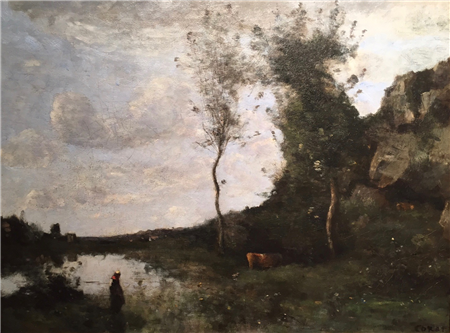
The title of the present work, Le Dormoir, refers to a shaded space where herds of cattle or sheep can rest. Le Dormoir was painted towards the end of Corot's life and captures the poetic beauty and dreamy quality present in his final paintings. Unlike his earlier works, Corot's paintings of the 1870s feature increasingly mythical and romantic subject matter, a softer paint application, and lyrical subtext. In 1873, the year in which he painted Le Dormoir, Corot created a number of vertical landscapes featuring small dancing and working figures beneath towering trees (i.e. Pastorale Souvenir d Italie, Glasgow Art Gallery and Museum). Like Pastorale, Le Dormoir is a harmonious composition that invites the viewer to a romantic vision of the forest and rural life.
Museum Collections Include:
Musee du Louvre, Paris; Metropolitan Museum of Art, New York; Yale University Art Gallery; Le Petit Palais, Paris; The Frick Collection, New York; The Phillips Collection, Washington D.C.; The Hermitage, St Petersburg; J. Paul Getty Museum, Los Angeles; The Art Institute of Chicago; Fitzwilliam Museum at the University of Cambridge; Guggenheim Hermitage Museum, Las Vegas; Museum of Fine Arts, Boston; Museum of Fine Arts, Houston; Corcoran Gallery of Art, Washington D.C.; Fine Arts Museums of San Francisco; High Museum of Art, Atlanta; Kimbell Art Museum, Fort Worth, TX; Kunstmuseum Basel, Switzerland; Los Angeles County Museum of Art; Norton Simon Museum, Pasadena; Neue Pinakothek, Munich; numerous other French, European, and American museums.Biography from Dobiaschofsky Auktionen
Jean-Baptiste-Camille Corot was born in 1796 in Paris, France. He studied landscape painting under Victor Bertin, adopting a classical-academic style influenced by Poussin. Corot's early works focused on precise rendering of nature and displayed transparency, simplicity, and clarity. After studying in Italy from 1825 to 1828, he incorporated southern light into his art and began exploring portraiture. Corot's landscapes evolved to feature a signature silver-gray color palette, moving away from the blue-yellow tones. His atmospheric depictions of tranquil scenes at twilight positioned him as a precursor to Impressionism, despite his admiration for classicists like Poussin and Lorrain.