Page loaded successfully. Showing biography for Carl Oscar Borg.
Carl Oscar Borg BIOGRAPHY
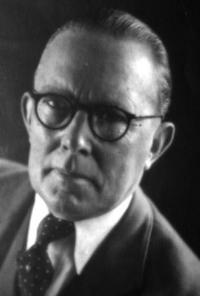
1879 Dais-Grinstad, Sweden - 1947 Santa Barbara, California. Known for: Western, Indian genre, and landscape painting.
Known for Southwest Indian portraits in various mediums including oil, watercolor, etchings, and woodblock, Carl Oscar Borg was born in Dais-Grinstad, Sweden. His family was poor, and he was largely... Read full biography
Known for Southwest Indian portraits in various mediums including oil, watercolor, etchings, and woodblock, Carl Oscar Borg was born in Dais-Grinstad, Sweden. His family was poor, and he was largely self-taught. He showed early art talent, and as a child copied pictures from books. At age 15, he... Read full biography
Known for Southwest Indian portraits in various mediums including oil, watercolor, etchings, and woodblock, Carl Oscar Borg was born in Dais-Grinstad, Sweden. His family was poor, and he was largely self-taught. He showed early art talent, and as a child copied pictures from books. At age 15, he apprenticed to a house painter, and at age 20, moved to London and assisted portrait and marine artist George Johansen. In 1901, he arrived in San Francisco from Sweden, having jumped ship as a seaman... Read full biography
Known for Southwest Indian portraits in various mediums including oil, watercolor, etchings, and woodblock, Carl Oscar Borg was born in Dais-Grinstad, Sweden. His family was poor, and he was largely self-taught. He showed early art talent, and as a child copied pictures from books. At age 15, he apprenticed to a house painter, and at age 20, moved to London and assisted portrait and marine artist George Johansen. In 1901, he arrived in San Francisco from Sweden, having jumped ship as a seaman on the "S.S. Arizonan." He walked the rail track to Los Angeles, and learned painting techniques from William Wendt, well-known landscape artist. Sponsored by Phoebe Hearst, mother of newspaper tycoon William Randolph Hearst, Borg studied art in Paris... Read full biography
Known for Southwest Indian portraits in various mediums including oil, watercolor, etchings, and woodblock, Carl Oscar Borg was born in Dais-Grinstad, Sweden. His family was poor, and he was largely self-taught. He showed early art talent, and as a child copied pictures from books. At age 15, he apprenticed to a house painter, and at age 20, moved to London and assisted portrait and marine artist George Johansen. In 1901, he arrived in San Francisco from Sweden, having jumped ship as a seaman on the "S.S. Arizonan." He walked the rail track to Los Angeles, and learned painting techniques from William Wendt, well-known landscape artist. Sponsored by Phoebe Hearst, mother of newspaper tycoon William Randolph Hearst, Borg studied art in Paris and Rome, and with Hearst's encouragement, also painted Indian portraits. He then taught at the Cal... Read full biography
Artist Biography
Biography page for Carl Oscar Borg ((1879 - 1947)), known for Western, Indian genre, and landscape painting. Showing 9 biographical entries and 0 sample artworks.
Carl Oscar Borg - Artist Info
About Carl Oscar Borg
Biography from the Archives of askART
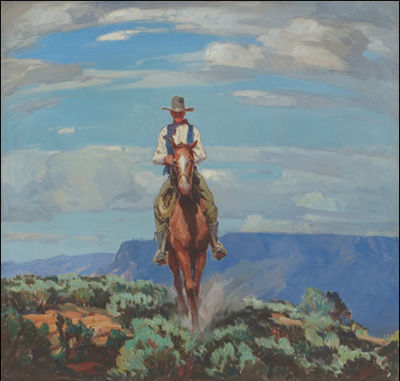 Known for Southwest Indian portraits in various mediums including oil, watercolor, etchings, and woodblock, Carl Oscar Borg was born in Dais-Grinstad, Sweden.
His family was poor, and he was largely self-taught. He showed early art talent, and as a child copied pictures from books. At age 15, he apprenticed to a house painter, and at age 20, moved to London and assisted portrait and marine artist George Johansen.
In 1901, he arrived in San Francisco from Sweden, having jumped ship as a seaman on the "S.S. Arizonan." He walked the rail track to Los Angeles, and learned painting techniques from William Wendt, well-known landscape artist.
Sponsored by Phoebe Hearst, mother of newspaper tycoon William Randolph Hearst, Borg studied art in Paris and Rome, and with Hearst's encouragement, also painted Indian portraits. He then taught at the California Art Institute in Los Angeles, spent six months in Honduras, and from 1918-24, was an instructor at the School of Arts in Santa Barbara.
From 1924-1935, he was in California and Arizona doing commissioned paintings of Southwest Indian tribal ceremonies for Hearst and also did Grand Canyon landscapes. He traveled in the country when war broke out and was forced to spend World War II in Sweden where his desert and Indian portraits became much sought after.
After the war, he returned to Santa Barbara and died there on May 8, 1947.
One of his paintings of the Grand Canyon is in the collection of Supreme Court Justice Sandra Day O'Connor, from Arizona.
Sources:
Edan Hughes, Artists in California, 1786-1940
James Ballinger, Visitors to Arizona, 1846-1980Biography from American Legacy Fine Arts
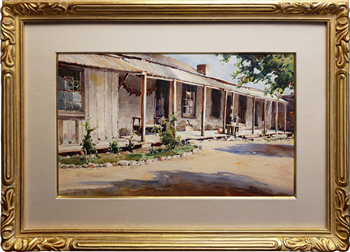 Carl Oscar Borg was born in a soldier’s hut named Östebyn östre (East Village) in the rural parish of Grinstad, Sweden in Dalsland province on March 3, 1879. His father was Gustaf Eriksson Borg and his mother was Kristina Olsdotter. Carl Oscar was the oldest of six children. His father found occasional work to feed the family, but they lived in poverty.
Carl Oscar was not given a formal education, but he was ambitious and began teaching himself how to draw by copying book illustrations. He helped raise money for the family by working for neighbors. At age fifteen he became an apprentice to a decorative painter who painted designs for traditional Swedish houses. Then, at age twenty, he moved to the capitol city of Stockholm where he found work as a ship painter. Working aboard a ship allowed him the opportunity to sail to Paris and then to London where he disembarked.
In London, Borg was robbed of all his belongings and had to live on the streets until he learned some English and managed to find employment as a theatrical scenery painter. He also became an assistant to George Johansen, a lesser-known artist who specialized in portrait and marine subjects.
In 1901 Borg decorated a Norwegian sea captain’s cabin in exchange for passage to the United States. The opportunity landed him in New York, and for two years he worked as a decorative house painter and took on a variety of jobs to earn money. In 1903 Borg signed on to the commercial cargo liner, SS Arizonan, as a seaman and jumped ship in San Francisco. (The Arizonan was later acquired by the United States in 1918 to enter World War I.)
From San Francisco, Borg walked the railroad track to Los Angeles, taking on odd jobs along the way. In Los Angeles, he became a partner in a sign and photography studio and began meeting people in L.A.’s burgeoning art scene, chief among them was Charles Fletcher Lummis (1859-1928). Lummis was already famous as a U.S. journalist who traveled the American Southwest on foot from Cincinnati to Los Angeles when he accepted the position of first City Editor of the Los Angeles Times. (Lummis published his encounters from the 3,507-mile journey in his book, A Tramp Across the Continent (1892).) Lummis was an advocate for Indian rights, a historic preservationist, photographer, ethnographer, archaeologist, poet, city librarian, and founder of the Southwest Museum.
Through Lummis, Borg became further captivated with the land and culture of the Southwest, an inspiration that continued throughout his life. Borg’s first survey into painting scenes of the Southwest came through a commission from the University of California system and the United States Bureau of Ethnology. The project was to document the vanishing life of the Southwest Indians. His first exhibition of these paintings was shown in San Francisco in 1917.
Borg continued visiting the Navaho and Hopi tribes each spring for fifteen years. The Atchison, Topeka and Santa Fe Railway purchased some of his Southwest paintings, including dramatic scenes of the Grand Canyon, for promotional purposes. The respect that Borg showed the Indians resulted in his being adopted into the Hopi Snake Clan. This adoption gained him rare access to their sacred ceremonies, and he was given a new tribal name, Hasten-na-va ha-sa, meaning ‘The Man Who Comes in Spring.”
Lummis’ wife, Eva, introduced Borg to the established landscape artist William Wendt (1865-1946) who became an important influence in Borg’s art. Wendt introduced Borg to the local arts community and Borg became a founding member of the Painter’s Club of Los Angeles in 1906, which reorganized as the California Art Club in 1909 where he was also a co-founder along with Wendt. Eva also introduced Borg to Phoebe Apperson Hearst, mother of businessman and newspaper tycoon William Randolph Hearst. Phoebe Hearst was impressed with Borg’s artistic ability and became his patron. She funded Borg’s five-year art education in Paris and Rome and his trips to Europe, North Africa, and the Southwest.
In 1918 Borg married Madeline Carriel, a much younger woman, and built a home and studio in Santa Barbara. While in Santa Barbara he taught at the Santa Barbara School of Arts (1918-1924) and became good friends with the local cowboy artist Edward Borein (1872-1945). Borg and Borein traveled and painted western scenes together. In 1924 Carl Oscar Borg and his wife moved back to Los Angeles, settling in Hollywood. One of Borg’s students at the California Art Institute introduced him to Douglas Fairbanks. Fairbanks was looking for an art director for his next film, The Black Pirate, and hired Borg.
The motion picture became America's first full-length film in color (released in 1926, silent). Borg’s career was taking healthy roots in California. In addition to his work with Fairbanks, from 1926 to 1929, Borg was art director for major Hollywood studios. He worked with Samuel Goldwyn and Cecil B. DeMille, and made seven films that featured some of the era’s biggest stars, including Ronald Colman and Gary Cooper.
After 1929 and the beginning of “talkies,” movies started being filmed mainly outdoors, thereby eliminating the need for scenic backdrop painters such as Carl Oscar Borg. Also in 1929, came the hardship of the Great Depression, and by 1930 Borg lost most of his savings. At this time, his wife Madeline left him for a younger man. Depressed, he returned to Sweden in 1934. The Swedish press hailed him as “The Great Indian Painter.” He returned to Los Angeles in December and rented his old Santa Barbara studio while he sought a divorce from his wife.
Modernism was taking hold of the art world, and in 1936 when Borg had an exhibition of his Southwest paintings in New York, the work received mixed reviews. Again depressed, he returned to Sweden. This time, he met Miss Lily Lindstrand and the two struck up a romance, which was cut short due to Borg being called back to Los Angeles to complete several new commissions, including film work with Cecil B. de Mille.
The following year in June, he returned to Sweden to see his dying father for the last time. On October 3,1938 Carl Oscar and Lily were married in the Swedish Church in Copenhagen, Denmark. The couple settled in Göteborg and Borg became a local painter. Borg’s Southwest subjects were popular in Sweden, and he donated a collection of his watercolors and etchings as well as his sizeable collection of Southwestern Indian artifacts to the National Ethnological Museum. The contribution earned him the Linne Medal by the Royal Swedish Academy of Science.
Although a naturalized American citizen, Borg was not permitted to leave Sweden for the U.S. during World War II. Finally, in 1945 Carl Oscar and Lily were able to return to his beloved Santa Barbara where they purchased a home and turned the second floor into his studio. In 1947 old friends invited them to travel to San Francisco together. Borg declined, however, Lily reluctantly agreed to go without him. The following day on May 8, Borg painted in his studio, then walked to a favorite restaurant for Spanish food. In the restaurant he had a massive heart attack, and at the age of sixty-eight he passed away in the ambulance on the way to the hospital. In accordance with Borg’s wishes, his ashes were cast to the winds in the Grand Canyon.
Carl Oscar Borg’s place in art history fits in multiple camps. He worked in various media, including watercolor, gouache, oil, etchings, and woodblocks, and he painted diverse subjects. His images of Southwestern culture fit among the Taos Art Colony with such artists as Joseph H. Sharp (1849-1953), E. Martin Hennings (1886-1956), Walter Ufer (1876-1936), Victor Higgins (1884-1949), and Oscar Berninghaus (1874-1952).
Borg’s scenes of California landscapes and coastal regions belong in the school of California Impressionism along with artists Edgar Payne, Maurice Braun, Hanson Puthuff, and William Wendt. His paintings of North Africa and Egypt can easily fit in Orientalist collections that include works by Frederick Arthur Bridgman (1947-1928) and Edwin Lord Weeks (1849-1903). Borg was a versatile artist with a restless spirit who searched for ethnic traditions and open frontiers.
Written and submitted by Elaine Adams, Director, American Legacy Fine Arts
Notes:
In 1936 Borg gifted his paintings and other materials to American Swedish Historical Museum in Philadelphia, which was founded in 1926. Paintings on permanent display include On The Island of Santa Cruz, c. 1920 and The Hopi Corral, c. 1915.
Borg was a member of the National Academy of Design National Academy of Arts, Société Nationale des Beaux-Arts and the Salmagundi Club. His works received numerous awards and gold medals, and are included in the collections of many important museums, universities, and private collections throughout the United States, including Harvard University, Brigham Young University, Smithsonian American Art Museum, and the Fine Arts Museums of San Francisco.
Sources:
Carl Oscar Borg and the Magic Region, by Helen Laird (from notes given by Lily Lindstrand Borg Elmberg), 1986, Gibbs B. Smith, Inc. Peregrine Smith Books, Layton, Utah
"Sunshine, Trains and Hollywood Bring Artists to Southern California," by Elaine Adams, California Art Club Newsletter, Summer 2011)
Carl Oscar Borg: Founding Member of the California Art Club by Jeffrey Morseburg
Carl Oscar Borg Biography by Marlene Miller
AskART.comBiography from Mark Sublette Medicine Man Gallery
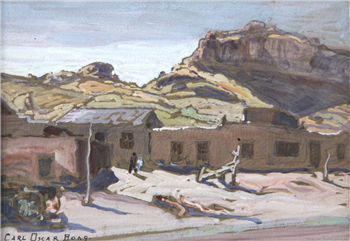 Born and raised in Sweden, Borg emigrated to the United States in 1902 and settled in California. Employed as a scene painter for the movie industry, he had his first exhibition in 1905 and was immediately recognized for his talent. Fellow artists introduced him to the West as a subject and he began traveling and sketching throughout California and the Southwest. His reputation earned him the interest of William Randolph Hearst's mother who sponsored him for five years of study in Europe where he received awards in France in 1913 and 1914.
Upon his return to the United States, Borg won the Panama-Pacific International Exposition in 1915. He lived in Santa Barbara from 1914 to 1930 and became a very good friend of Edward Borein's. The two traveled throughout the West painting Indian ceremonials and cowboy genre subjects, teaching art classes as they went. Borg also painted in Central and South America, Spain, Morocco, the Valley of the Nile, and Italy.
In 1936 Borg, Millard Sheets, and Dr. Eugene Bolton of the University of California wrote and illustrated a book on the history of California titled Cross, Sword, and Gold Pan. Borg also published a book of etchings titled The Great South West that same year. His own biography was published in Sweden.
His works are held by the University of California, Los Angeles County Museum of Art, Hearst Free Library, Montclair Art Museum, Seattle Art Museum, the Library of Congress, Goteborg Museum in Sweden and the Bibliotheque in Paris.
Carl Oscar Borg was twenty years old when he left his native Sweden for England. He worked in London as a scenery painter for several years before immigrating to America in 1902. Two years later he moved to California, where he would live for the rest of his life. He was initially employed as a scene painter for the newly established motion picture industry, an experience that surely influenced his outlook on western themes.
In 1905, he traveled throughout California and the Southwest, sketching and making notes and had his first one-man exhibition as a fine artist. Soon after that, Borg traveled to Paris for futher study, where he advanced rapidly as a painter, gaining notoriety at home as a prizewinner in the Panama-Pacific Exposition in 1915.
By this time, Borg had relocated to Santa Barbara and become close friends with Edward Borein. The two painters shared the same enthusiasm for the West, and Borg developed a local reputation as a teacher of merit. He traveled widely, painting and sketching where he went, and specializing in the scenery and subjects of the Southwest. He also became an able printmaker, publishing an excellent collection in 1936 titled "The Great Southwest: Etchings", which concentrated on Navajo and Hopi themes.
Carl Oscar Borg was born in Sweden, and apprenticed to the English artist George Johansen at the age of 15. Working as a seaman, Borg jumped ship in San Francisco in 1901. Without funds, he walked the railway, some 450 miles, to Los Angeles, ultimately meeting William Wendt, who would teach him painting techniques.
Having shown great promise, Borg was sponsored by Phoebe Hearst to study in Paris, and Rome. It was Mrs. Hearst who encouraged Borg to paint Native American subjects, a theme for which the artist is most remembered. Borg also taught in art schools in Los Angeles and Santa Barbara, where he died in 1947. Known for Southwest Indian portraits in oil, watercolor, etching, or woodblock, Carl Oscar Borg was born in Dais-Grinstad, Sweden.Biography from Altermann Galleries and Auctioneers, I
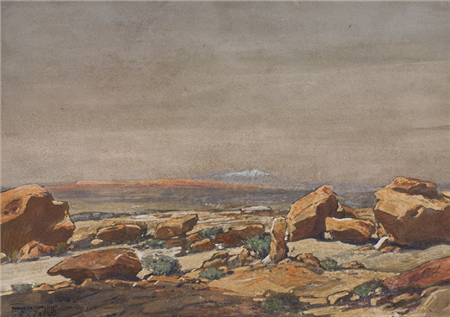 Carl Oscar Borg was twenty years old when he left his native Sweden for England. He worked in London as a scenery painter for several years before immigrating to America in 1902. Two years later he moved to California, where he would live for the rest of his life. He was initially employed as a scene painter for the newly established motion picture industry, an experience that surely influenced his outlook on western themes.
In 1905, he traveled throughout California and the Southwest, sketching and making notes and had his first one-man exhibition as a fine artist. Soon after that, Borg traveled to Paris for further study, where he advanced rapidly as a painter, gaining notoriety at home as a prizewinner in the Panama-Pacific Exposition in 1915.
By this time, Borg had relocated to Santa Barbara and become close friends with Edward Borein. The two painters shared the same enthusiasm for the West, and Borg developed a local reputation as a teacher of merit. He traveled widely, painting and sketching where he went, and specializing in the scenery and subjects of the Southwest.
He also became an able print maker, publishing an excellent collection in 1936 titled The Great Southwest: Etchings, which concentrated on Navajo and Hopi themes.
Source:
The American West: Legendary Artists of the Frontier, Dr. Rick Stewart, Hawthorne Publishing Company, 1986Biography from William A. Karges Fine Art
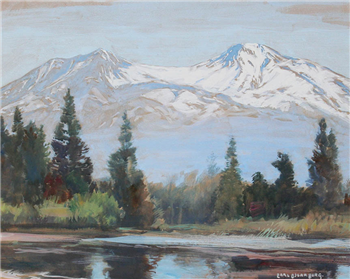 Carl Oscar Borg was born in Sweden, and apprenticed to the English artist George Johansen at the age of 15. Working as a seaman, Borg jumped ship in San Francisco in 1901. Without funds, he walked the railway, some 450 miles, to Los Angeles, ultimately meeting William Wendt, who would teach him painting techniques.
Having shown great promise, Borg was sponsored by Phoebe Hearst to study in Paris, and Rome. It was Mrs. Hearst who encouraged Borg to paint Native American subjects, a theme for which the artist is most remembered. Borg also taught in art schools in Los Angeles and Santa Barbara, where he died in 1947.Biography from Artistic Gallery
Carl Oscar Borg was born in Dals-Grinstad, Sweden on March 3, 1879. He began copying pictures from books as a child. At 15, he was apprenticed to a house painter and at 20 moved to London where he worked as an assistant to portrait and marine painter George Johansen. Borg began to paint seascapes at this time.
In 1901 he sailed for the United States and worked as a house and furniture painter in the East. While serving as a seaman aboard the S.S. Arizonian, he jumped ship in San Francisco in 1903, and decided to make California his home. Lacking funds, he walked the railroad tracks to Los Angeles. He became friends with artist William Wendt who taught him painting techniques. Through the patronage of Phoebe Hearst, from the Hearst newspaper family, he was able to return to Europe and study art in Paris and Rome.
Upon his return, Borg taught at the California Art Institute in Los Angeles, and spent six months in Honduras during 1908. From 1918-24, he lived in Santa Barbara where he taught at the School of the Arts. The interval years 1924-35 were spent traveling in San Francisco, Los Angeles, and the Grand Canyon.
He made three trips to Sweden in the 1930s, and when war broke out in Europe, he was forced to remain there the duration of the war. While in Sweden, he had considerable fame and financial success in selling his paintings of Indians and desert scenes to art collectors.
After WWII ended, Borg returned to Santa Barbara where he died on May 8, 1947. His biography was published in Sweden posthumously. His subjects included Hopi and Navajo Indians, cowboys, historical scenes, landscapes, marines, and missions.
Member:
California Art Club; Laguna Beach Art Association; San Francisco Art Association; California Society of Etchers; Salmagundi Club, New York; Associate of the National Academy of Design; California Watercolor Society; Academy of Western Painters; Societe Internationale des Beaux Arts et de Lettres, Paris; California Printmakers; Painters of the West.
Awards:
Gold medal, St. Louis Exposition, 1904; first prize, Los Angeles Painters Club, 1909; silver medal, Versailles, 1914; first prize, California Art Club, 1915; silver medal, PPIE, 1915; gold and silver medals, Panama-California Exposition, San Diego, 1915; silver medal, Societe des Artistes Francais, 1920; silver medal, Pacific Southwest Exposition, 1928; and others.
Major collectors:
Los Angeles County Museum of Art; Montclair Art Museum, New Jersey; California State Library; Seattle Art Museum; Library of Congress; de Young Museum; Lowie Museum, University of California, Berkeley; Mills College, Oakland; Oakland Museum; Los Angeles Public Library; Santa Barbara Museum; National Museum of American Art; Bibliotheque Nationale, Paris; Henry Art Gallery, University of Washington, Seattle; Gothenburg Ethological Museum, Sweden; Phoenix MuseumBiography from Marlene Miller
Carl Oscar Borg, protégé of Phoebe Hearst, friend of personalities like Edward Borein, Thomas Moran and Charles M. Russell, could create any subject in any medium, and do it well. He was most successful and highly regarded during his lifetime, receiving numerous awards and medals.
In the annals of American art history, Carl Oscar Borg belongs to the group of artists including Joseph Sharp, E. Martin Hennings, Walter Ufer, Victor Higgins, and Oscar Berninghaus. Borg belongs also to the group of American artists who came to California at the turn of the century to record the California landscape---artists like Marion and Elmer Wachtel, Hanson Puthuff, and William Wendt who taught him painting techniques. Borg's works are included in many major museum, university, and private collection throughout the United States.
Borg succeeded in preserving America's cultural heritage by documenting the customs and religious ceremonies of the Native Americans that had been shared with him. He felt a kinship with the West and the people who introduced him to it. He used paint, canvas and brushes to express the unique qualities he found in New Mexico, Arizona and California. He captured the grandeur of this unusual scenery, which is emphasized by atmosphere, light, color and expanse.
Carl Oscar Borg was born into a poor family in Dals-Grinstad, Sweden on March 3, 1879. As soon as he could hold a pencil he started copying pictures from books. He had neither the vocabulary nor the concepts to articulate a philosophy, but he yearned to be a great artist. Borg apprenticed to a house painter at age 15, then moved to London and became assistant to portrait and marine painter George Johansen. He began painting during that time.
In 1901, he sailed for the U.S. and worked as a house and furniture painter in the East. It was not the life he had dreamt about, and at the urging of his friends he headed for California. Carl Oscar Borg discovered Santa Barbara in 1903 as he made his way from San Francisco to Los Angeles. California provided the opportunity, support, and the spiritual environments, which permitted his talents to unfold, and his genius to develop. He enjoyed sailing out to the Channel Islands and often camped out weeks at the time to paint.
Under the patronage of Phoebe Hearst, who recognized Borg's talent, he was able to return to Europe to study art. It was also Mrs. Hearst who made arrangements with the Department of the Interior for Borg to live with the Native Americans. Borg wrote: "The inhabitants of these great solitudes, these limitless horizons, this wilderness of color and form, are marked by an Arcadian simplicity, by a dignity and reserve that I am sure would be hard to find among any other living peoples…" And every summer, while residing in California, Borg would return to the desert to spend time with his many intimate friends among the Indians.
He taught art at the California Art Institute in Los Angeles, and at the Santa Barbara School of the Arts. He was the first art director for major Hollywood studios and worked with Sam Goldwyn, Douglas Fairbanks and Cecil B. DeMille.
For twenty years Borg made his way as an artist in the West, but the West began to resemble the rest of America. Carl Oscar Borg did not like the changes. But the automobile, railroad and the movies did support him as an artist. The Santa Fe Railroad hung his paintings along with other prominent artist's work in their offices to attract the interest and attention of the tourists. Touring Topics, the AAA's publication, featured one of Borg's Grand Canyon paintings on the cover. Borg had a special place in his heart for the Grand Canyon. He wished to have his ashes be given to the wind of the Canyon.
But times were changing. Many of his friends in California had died. Borg saw the growing popularity of modern art. It was clear that these artists were fighting a losing battle. Borg returned to Sweden in 1934 and again in 1938. He painted people and scenes of Sweden, and successfully exhibited his paintings of the American Southwest. Although he was an American citizen, he could not return to the United States until after the war. Borg was very homesick for California, and could not wait to get back. He wrote to his friend Edwin Gledhill that he could not spend another winter in Sweden.
He returned to Santa Barbara in September of 1945. Many of his friends had died, and he was estranged from the world that had evolved there. But he was at peace with himself. On May 8, 1947, Borg was painting in his studio, as he did every day. That evening, he walked to his favorite restaurant to enjoy his favorite food. He was stricken with a massive heart attack and died in the ambulance on the way to the hospital. As he requested, his ashes were given to the wind of the Grand Canyon.Biography from Thomas Nygard Gallery
CARL OSCAR BORG, ANA (1879-1947)
Born and raised in Sweden, Borg emigrated to the United States in 1902 and settled in California. Employed as a scene painter for the movie industry, he had his first exhibition in 1905 and was immediately recognized for his talent. Fellow artists introduced him to the West as a subject and he began traveling and sketching throughout California and the Southwest. His reputation earned him the interest of William Randolph Hearst's mother who sponsored him for five years of study in Europe where he received awards in France in 1913 and 1914.
Upon his return to the United States, Borg won the Panama-Pacific International Exposition in 1915. He lived in Santa Barbara from 1914 to 1930 and became a very good friend of Edward Borein's. The two traveled throughout the West painting Indian ceremonials and cowboy genre subjects, teaching art classes as they went. Borg also painted in Central and South America, Spain, Morocco, the Valley of the Nile, and Italy.
In 1936 Borg, Millard Sheets, and Dr. Eugene Bolton of the University of California wrote and illustrated a book on the history of California titled Cross, Sword, and Gold Pan. Borg also published a book of etchings titled The Great South West that same year. His own biography was published in Sweden.
His works are held by the University of California, Los Angeles County Museum of Art, Hearst Free Library, Montclair Art Museum, Seattle Art Museum, the Library of Congress, Goteborg Museum in Sweden and the Bibliotheque in Paris.Biography from Hubbell Trading Post National Historic Site
Carl Oscar Borg, N.A.
(American, Born Sweden 1879-1947)
Carl Oscar Borg was considered "a major American artist," though he was born in Grinstad, Sweden on March 3, 1879. Borg worked as a seaman and studied art in London before emigrating to New York City in 1902. He moved to California in 1903 and through the patronage of Mrs. Phoebe Hearst, was able to return to Europe for further study in Paris and Rome.
Upon his return he taught at the California Art Institute in Los Angeles, and from 1918 to 1924 lived in Santa Barbara where he taught at the School of Arts. The interval years 1924 to 1935 were spent traveling to San Francisco, Los Angeles and the Grand Canyon. The subjects of his paintings included Hopi and Navajo Indians, cowboys, historical scenes, and California landscapes, seascapes and missions.
He made three trips to Sweden in the 1930s, and when war broke out in Europe he was forced to remain there for the duration of the war. While in Sweden he had considerable fame and financial success in selling his paintings of Indians and desert scenes to art collectors. After World War II ended, he returned to Santa Barbara where he died on May 8, 1947.
Borg was a member of the California Art Club, Laguna Beach Art Association, California Society of Etchers, Salmagundi Club, New York; Association of the National Academy of Design, New York City; California Watercolor Society, California Printmakers, and Painters of the West.
He received many awards from around the world for his artistic talent. His works are held in the collections of the Los Angeles County Museum of Art, Seattle Art Museum, Library of Congress, University of California at Berkeley Museum and the Los Angeles Public Library, to name a few. His own biography was published in Sweden.
REFERENCES:
Borg, Carl Oscar. Carl Oscar Borg: A Niche in Time, Essays by Katherine Plake Hough, Michael R. Grauer, Helen Laird. Palm Springs, California: Palm Springs Desert Museum. ©1990.
The Great South West. ___________. 1936.
Borg, Carl Oscar, Millard Sheets and Dr. Eugene Bolton. Cross, Sword and Gold Pan. Berkeley: University of California, 1936.
Cuba, Stanley and Elizabeth Cunningham. "Carl Oscar Borg: Chronicler of the Southwest." Western Art Digest. Colorado Springs, Colorado: September, October 1986.
Falk, Peter Hastings, Who Was Who in American Art, Connecticut: Sound View Press. 1985.
Hughes, Edan Milton, Artists in California: 1786-1940. San Francisco: Hughes Publishing Company. 1986.
Laird, Helen. "Carl Oscar Borg," Antiques and Fine Art. Before March, 1990.)
Carl Oscar Borg and the Magic Region: Artist of the American West, Salt Lake City: Peregrine Smith Books. c1986.
Samuels, Peggy and Harold, Samuels' Encyclopedia of Artists of the American West, New Jersey: Castle. 1985.