Page loaded successfully. Showing biography for Carl Ray.
Carl Ray BIOGRAPHY
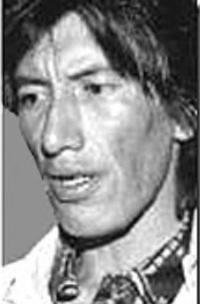
1943 Sandy Lake Indian Reserve, Ontario, Canada - 1978 Sioux Lookout, Ontario, Canada. Known for: Painting, drawing, graphic art, printmaking, illustration, murals, teaching.
Carl Ray (1943 – 1978). “Universally admired, he was, with Norval Morrisseau, one of the first native Ontario artists to defy tribal taboos and depict the sacred legends.” (1). An important and... Read full biography
Carl Ray (1943 – 1978). “Universally admired, he was, with Norval Morrisseau, one of the first native Ontario artists to defy tribal taboos and depict the sacred legends.” (1). An important and influential Canadian painter, draftsman, graphic artist, printmaker, illustrator, muralist and educator,... Read full biography
Carl Ray (1943 – 1978). “Universally admired, he was, with Norval Morrisseau, one of the first native Ontario artists to defy tribal taboos and depict the sacred legends.” (1). An important and influential Canadian painter, draftsman, graphic artist, printmaker, illustrator, muralist and educator, Carl Ray, of Cree Algonquin ancestry, was born on Sandy Lake Indian Reserve, Ontario and murdered in Sioux Lookout, Ontario. He was a member of the group of modernist native artists known as the... Read full biography
Carl Ray (1943 – 1978). “Universally admired, he was, with Norval Morrisseau, one of the first native Ontario artists to defy tribal taboos and depict the sacred legends.” (1). An important and influential Canadian painter, draftsman, graphic artist, printmaker, illustrator, muralist and educator, Carl Ray, of Cree Algonquin ancestry, was born on Sandy Lake Indian Reserve, Ontario and murdered in Sioux Lookout, Ontario. He was a member of the group of modernist native artists known as the Indian Group of Seven*. He is discussed in most of the recent comprehensive books about Canadian art and he is the subject of an article in the Canadian Encyclopedia. His works are in numerous museum collections including the National Gallery of Canada.... Read full biography
Carl Ray (1943 – 1978). “Universally admired, he was, with Norval Morrisseau, one of the first native Ontario artists to defy tribal taboos and depict the sacred legends.” (1). An important and influential Canadian painter, draftsman, graphic artist, printmaker, illustrator, muralist and educator, Carl Ray, of Cree Algonquin ancestry, was born on Sandy Lake Indian Reserve, Ontario and murdered in Sioux Lookout, Ontario. He was a member of the group of modernist native artists known as the Indian Group of Seven*. He is discussed in most of the recent comprehensive books about Canadian art and he is the subject of an article in the Canadian Encyclopedia. His works are in numerous museum collections including the National Gallery of Canada. (2). His mediums included acrylics, gouache, ink, watercolor, fresco, serigraph, stencil, and mixed mediums. His subjects inclu... Read full biography
Artist Biography
Biography page for Carl Ray ((1943 - 1978)), known for Painting, drawing, graphic art, printmaking, illustration, murals, teaching. Showing 2 biographical entries and 0 sample artworks.
Carl Ray - Artist Info
About Carl Ray
Biography from the Archives of askART
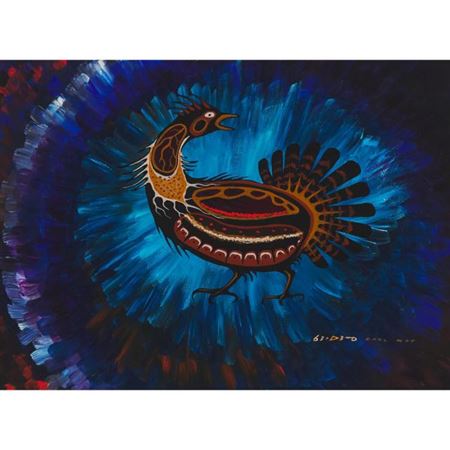 Carl Ray (1943 – 1978)
“Universally admired, he was, with Norval Morrisseau, one of the first native Ontario artists to defy tribal taboos and depict the sacred legends.” (1)
An important and influential Canadian painter, draftsman, graphic artist, printmaker, illustrator, muralist and educator, Carl Ray, of Cree Algonquin ancestry, was born on Sandy Lake Indian Reserve, Ontario and murdered in Sioux Lookout, Ontario. He was a member of the group of modernist native artists known as the Indian Group of Seven*. He is discussed in most of the recent comprehensive books about Canadian art and he is the subject of an article in the Canadian Encyclopedia. His works are in numerous museum collections including the National Gallery of Canada. (2)
His mediums included acrylics, gouache, ink, watercolor, fresco, serigraph, stencil, and mixed mediums. His subjects included figures, genre*, landscapes, wildlife, fish, birds, and spirituality; however, he is most famous for his depictions of sacred native legends, myths, rituals and ceremonies. His styles, in addition to Woodland School of Art*, were Realism* and Surrealism*. He signed his works in syllabics* and in English and frequently in both on the same work, as can be seen on many of his askART auction results.
Quote: ‘His death was a great loss – for the simple reason that Ray produced the most mature work of any Woodland artist’ (3)
He was a self-taught artist. His primary influence was that of his close associate, and the founder of the Woodland School of Art*, Norval Morrisseau. Ray’s other associates (and in some cases followers) included Jackson Beardy, Eddy Cobiness, Alex Janvier, Goyce Kakegamic, Joshim Kakegamic, Daphne Odjig and Joe Sanchez (see all in askART).
In 1967 Ray and Norval Morrisseau painted a mural for the controversial Indians of Canada Pavilion at Expo 67 in Montreal. From 1971 to 1973, Ray taught in traveling workshops sponsored by the Department of Indian affairs, and later by the Ojibwe Cultural Foundation. He illustrated the book Sacred Legends of the Sandy Lake Cee (1971), by James R Stevens (see Sources below) and did the cover art for The White City (1976) (see Sources below). He was also the editor of Kitiwin, the Sandy Lake newspaper.
His works have been featured in exhibitions such as “Canadian Indian Art ’74”, Royal Ontario Museum, Toronto (1974); “Indian Art ’75”, Woodland Indian Cultural Education Centre, Brantford, Ontario (1975); “Contemporary Native Art of Canada: The Woodland Indians”, Royal Ontario Museum, Toronto [also at Canada House, London, England and in Lahr, Germany] (1976); “Contemporary Indian Art — The Trail from the Past to the Future”, Trent University, Peterborough, Ontario (1977); “The Grand Western Canadian Screen Shop, A Print Legend: A Fifteen Year Survey, 1968 – 1983”, Gallery 1.1.1., University of Manitoba, Winnipeg (1983); “Contemporary Indian Art at Rideau Hall”, Rideau Hall [the official residence of the Governor General of Canada], Ottawa (1983); “Norval Morrisseau and the Emergence of the Image Makers”, Art Gallery of Ontario, Toronto (1984); “The Collective Achievement: Selections from the Permanent Collection”, Tom Thomson Memorial Art Gallery, Owen Sound, Ontario (1988); “Woodlands: Contemporary Art of the Anishnabe”, Thunder Bay Art Gallery, Thunder Bay, Ontario (1989); “The Grand Western Canadian Screen Shop: Printing, People and History”, MacKenzie Art Gallery, Regina, Saskatchewan (1992); “Woodland Art of Canada's First Nations”, Ethnographic Museum, Budapest, Hungary (1993); “The Art of the Anishnabe”, Thunder Bay Art Gallery, Thunder Bay, Ontario (1993); “Water, Earth and Air”, Thunder Bay Art Gallery, Thunder Bay, Ontario (1997); “The Helen E. Band Collection of First Nations Art”, Thunder Bay Art Gallery, Thunder Bay, Ontario and touring (1999 – 2000); “Gatherings: Aboriginal Art from the collection of the Winnipeg Art Gallery”, Winnipeg Art Gallery*, Manitoba (2002); “From Wigwas to Canvas: Generations of Woodland Art”, MacKenzie Art Gallery, Regina, Saskatchewan (2002); “Before and after the Horizon: Anishinaabe Artists of the Great Lakes”, Smithsonian Institution National Museum of the American Indian, New York and the Art Gallery of Ontario, Toronto (2013 – 2014); and “7: Professional Native Indian Artists Inc.: Group of Seven: Janvier, Ray, Morrisseau, Odjig, Sanchez, Beardy, Cobiness”, MacKenzie Art Gallery, Regina, Saskatchewan (2013 – 2014). (4)
Ray’s works have been the subject of solo exhibitions at Brandon University, Manitoba (1969); Confederation College, Thunder Bay (1970); and the University of Minnesota, Minneapolis (1972).
They have also been featured in solo and group exhibitions at prominent commercial galleries such as the Dominion Gallery, Montreal; Aggregation Gallery [now Wynick/Tuck Gallery], Toronto; and Galerie Fore, Winnipeg.
According to the Canadian Heritage Information Network* and individual museum sources, his works are in the permanent collections of the Art Gallery of Alberta (Edmonton), Art Gallery of Ontario (Toronto), Canadian Museum of History (Gatineau, Quebec), MacKenzie Art Gallery (Regina, Saskatchewan), Maltwood Museum (University of Victoria, B.C.), McMaster Museum of Art (Hamilton, Ontario), McMichael Canadian Art Collection (Kleinburg, Ontario), Museum of Anthropology (University of British Columbia, Vancouver), Ottawa Art Gallery (Ontario), Simon Fraser University Gallery (Burnaby, B.C.), Thunder Bay Art Gallery (Thunder Bay, Ontario), Tom Thomson Memorial Art Gallery (Owen Sound, Ontario), University of Toronto Art Collection (Ontario), Winnipeg Art Gallery (Manitoba) and the National Gallery of Canada (Ottawa). (5)
His honors include a Canada Council* grant (1969) and two Department of Northern Development and Indian Affairs grants (1971 and 1973).
Footnotes:
(1) Quote source: Page 1976, The Canadian Encyclopedia (1999), edited by James H. Marsh (see Sources below).
(2) Please note: Most sources say Ray was killed in a fight at a house party on September 26, 1978; and, most say he was stabbed to death; however, A Dictionary of Canadian Artists (see Sources) says, he "...was brutally beaten to death." We have not looked into the crime any further other than to note that a man was charged with Ray’s death on October 3, 1978. Source: The Times News, Thunder Bay, Ontario, October 3, 1978 – M.D. Silverbrooke
(3) Quote source: Adele Freedman, Art Review, Globe & Mail, Toronto, June 10, 1979.
(4) Please note: Anishinaabe is the most frequently used spelling for the name of the larger cultural group to which the Ojibwe, Cree and Algonquin peoples belong. It is the spelling used by the Canadian Encyclopedia, the Ojibwe People's Dictionary website, and it is the spelling most commonly used online; where the spelling Anishnabe is used in this biography it has been copied exactly as it appears in a book or exhibition title. – M.D. Silverbrooke
(5) Please note: Most of our sources list the Royal Ontario Museum, Toronto as a collector of Ray’s work; however, we could not confirm it on the museum’s website or through the Canadian Heritage Information Network*, as we did with all the museums on our list. – M.D. Silverbrooke
Sources:
7: Professional Native Indian Artists Inc.: Group of Seven: Janvier, Ray, Morrisseau, Odjig, Sanchez, Beardy, Cobiness (2014), by Michelle LaVallee et al; MacKenzie Art Gallery, Regina
Miriam and Hudson Sargeant Art Collection (2014), by Catherine Sinclair; Ottawa Art Gallery, Ottawa
Living with Animals: Ojibwe Spirit Powers (2014), by Michael Pomedli; University of Toronto Press, Toronto
Norval Morrisseau: Man Changing into Thunderbird (2014), by Armand Ruffo; Douglas & McIntyre, Madeira Park, British Columbia
Before and after the Horizon: Anishinaabe Artists of the Great Lakes (2013), General Editors, David W. Penney and Gerald McMaster; Published by the Smithsonian Institution's National Museum of the American Indian, Washington
A Concise History of Canadian Painting 3rd edition (2012), by Dennis Reid; Oxford University Press, Toronto
The Visual Arts in Canada: The Twentieth Century (2010), by Brian Foss, Anne Whitelaw and Sandra Paikowsky (see askART Publications)
Canadian Aboriginal Art and Spirituality: A Vital Link (2006), by John W Friesen and Virginia Agnes Lyons Friesen; Detselig Enterprises, Calgary, Alberta
Biographical Index of Artists in Canada (2003), by Evelyn de Rostaing McMann (see askART Publications)
The Collector's Dictionary of Canadian Artists at Auction (2001), by Anthony R. Westbridge and Diana L. Bodnar (see askART Publications)
First Nations Artists in Canada: A biographical-bibliographical guide, 1960 to 1999 (2001), by Joan Reid Acland; Gail and Stephen A. Jarislowsky Institute for Studies in Canadian Art, Montreal
Canadian Art in the Twentieth Century (1999), by Joan Murray; Dundurn Press, Toronto
Saint James Guide to Native North American Artists (1998), by Roger Matuz; St. James Press, St. James, MO
The Helen E. Band Collection of First Nations Art: From the Permanent Collection of the Thunder Bay Art Gallery (1998), by Janet Clark; Thunder Bay Art Gallery, Thunder Bay, Ontario
A to Z of Canadian Art: artists & art terms (1997), by Blake McKendry (see askART Publications)
The Grand Western Canadian Screen Shop: Printing, People and History (1992), by Angela E. Davis; MacKenzie Art Gallery, Regina, Saskatchewan
The Art Collection of McMaster University: European, Canadian, American, Chinese and Japanese Paintings, Prints, Drawings, Sculpture and Ceramics (1990), by Kim G. Ness; McMaster University Press, Hamilton
The Canadian Encyclopedia (1999), edited by James H. Marsh; McClelland & Stewart, Toronto
In the Shadow of the Sun: Perspectives on Contemporary Native Art (1993), by Gerald McMaster et al; Published by the Canadian Museum of Civilization, Gatineau, Quebec
A Paintbrush in My Hand (1992), by Daphne Odjig, Rosamond M Vanderburgh, Beth Southcott (see askART Publications)
Art and Architecture in Canada (1991), by Loren R. Lerner and Mary F. Williamson (see askART Publications)
A Dictionary of Canadian Artists, Volume 7, Rakos to Sadowski”(1990), by Colin S. MacDonald; Canadian Paperbacks Publishing Limited, Ottawa, Ontario
The McMichael Canadian Collection (1989), by Jean Blodgett et al; published by McMichael Canadian Art Collection, Kleinburg, Ontario
Woodlands: Contemporary Art of the Anishnabe (1989) by Carol Podedworny; Thunder Bay Art Gallery, Thunder Bay, Ontario
A Concise History of Canadian Painting, Second Edition (1988), by Dennis Reid; Oxford University Press, Toronto
The Collective Achievement: Selections from the Permanent Collection (1988), by Maggie Mitchell; Tom Thomson Memorial Art Gallery, Owen Sound, Ontario.
The Canadian Encyclopedia” Second Edition (1988), edited by James H. Marsh; Hurtig Publishers Ltd., Edmonton, Alberta
The Art Collection of McMaster University: European, Canadian and American Paintings, Prints, Drawings and Sculpture (1987), by Kim G. Ness; McMaster University Press, Hamilton
Thunder Bay Art Gallery: The Permanent Collection (1986), by John Bick and Carol Podedworny; Thunder Bay Art Gallery, Ontario
One Man's Obsession (1986), by Robert McMichael; Prentice-Hall Canada
The Canadian Encyclopedia (1985), edited by James H. Marsh; Hurtig Publishers Ltd., Edmonton, Alberta
Norval Morrisseau and the Emergence of the Image Makers (1984), by Elizabeth McLuhan and Tom Hill; Art Gallery of Ontario, Toronto
The Sound of the Drum: The Sacred Art of the Anishnabec (1984), by Mary E. (Beth) Southcott; Boston Mills Press, Erin, Ontario
Contemporary Indian Art at Rideau Hall (1983), preface by John C. Munro; Indian and Northern Affairs Canada, Ottawa
The McMichael Canadian Collection (1983), by Bernhard Cinader et al; published by McMichael Canadian Art Collection, Kleinburg, Ontario
The Grand Western Canadian Screen Shop, A Print Legend: A Fifteen Year Survey, 1968-1983 (1983), by Chris Finn, Philip Fry and Sarah Yates-Howorth; The Grand Western Canadian Screen Shop, Winnipeg
The Sweet Grass Lives On: Fifty Contemporary North American Indian Artists (1980), by Jamake Highwater; Lippincott & Crowell, New York
A Heritage of Canadian Art: The McMichael Collection (1979), by Paul Duval; Clarke, Irwin, Toronto
The Index of Ontario Artists (1978), edited by Hennie Wolff; published by Visual Arts Ontario and Ontario Association of Art Galleries
The White City (1976), by Tom Marshall; Oberon Press, Ottawa
Sacred legends of the Sandy Lake Cree (1971), by James R Stevens and Carl Ray; McClelland and Stewart, Toronto
Canadian Heritage Information Network*
MacKenzie Art Gallery website
Bearclaw Gallery website
Gallery Phillip website
Native Art in Canada website
Wynick/Tuck Gallery Limited website
Red Kettle Art & Collectables website
* For more in-depth information about these terms and others, see AskART.com. Glossary http://www.askart.com/AskART/lists/Art_Definition.aspx.
Written and contributed to askART by M.D. Silverbrooke.Biography from the Archives of askART
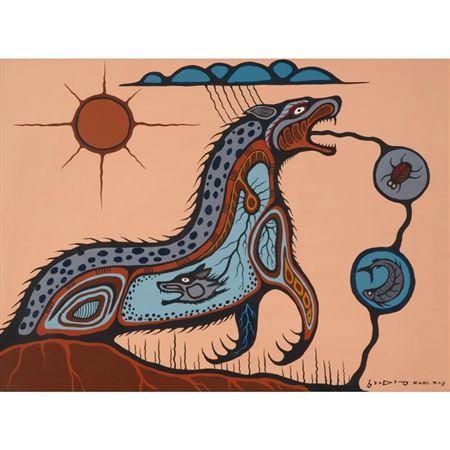 The following information was submitted in June of 2006 by C.Lista:In my limited research I found a book Sacred Legends of the Sandy Lake Cree by James Stevens. Illustrated by Carl Ray. McClelland and Stewart Ltd. c.1971, 25 Hollinger Road, Toronto 374. This book has painted the beliefs and stories of the Cree.
In the mid 70's the Royal Ontario Museum in Toronto held an exhibit of Carl Ray's work. The painting was then named "The Broken Moon".