Page loaded successfully. Showing biography for Carlos Nadal.
Carlos Nadal BIOGRAPHY
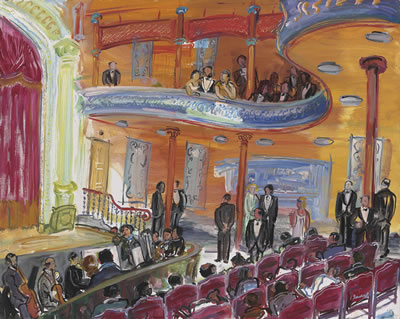
1917 Paris, France - 1998 Barcelona, Spain. Known for: Abstract naive-sophisticated marine, landscape and still life painting, murals.
Following is an obituary of the artist by John Duncalfe, The Independent, June 20, 1998. THE CATALAN painter Carlos Nadal was the last wild expressionist of Spain. He was also perhaps one of the last... Read full biography
Following is an obituary of the artist by John Duncalfe, The Independent, June 20, 1998. THE CATALAN painter Carlos Nadal was the last wild expressionist of Spain. He was also perhaps one of the last artists with direct connections to the original group of Fauvist painters. "A page of script can... Read full biography
Following is an obituary of the artist by John Duncalfe, The Independent, June 20, 1998. THE CATALAN painter Carlos Nadal was the last wild expressionist of Spain. He was also perhaps one of the last artists with direct connections to the original group of Fauvist painters. "A page of script can never replace a canvas," writes Hubert Nyssen in his book Carlos Nadal (1980):. Words seem to be inadequate in their attempt to recreate the pictorial work. Looking at this work, five words seem to... Read full biography
Following is an obituary of the artist by John Duncalfe, The Independent, June 20, 1998. THE CATALAN painter Carlos Nadal was the last wild expressionist of Spain. He was also perhaps one of the last artists with direct connections to the original group of Fauvist painters. "A page of script can never replace a canvas," writes Hubert Nyssen in his book Carlos Nadal (1980):. Words seem to be inadequate in their attempt to recreate the pictorial work. Looking at this work, five words seem to invite themselves: revelry, childhood, folly, dream, magic . Nadal's work at first appears to be naive, almost childlike. However, it is difficult not to turn and sup the extravagant wild colours, bold lines and strange perspective. Nadal was heavily... Read full biography
Following is an obituary of the artist by John Duncalfe, The Independent, June 20, 1998. THE CATALAN painter Carlos Nadal was the last wild expressionist of Spain. He was also perhaps one of the last artists with direct connections to the original group of Fauvist painters. "A page of script can never replace a canvas," writes Hubert Nyssen in his book Carlos Nadal (1980):. Words seem to be inadequate in their attempt to recreate the pictorial work. Looking at this work, five words seem to invite themselves: revelry, childhood, folly, dream, magic . Nadal's work at first appears to be naive, almost childlike. However, it is difficult not to turn and sup the extravagant wild colours, bold lines and strange perspective. Nadal was heavily influenced by Henri Matisse and Georges Braque, whom he met first as a young child at his father's studio.... Read full biography
Artist Biography
Biography page for Carlos Nadal ((1917 - 1998)), known for Abstract naive-sophisticated marine, landscape and still life painting, murals. Showing 4 biographical entries and 0 sample artworks.
Carlos Nadal - Artist Info
About Carlos Nadal
Name variants
Carles Nadal Farreras, Carlos Nadal Farreras
Biography from the Archives of askART
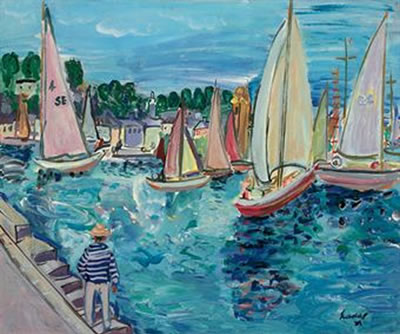 Following is an obituary of the artist by John Duncalfe, The Independent, June 20, 1998
THE CATALAN painter Carlos Nadal was the last wild expressionist of Spain. He was also perhaps one of the last artists with direct connections to the original group of Fauvist painters.
"A page of script can never replace a canvas," writes Hubert Nyssen in his book Carlos Nadal (1980):
Words seem to be inadequate in their attempt to recreate the pictorial work. Looking at this work, five words seem to invite themselves: revelry, childhood, folly, dream, magic . . .
Nadal's work at first appears to be naive, almost childlike. However, it is difficult not to turn and sup the extravagant wild colours, bold lines and strange perspective.
Nadal was heavily influenced by Henri Matisse and Georges Braque, whom he met first as a young child at his father's studio. He was born in Paris, in 1917, to Catalan parents. His father ran an atelier of decorative arts, making posters and theatre backdrops, which in the early 1920s was a lucrative business.
In 1921 his parents returned to Barcelona. The young Carlos Nadal could think only of painting. At the age of 13 he lied about his age and enrolled as a student of the School of Arts and Crafts in Barcelona, and in 1932 became a student of the Senior Fine Art Academy of St George, Barcelona.
In 1936 he was conscripted into the Republican Army during the Spanish Civil War, fighting with them on the Aragonese Front and, towards the end of the campaign, in the front line at Tremp.
In January 1939, he was captured and interred at the concentration camp at St Cyprien. He spent five long months only able to draw on walls and pieces of detritus. This stood Nadal in good stead as he later could and would paint on anything from tea-towels to wallpaper, if the correct materials were not available.
Nadal escaped from the camp and returned to Spain without documents; there he was arrested once again and detailed at Figueras. Eventually he was given a conditional discharge and returned to Barcelona, where he continued his studies. In 1942, Nadal's first one-man exhibition took place.
In 1944 he was commissioned by the Spanish painter Miguel Farre to assist with painting a series of large religious murals in three churches, the Iglesia Santa Ana and the Carmelites, in Barcelona, Tarrasa Cathedral and the Chapel Raventos, at the Raventos family estate, San Sarduni De Noya.
At the end of the Second World War, Nadal returned to Paris with a small scholarship from Barcelona Council. He additionally received a grant from the French Ministry of Culture. He began studies in the atelier of Ossip Zadkine, where he met his wife-to-be, a Belgian art student called Flore Joris.
At this time Nadal roomed in the Montparnasse area, where his close friends included the painters Antoni Clave, Oscar Dominguez, Andre Lanskoy and Joan Mir, and the writer Jean-Paul Sartre. He also met Georges Braque, Pablo Picasso, Albert Marquet, Raoul Dufy and Maurice Utrillo.
Nadal was able to take up residence in the Spanish Hall at the Universite de la Cite and, while sketching in the Parc Monceau opposite, he met Braque again, who had been watching him work for several days. He was invited to visit Braque's studio and, from then on, the Braque family often fed the hungry Nadal.
Although, by this time, Abstraction was becoming the great fashion, Nadal never lost his love for the Fauvist movement. In a series of later paintings, Homage to My Friends, he captures Fauvism and Cubism within a single canvas.
Nadal was offered a US scholarship in 1949 by the Carnegie Foundation, but chose instead to marry Flore Joris, by now a sculptor. They moved to Brussels, where Nadal took up a contract with the art dealer Louis Manteau, and where their neighbour was Rene Magritte. Nadal also made friends with Paul Delvaux.
Louis Manteau gave the Nadals use of a house on the Cote d'Azur near Villauris and there Nadal painted many of his Mediterranean works, Wild Seas with Luminous Skies, Bateau, and Paysage, with its red trees and blue villas - always colours to shock and astound. It was here that Manteau introduced Nadal to Picasso, and the two Spaniards became good friends, sometimes visiting Matisse, who was by now unwell.
In 1957 Nadal was commissioned to decorate the Belgian Pavilion at the World Atom Fair in Switzerland and then in 1958 to paint a large continuous mural for the Belgian Congo Transport Company at the Universal Exhibition in Brussels, consisting of 320 square metres of continuous painting.
By the Sixties, Nadal was in great demand for exhibitions in Europe, although little known in Britain. At last he had enough money to build his own studio and summer house near Barcelona.
In 1978 I was introduced to Nadal in Barcelona, and asked to represent him in the UK. I was stunned by "the artist that got away" - where had he been hiding? After several shows in the provinces, the Harrogate International Festival invited Nadal to hold a retrospective in 1984. Philip Solomon, Brian Sewell and I travelled out to Spain to make a selection for an exhibition in 1987 at the Solomon Gallery, in London.
Online Source:
www.independent.co.uk/arts-entertainment/obituary-carlos-nadal-1166103.html (Accessed 1/15/2014)Biography from Setdart
The son of Santiago Nadal, a painter and decorator based in Paris, Carles Nadal has lived in Barcelona since childhood, where the family moved due to his father's illness. At the age of thirteen he began to work as an apprentice in a decorative painting workshop, and in 1936 he received a scholarship from the City Council of Barcelona to study at the School of Fine Arts of Sant Jordi.
At the outbreak of the Civil War he was recruited into the Republican army, with which he fought on the fronts of Aragon and Tremp. At the beginning of 1939 he crossed the French border and was interned in the refugee camp of Saint Cyprien, where he remained for several months. He managed to escape and cross the border again, but was arrested and imprisoned in Figueras.
Under parole he returned to Barcelona, where he continueed his artistic career while simultaneously working as a decorator and studying Fine Arts. In 1941 he made his debut in a collective exhibition at the Dalmau Gallery, obtaining good reviews. He finished his studies with good grades, obtaining the recognition of teachers and professors, some of whom became friends and collaborators of the young Nadal. In fact, it was one of them, Luis Muntané, who facilitated his first individual exhibition in 1944, at La Pinacoteca in Barcelona.
Two years later he moved to Paris, again with a grant from the Barcelona City Council. There he worked and exhibited with the group Présence de l'Homme, as well as participated in the Salons d'Automne. Later, thanks to a scholarship from the French State, he attended the Paris School of Fine Arts. In 1948 he married Flore Joris, establishing his residence in Brussels, where he remained until the mid-seventies.
In Belgium he discovered, as he himself repeatedly stated, light and color. During these years he continued to show his work in Spain and Belgium as well as in France, Germany, Holland, Switzerland, the United Kingdom and the United States. Nadal's painting is post-impressionist, intensely colorful, and is based on the search for chromatic force as the most direct means of communication. His awards include the Grand Prix de Spa, Belgium, and his appointment as a member of the Royal Academy of London. His works can be found in the MACBA, the Spa Museum in Belgium and the Royal Museum of Brussels.Biography from Magna Art Auctions
Known as "the last of the Fauves", Carlos Nadal consolidates himself as one of the essential Spanish artists of the twentieth century. After years of academic training at the School of the Fish Market in Barcelona, Nadal configured his own artistic language with a great European professional career following the trend initiated in 1905 by Henri Matisse's circle.
While Fauvism helps to describe his work, it does not encompass the complexity of a style of his own. "Jardin en Provence" being a work of his last years, it fully reflects the characteristic expressive color that accompanied his career. In the greenery or buildings of "Jardin en Provence" we can establish a link with the work of other contemporary artists. Perhaps the most repeated by art historians has been Raoul Dufy for his tendency to color over line or the synthesis of forms, reducing to the most essential lines. In short, "Jardin en Provence" sums up the extensive artistic career of Carlos Nadal.Biography from Claude Aguttes
Spanish painter, Carlos Nadal was born in Paris. He has lived and worked in Barcelona, as well as intermittently in Brussels following his marriage to Flore Joris, a young Belgian artist.
It is thanks to his father and his commercial activities that Carlos Nadal met and discovered the works of Henri Matisse, Raoul Dufy and Maurice Utrillo. He will be particularly marked by Henri Matisse's fauvism, which he assimilates and transcribes in his paintings.