Page loaded successfully. Showing biography for Carmen Herrera.
Carmen Herrera BIOGRAPHY
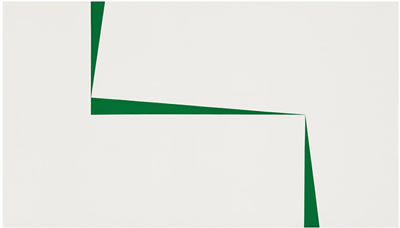
1915 Havana, Cuba - 2022 Lower Manhatten, New York. Known for: Pure abstract geometric white and black painting, minimalism.
Don’t Be Intimidated About Anything’: Carmen Herrera at 100. By Andrew Russeth Posted 06/05/15 . One afternoon in late April, the artist Carmen Herrera was sitting in her apartment and studio a few... Read full biography
Don’t Be Intimidated About Anything’: Carmen Herrera at 100. By Andrew Russeth Posted 06/05/15 . One afternoon in late April, the artist Carmen Herrera was sitting in her apartment and studio a few blocks north of Union Square recalling the frequent visits she would make to the Whitney Museum of... Read full biography
Don’t Be Intimidated About Anything’: Carmen Herrera at 100. By Andrew Russeth Posted 06/05/15 . One afternoon in late April, the artist Carmen Herrera was sitting in her apartment and studio a few blocks north of Union Square recalling the frequent visits she would make to the Whitney Museum of Art some 70 years ago, when it was located in Greenwich Village. “It was empty!” she said. “Nobody went to museums. It was incredible. And now, you go to a museum, you want to look at something and... Read full biography
Don’t Be Intimidated About Anything’: Carmen Herrera at 100. By Andrew Russeth Posted 06/05/15 . One afternoon in late April, the artist Carmen Herrera was sitting in her apartment and studio a few blocks north of Union Square recalling the frequent visits she would make to the Whitney Museum of Art some 70 years ago, when it was located in Greenwich Village. “It was empty!” she said. “Nobody went to museums. It was incredible. And now, you go to a museum, you want to look at something and hundreds of people are in front of you.”. Herrera shared this with good-natured exasperation, almost laughing as she complained. She turned 100 this past Sunday, and seems well past the age of worrying. Plus it would not quite be fair to be too upset... Read full biography
Don’t Be Intimidated About Anything’: Carmen Herrera at 100. By Andrew Russeth Posted 06/05/15 . One afternoon in late April, the artist Carmen Herrera was sitting in her apartment and studio a few blocks north of Union Square recalling the frequent visits she would make to the Whitney Museum of Art some 70 years ago, when it was located in Greenwich Village. “It was empty!” she said. “Nobody went to museums. It was incredible. And now, you go to a museum, you want to look at something and hundreds of people are in front of you.”. Herrera shared this with good-natured exasperation, almost laughing as she complained. She turned 100 this past Sunday, and seems well past the age of worrying. Plus it would not quite be fair to be too upset about the crowds at museums, since the throngs that are filling one of them at the moment, the Whitney’s new home in the Meatpacking Dis... Read full biography
Artist Biography
Biography page for Carmen Herrera ((1915 - 2022)), known for Pure abstract geometric white and black painting, minimalism. Showing 2 biographical entries and 0 sample artworks.
Carmen Herrera - Artist Info
About Carmen Herrera
Biography from the Archives of askART
 Don’t Be Intimidated About Anything’: Carmen Herrera at 100
By Andrew Russeth Posted 06/05/15
One afternoon in late April, the artist Carmen Herrera was sitting in her apartment and studio a few blocks north of Union Square recalling the frequent visits she would make to the Whitney Museum of Art some 70 years ago, when it was located in Greenwich Village. “It was empty!” she said. “Nobody went to museums. It was incredible. And now, you go to a museum, you want to look at something and hundreds of people are in front of you.”
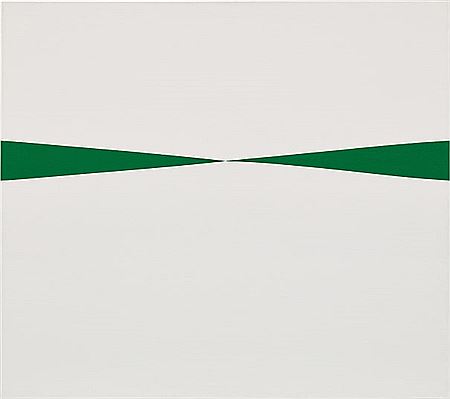
Herrera shared this with good-natured exasperation, almost laughing as she complained. She turned 100 this past Sunday, and seems well past the age of worrying. Plus it would not quite be fair to be too upset about the crowds at museums, since the throngs that are filling one of them at the moment, the Whitney’s new home in the Meatpacking District, are now seeing her work, after years of obscurity—a large painting she made in 1959 that has a short green isosceles triangle that stretches across the middle of a white canvas. The museum acquired it just last year.
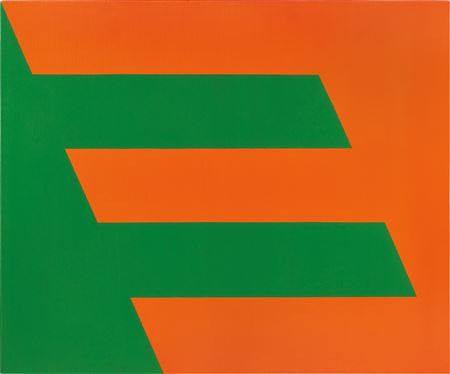
It is a stunning painting, and it is hung in perhaps the most beautiful and tranquil room in the new museum, alongside pieces by well-established giants like Frank Stella, John McLaughlin, Ellsworth Kelly, and Agnes Martin. The work is titled Blanco y Verde, a straightforward name that underscores Herrera’s remarkable achievement: an art of crisp, clear straight lines, of pure color and pure shape. Her paintings are cut to their bare minimum, but it would be wrong to describe them as sparse or restrained. Their solid colors are arranged so that they teem with energy, whether effervescent (as in a bright orange rectangular diptych from 2007) or subtle, like that 55-year-old white and green number.
In recent days Herrera had been having trouble hearing in one ear, and so her longtime friend, Tony Bechara, a voluble artist, sometimes helped her to understand my questions, speaking more loudly than me or translating them into Spanish, which she first spoke growing up in Havana. Nevertheless, she was quick with her quips. “Men!” she exclaimed, when Bechara spoke too much about her work. “We can’t live without them, and we cannot live with them.”
Herrera’s father was a newspaper editor, her mother a reporter. Growing up in Havana, she took art classes, but she studied to be an architect, quitting that path in the late 1930s when she married Jesse Loewenthal, a school teacher who died in 2000 at the age of 98. (By that point she had still not sold a single painting.) Around the time of her marriage she began painting in earnest.
Her first great inspiration was the Cuban artist Amelia Peláez, Herrera told me. “I admired her so much. I liked what she was doing. It was the first thing I really liked. I heard her and I asked questions, and she was terrific.”
The couple moved to New York, and Herrera studied at the Art Students League. “It was all women, and I hate to say it,” she said, shaking her head, “but we were like cats—fighting.” She recalled that one of her teachers, Fredo Sides, told one of her friends, “What is she doing here? Why doesn’t she go home and begin painting, think about whether she wants to be a painter or not? I think she’s very good, she better get out of here.” And so, “Thank you!” she said, “And I left.”
She and Loewenthal moved to Paris after the war, where she quickly fell in with the abstract artists showing under the banner of the Salon des Réalités Nouvelles, and she developed an organic form of abstraction, with flowing, curving shapes. Europe seemed more receptive to her work, and the fact that it was made by a woman. By the mid-1950s the two were back in New York for good, and her work became sharper and more minimal. Barnett Newman, whose paintings perhaps most closely resemble hers, and his wife, Annalee, were neighbors. “We used to have breakfast every Sunday together.”
“I was very young, much younger than they were,” she said. “I was just listening. I knew very little English, but it was very interesting.” What did she learn from him? “Don’t be intimidated about anything,” she said. That was a useful lesson since, despite having occasional shows in the coming decades, nothing ever sold, a streak that ended only in 2004, when Bechara got a dealer interested for the first time, igniting a wave of support from the market and museums.
Midway through the interview, Bechara suggested a Scotch, which Herrera usually enjoys midday. He abstains.
“He’s very sober, he doesn’t drink,” she announced.
“I only drink at night.”
“I don’t care!” she said in a mock huff.
Drink in hand, the stories kept coming. Filipino artist Alfonso A. Ossorio once lived below the apartment we were sitting in—Herrera has been in it for half a century—and had apparently wanted the space for himself. He would telephone occasionally and declare, “You better get out of there, because I’m going to kill you.”
And sitting with Jean Genet in Paris one day, an American woman approached, and attempted to flatter the writer, Herrera recalled. “She said, ‘Oh, I love your work,’ and this and that. And he said, ‘Oh, you too are a pederast?’” Herrera laughed heartily. “He was a sweet man but also a funny man.”
At 100, Herrera has become someone whom newspapers regularly declare, as Proust sardonically put it, one of “the last representatives of a world to which no witness any longer exists.” Of course, it is actually true, and the art world is finally paying its proper respects. The Whitney is at work on a retrospective for next year, Lisson Gallery, which represents her, is planning a show for later this year, and Alison Klayman, who directed Ai Weiwei: Never Sorry, is making a documentary about her life.
Meanwhile, though, Herrera is continuing to work. She still draws when she feels well enough, sitting by her front window, sketching out ideas for new paintings, which she then has transfers to grid paper and has her assistant execute. An unfinished new painting was sitting in her studio, a green triangle filling half of it. She was thinking about what to do with it next.
I asked her where her ideas for her forms come from. “I have to have it in my head,” she said. “I do a drawing, and then I figure it out.”
“Once you think about it,” she said, with a bit of bravado, “it’s very easy.”
“Art of the City” is a weekly column by ARTnews co-executive editor Andrew Russeth.
Source:
ARTNEWS, Web, May 2016Biography from the Archives of askART
 "Powerhouse Painter Carmen Herrera Inaugurates Lisson’s New York Gallery"
If you’re not yet familiar with Carmen Herrera, chances are you will be soon.
Artsy Editorial, By Casey Lesser, May 2nd, 2016
Today, London and Milan’s Lisson Gallery inaugurates its New York space with a highly anticipated show of Herrera’s paintings from the last two years. Ever since Lisson broke news of the exhibition in February (a prelude to her September solo show at the Whitney), the buzz around the artist has been mounting. We’ve been reminded that Herrera was born in Cuba in 1915 and is still going strong in the month of her 101st birthday; didn’t sell a work until 2004; ran in the circles of Josef Albers, Jean Arp, and Sonia Delaunay in Paris, and Barnett Newman in New York; and that despite the fact that she’s been a practicing artist in New York for more than half a century, tirelessly refining her bold geometric style, she’s only been recognized in a big, international, art-world way during the last decade. While it’s easy to get caught up in her fascinatingly unconventional narrative, take one step into Herrera’s Lisson show and the chatter falls away.
As I enter Lisson’s airy white cube on 24th Street, the 13 paintings (and one sculpture) inside are antidotes to an overcast Monday morning. The two-toned, hard-edged paintings jumping off of the white walls bear proud shocks of color—electric orange and kelly green, lemon yellow and black, cornflower blue and white among them. Certain works elicit a feeling of comfort, akin to seeing the colors of a favorite sports team or an alma mater.
The first work I see is Alpes (2015), a snow white rectangle cut by two deep green triangles. Like much of Herrera’s work, the painting confounds ideas of figure and ground, or background and foreground. She offers multiple ways of seeing the interlocking forms; someone else might see the green first, between mountains of white.
And while there’s something exceedingly enticing about Herrera’s crisp contrasts between colors, equally vital are her singular compositions. As Robert Storr points out in the exhibition catalogue essay, “The invigorating, one can even say suspenseful, essence of these works is their fundamental instability.” From rectangles filled with asymmetrical, alternating stripes, to a six-sided canvas checkered with red and white, to diptychs and triptychs that repeat patterns or conjoin to form a single symmetrical motif—it’s impossible to know what the artist might do next. A surprising, powerful sculpture made from intertwining blocks of aluminum, Untitled Estructura (Blue) (1962/2015), only adds to the mix. But even so, each work feels connected, fundamentally related, like members of a family.
Beginning with small maquettes in which she calculates her compositions and color palettes, Herrera neatly executes these paintings with an assistant through a method using tape and paint rollers. Though from afar, the works appear to be superhuman, machine-made feats, up close tiny traces of the artist’s hand are visible—faint pencil markings and miniscule beads of color that seeped beyond their boundaries. These slight imperfections are quiet reminders of the artist herself, and windows into her fastidious process.
In the foreword to the exhibition catalogue, Lisson founder Nicholas Logsdail recounts the experience of discovering Herrera’s work in 2009: “I couldn’t be sure whether or not I had seen these works somewhere before,” he writes. This sense of familiarity may be felt by many. Herrera distills painting to its purest elements—line, form, and color—in a way that feels familiar, but at the same time new. Much in the way that her career as an artist escapes any sense of convention, she escapes clean art-historical categorization. Herrera challenges western art-world conceptions in a way that is welcome, and needed.
?
—Casey Lesser
?Carmen Herrera is on view at Lisson Gallery, New York, May 3–June 11, 2016.