Page loaded successfully. Showing biography for Charles Berninghaus.
Charles Berninghaus BIOGRAPHY
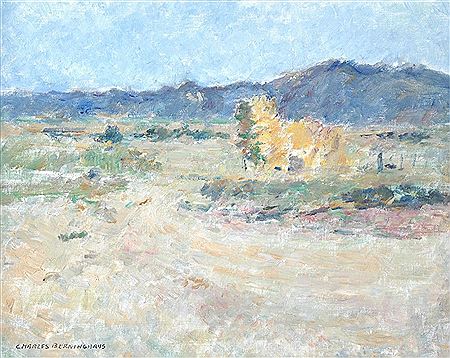
1905 St. Louis, Missouri - 1988 Taos, New Mexico. Known for: Landscape, floral outdoor, figure and mural painting.
The following biography is from information provided to AskART by Barbara Brenner, niece of Charles Berninghaus:. Charles Berninghaus, impressionist landscape painter, came by art quite naturally... Read full biography
The following biography is from information provided to AskART by Barbara Brenner, niece of Charles Berninghaus:. Charles Berninghaus, impressionist landscape painter, came by art quite naturally because his father, Oscar E. Berninghaus, had already made a name for himself in the art world by the... Read full biography
The following biography is from information provided to AskART by Barbara Brenner, niece of Charles Berninghaus:. Charles Berninghaus, impressionist landscape painter, came by art quite naturally because his father, Oscar E. Berninghaus, had already made a name for himself in the art world by the time Charles was born. Oscar first arrived in Taos in 1899 and was one of the six founders of the Taos Society of Artists, that well-known group that even today is known for the outstanding work its... Read full biography
The following biography is from information provided to AskART by Barbara Brenner, niece of Charles Berninghaus:. Charles Berninghaus, impressionist landscape painter, came by art quite naturally because his father, Oscar E. Berninghaus, had already made a name for himself in the art world by the time Charles was born. Oscar first arrived in Taos in 1899 and was one of the six founders of the Taos Society of Artists, that well-known group that even today is known for the outstanding work its members produced. (Julius) Charles Berninghaus was born May 19, 1905 in St. Louis, Missouri. His first trip to Taos was made when he was five years old. After his mother died in 1913, he and his older sister Dorothy, spent summers in Taos with their... Read full biography
The following biography is from information provided to AskART by Barbara Brenner, niece of Charles Berninghaus:. Charles Berninghaus, impressionist landscape painter, came by art quite naturally because his father, Oscar E. Berninghaus, had already made a name for himself in the art world by the time Charles was born. Oscar first arrived in Taos in 1899 and was one of the six founders of the Taos Society of Artists, that well-known group that even today is known for the outstanding work its members produced. (Julius) Charles Berninghaus was born May 19, 1905 in St. Louis, Missouri. His first trip to Taos was made when he was five years old. After his mother died in 1913, he and his older sister Dorothy, spent summers in Taos with their father. Oscar was a gentle and caring father, and the children loved their carefree summers in the Southwest. They often accompanied him on... Read full biography
Artist Biography
Biography page for Charles Berninghaus ((1905 - 1988)), known for Landscape, floral outdoor, figure and mural painting. Showing 3 biographical entries and 0 sample artworks.
Charles Berninghaus - Artist Info
About Charles Berninghaus
Name variants
Julius Charles Berninghaus
Biography from the Archives of askART
 The following biography is from information provided to AskART by Barbara Brenner, niece of Charles Berninghaus:
Charles Berninghaus, impressionist landscape painter, came by art quite naturally because his father, Oscar E. Berninghaus, had already made a name for himself in the art world by the time Charles was born. Oscar first arrived in Taos in 1899 and was one of the six founders of the Taos Society of Artists, that well-known group that even today is known for the outstanding work its members produced.
(Julius) Charles Berninghaus was born May 19, 1905 in St. Louis, Missouri. His first trip to Taos was made when he was five years old. After his mother died in 1913, he and his older sister Dorothy, spent summers in Taos with their father. Oscar was a gentle and caring father, and the children loved their carefree summers in the Southwest. They often accompanied him on trips into the mountains to sketch. Charles and Dorothy may have spent the time fishing as they both became excellent fly-fishers. They grew up knowing all the early artists with whom their father associated both in Taos and St. Louis.
Charles had an opportunity to see how all these artists worked, and always had access to paints and canvas. He attended St. Louis schools through high
school, graduating in 1924, followed by art training at the St. Louis School
of Fine Arts, the Art Institute of Chicago, and the Art Students League in New York.
After a short time in the overcrowded environment of New York, Charles
knew he preferred the clear skies of New Mexico and became a permanent
resident of Taos in 1927. He was encouraged by his father, but never pushed
to follow in his footsteps. Oscar knew Charles would have to find his own path and style. And this he did.
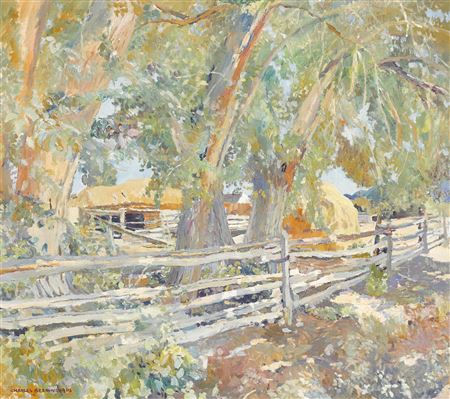
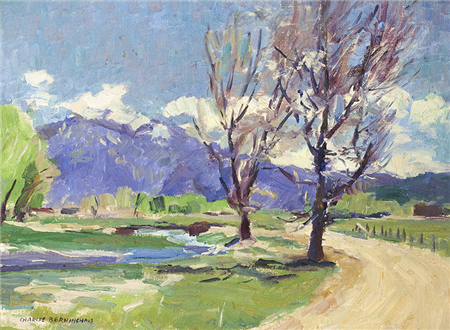
Charles' paintings are much more impressionistic than his fathers. He painted out doors almost exclusively, and painted very fast in order to catch the "light"of the moment. He used only one brush, wiping it clean before each change of color. Landscapes without figures are most common, as Charles loved the country, flowers, trees, and streams of New Mexico. He always said: "Why paint anything unpleasant?"
The whole outdoors was his studio and he carried his equipment in his car
with him at all times. His work at the art schools gave him a good fundamental background in drawing, but he is better known for his flower and landscape paintings.
The first exhibition in which Charles participated was at the Museum of Fine Arts in Santa Fe in October 1922. The paintings shown were "Church at Ranchos", "New Mexico" and "Loma Church". At that time Charles was 17 years old and not yet a high school graduate! Later exhibitions include: Art Institute of Chicago 39th Annual American show, 1926: "Fishing Boat"; Pennsylvania Academy of Fine Arts 122nd Annual Show 1927: "Fall" ; National Academy of Design, NY 1929: "Mountains and Snow" ; Art Institute of Kansas City Midwestern Exhibition, 1934: "Fall Aspens"; Museum of History and Art, Los Angeles: 1934 "The Corral Fence"; San Diego Museum, International Exhibition, 1935: "The Corral Fence"; Santa Fe Museum of Fine Arts 1935, 1939, 1943, 1944, National Academy of Design, NY, 120th Annual Exhibition, 1945: "Winter Landscape" at the Harwood annual Exhibit 1945.
A review of the St. Louis Art League exhibit in an article from the "St. Louis Globe," October 28, 1923, states: "...it so happens that the Berninghaus is not Oscar, the already famous painter of Indians, ponies and Taos Mountain, but his young son, Charles, who comes to the League show with four sketches in which it is impossible to find any trace of 'parental authority.' In fact, J. Charles considers his father something of an old fogy in art. He has his own ideas, and they are exceedingly modern."
Charles put the old fashioned practice of "Barter" to good use. Records show many trades of paintings for auto repairs, tires, tennis equipment, art supplies, radios, batteries etc. In 1938 he traded a 12 x 14 painting
called "Spring Aspens" to Mrs. Nicolai Fechin for a Nash automobile!
Charles' more modern and impressionistic paintings served as a transition from the works of the early Taos artists to that of Robert Daughters, Rod Goebel, Walt Gonske and others. His work became more abstract and loose as he aged, mostly because he didn't believe in paying an ophthalmologist for glasses when he really needed them. The dime store variety was all he ever used.
Charles was an individual who lived his life just as he wanted to. He was married twice, each for a relatively short time as he found that living alone he could be just who he wanted to be and do just what he wanted to do. His
possessions were few and bank account low, but he lived as he pleased and
was obligated to no one. Other artists said he was an "artist's artist", and
it is my belief that his work will be more and more appreciated as the years go by.
Charles Berninghaus died January 1, 1988, leaving us all emotionally richer for having known him, and visually richer with the paintings he left for the world to enjoy.Biography from Mark Sublette Medicine Man Gallery
Charles Berninghaus, son of artist Oscar E. Berninghaus, was born in St. Louis Missouri on May 19, 1905. When he was five years old, he made his first trip to Taos, New Mexico with his father on a sketching trip. His mother died in 1913, and Charles and his sister Dorothy started spending the summers with their father in Taos. Since Oscar was already a well-known artist and founder of the Taos Society of Artists, Charles was brought up around lots of artists and an abundance of art materials to play with.
Oscar encouraged his son to be an artist, but was aware of the importance of letting his son find his own style. Charles went to St Louis schools through high school and then attended the St. Louis School of Fine Arts, the Art Institute of Chicago and the Art Students League in New York. During this time, he still spent summers in Taos and finally moved to Taos for good in 1927. He helped his father paint a mural for the Missouri State Capitol in 1923. Charles eventually became a successful painter, mostly working plein air in an impressionistic style. He painted very rapidly and normally used only one brush which he would wipe clean before each change of color. Declaring, "Why paint anything unpleasant?" Berninghaus usually painted the landscape, trees, flowers and streams of New Mexico.
Charles' first exhibition was in 1922 at the Museum of Fine Arts in Santa Fe, when he was 17 and had not yet graduated from high school. He participated in many other exhibitions in the years to come including the Art Institute of Chicago, Pennsylvania Academy of Fine Arts, National Academy of Design, NY and the Museum of History and Art, Los Angeles.
In 1999 the Panhandle Plains Historical Museum mounted a collection of over 60 works from Charles and his father Oscar's work. Charles' work became more abstract as he got older, probably because he didn't believe in getting prescription glasses. He lived on very little money and bartered for much of what he wanted. He even traded a painting in 1938 for a Nash automobile from Mrs. Nicolai Fechin.
Berninghaus died on January 1, 1988 in Taos, New Mexico.
Bibliography
1. Panhandle Plains Historical Museum
2. Encyclopedia of Artists of the American West, Peggy and Harold Samuels
3. Museum of Fine Art, Santa FeBiography from Altermann Galleries and Auctioneers, I
 Charles (Julius) Berninghaus
Born: St. Louis, Missouri 9105
Died: Taos, New Mexico
Western landscape painter, muralist
Charles Berninghaus, son of Taos pioneer artist Edmund Berninghaus, studied at the St. Louis School of Fine Arts, Art Institute of Chicago, and the Arts Students League. His family had moved to Taos when he was in his late teens. He worked with his father on the murals for the Missouri State Capitol and for commercial clients.
Resource: SAMUELS' Encyclopedia of ARTISTS of THE AMERICAN WEST,
Peggy and Harold Samuels, 1985, Castle Publishing