Page loaded successfully. Showing biography for Charles L'Eplattenier.
Charles L'Eplattenier BIOGRAPHY
1874 Neuchâtel, Switzerland - 1946 Les Côtes-du-Doubs, Switzerland. Known for: Art nouveau design, nude figure, portrait, landscape painting, decorative arts, teaching.
Charles L'Éplattenier (1874–1946) was a Swiss painter and architect. A contemporary and associate of René Chapallaz, Léon Gallet, and Le Corbusier, L'Éplattenier is considered one of the foremost... Read full biography
Charles L'Éplattenier (1874–1946) was a Swiss painter and architect. A contemporary and associate of René Chapallaz, Léon Gallet, and Le Corbusier, L'Éplattenier is considered one of the foremost exponents of Swiss Art Nouveau despite working almost exclusively in the town of La Chaux de Fonds,... Read full biography
Charles L'Éplattenier (1874–1946) was a Swiss painter and architect. A contemporary and associate of René Chapallaz, Léon Gallet, and Le Corbusier, L'Éplattenier is considered one of the foremost exponents of Swiss Art Nouveau despite working almost exclusively in the town of La Chaux de Fonds, where from 1897 he taught at the school of decorative arts. He taught the architect Le Corbusier. It is possible that Le Corbusier was influenced in his choice of pseudonym by the name of his teacher. At... Read full biography
Charles L'Éplattenier (1874–1946) was a Swiss painter and architect. A contemporary and associate of René Chapallaz, Léon Gallet, and Le Corbusier, L'Éplattenier is considered one of the foremost exponents of Swiss Art Nouveau despite working almost exclusively in the town of La Chaux de Fonds, where from 1897 he taught at the school of decorative arts. He taught the architect Le Corbusier. It is possible that Le Corbusier was influenced in his choice of pseudonym by the name of his teacher. At the time La Chaux-de-Fonds was developing into one of the leading centres of the Swiss watch industry. Increasing prosperity created a large demand for property and art in the style of the time among the wealthy citizens of the city. L'Éplattenier... Read full biography
Charles L'Éplattenier (1874–1946) was a Swiss painter and architect. A contemporary and associate of René Chapallaz, Léon Gallet, and Le Corbusier, L'Éplattenier is considered one of the foremost exponents of Swiss Art Nouveau despite working almost exclusively in the town of La Chaux de Fonds, where from 1897 he taught at the school of decorative arts. He taught the architect Le Corbusier. It is possible that Le Corbusier was influenced in his choice of pseudonym by the name of his teacher. At the time La Chaux-de-Fonds was developing into one of the leading centres of the Swiss watch industry. Increasing prosperity created a large demand for property and art in the style of the time among the wealthy citizens of the city. L'Éplattenier and his students developed a local form of Art Nouveau known as style sapin ("pine style") after a frequently recurring motif. Style sapin is ch... Read full biography
Artist Biography
Biography page for Charles L'Eplattenier ((1874 - 1946)), known for Art nouveau design, nude figure, portrait, landscape painting, decorative arts, teaching. Showing 3 biographical entries and 0 sample artworks.
Charles L'Eplattenier - Artist Info
About Charles L'Eplattenier
Name variants
Charles Eplattenier, Charles Leplattenier
Biography from the Archives of askART
 Charles L'Éplattenier (1874–1946) was a Swiss painter and architect. A contemporary and associate of René Chapallaz, Léon Gallet, and Le Corbusier, L'Éplattenier is considered one of the foremost exponents of Swiss Art Nouveau despite working almost exclusively in the town of La Chaux de Fonds, where from 1897 he taught at the school of decorative arts. He taught the architect Le Corbusier. It is possible that Le Corbusier was influenced in his choice of pseudonym by the name of his teacher.
At the time La Chaux-de-Fonds was developing into one of the leading centres of the Swiss watch industry. Increasing prosperity created a large demand for property and art in the style of the time among the wealthy citizens of the city. L'Éplattenier and his students developed a local form of Art Nouveau known as style sapin ("pine style") after a frequently recurring motif. Style sapin is characterised by an intensive study of nature and the artistic stylization of indigenous structures.
L'Éplattenier's works include monuments to the Republic and the politician Numa Droz in La Chaux-de-Fonds, figures and decorative elements in the town's crematorium and at the cemetery, as well as repoussé and enamel watch case designs for the Gallet Watch Company. Upon funding for construction at the bequeath of Léon Gallet, the Musée des beaux-arts de La Chaux-de-Fonds (Beaux Arts Museum of La-Chaux-de-Fonds), was built to L'Éplattenier's designs.
L'Eplattenier also designed a prototype military helmet, which was shunned in favour of the Imboden helmet. L'Eplattenier's helmets are now prized collectors' items, and one is on display at the Morges Military Museum on Lake Geneva at the Swiss canton of Vaud.
L’Éplattenier designed in 1906 the 'Helvetia Brustbild' postage stamp for a new Swiss definitive series issued November 11, 1907. The new 10, 12, and 15 cent definitive stamps featured a half-length portrait of Helvetia.
A lover of the outdoors, L'Éplattenier fell to his death in 1946 from one of the rocky promontories while hiking along the River Doubs, near Brenets, Switzerland.
Source:
Wikipedia, Mar. 2019Biography from Dobiaschofsky Auktionen
After successful first drawing lessons at Neuenburger with watercolorist Paul Bouvier, Charles L'Eplattenier, scion of a peasant family, went in1890 to an aunt in Budapest, where he attended the arts school for three years.
A scholarship from the canton of Neuchâtel, Switzerland enabled him to continue his studies in 1896 at the Paris École des Beaux-Arts. Already at the age of 23, he was appointed professor at the École d'Art of La Chaux-de-Fonds, where he also served as director from 1903-1914.
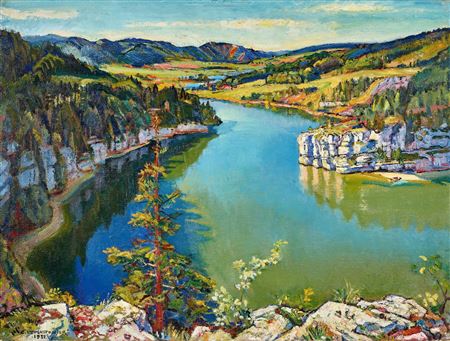
In addition to his teaching, he made a name for himself as a sculptor, architect and illustrator as well as a pioneer of new connections between art, craft and industry. In his work, the landscape always came first. With preference he chose motifs from the surrounding area. So he devoted himself repeatedly to the landscapes of the Jura and especially the areas along the Doubs in Switzerland.Biography from Dobiaschofsky Auktionen
After successful first drawing lessons with the Neuchâtel watercolorist Paul Bouvier, Charles L'Eplattenier, scion of a peasant family, went to live with an aunt in Budapest in 1890, where he attended the School of Arts and Crafts for three years. In 1896, a scholarship from the Canton of Neuchâtel enabled him to continue his studies at the École des Beaux-Arts in Paris.
At the age of 23, he was appointed professor at the École d'Art in La Chaux-de-Fonds, where he served as director from 1903 to 1914. In addition to his teaching activities, he made a name for himself as a sculptor, architect and illustrator, as well as a pioneer of new connections between art, craft and industry. In his work, the landscape was always at the forefront. With preference he chose motifs from the immediate surroundings. Thus, he repeatedly devoted himself to the landscapes of the Jura and especially the areas along the Doubs.