Page loaded successfully. Showing biography for Christopher (Kit) Wood.
Christopher (Kit) Wood BIOGRAPHY
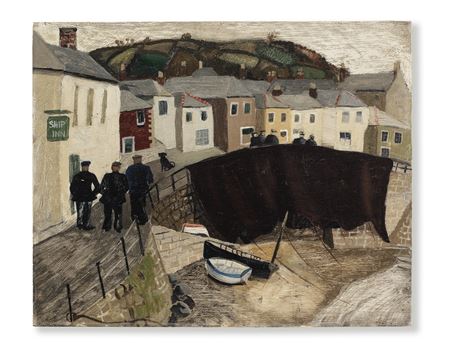
1901 Knowsley, England - 1930 Salisbury, England. Known for: Naive style landscape, figure, marine and still life painting.
Christopher Wood was born in Knowsley to Doctor Lucius and Clare Wood. He was educated at Marlborough College in Wiltshire, then briefly flirted with medicine and architecture at Liverpool University... Read full biography
Christopher Wood was born in Knowsley to Doctor Lucius and Clare Wood. He was educated at Marlborough College in Wiltshire, then briefly flirted with medicine and architecture at Liverpool University before pursuing an artistic career. At Liverpool University, Wood met Augustus John, who encouraged... Read full biography
Christopher Wood was born in Knowsley to Doctor Lucius and Clare Wood. He was educated at Marlborough College in Wiltshire, then briefly flirted with medicine and architecture at Liverpool University before pursuing an artistic career. At Liverpool University, Wood met Augustus John, who encouraged him to be a painter. The French collector Alphonse Kahn invited him to Paris in 1920. From 1921 he trained as a painter at the Academie Julian* in Paris, where he met Picasso, Jean Cocteau, Georges... Read full biography
Christopher Wood was born in Knowsley to Doctor Lucius and Clare Wood. He was educated at Marlborough College in Wiltshire, then briefly flirted with medicine and architecture at Liverpool University before pursuing an artistic career. At Liverpool University, Wood met Augustus John, who encouraged him to be a painter. The French collector Alphonse Kahn invited him to Paris in 1920. From 1921 he trained as a painter at the Academie Julian* in Paris, where he met Picasso, Jean Cocteau, Georges Auric and Diaghilev. He traveled around Europe and north Africa between 1922 and 1924. By the 1920s his father was running a General Practice in Broad Chalke, Wiltshire, and Wood painted a series of canvases there including Cottage in Broadchalke,... Read full biography
Christopher Wood was born in Knowsley to Doctor Lucius and Clare Wood. He was educated at Marlborough College in Wiltshire, then briefly flirted with medicine and architecture at Liverpool University before pursuing an artistic career. At Liverpool University, Wood met Augustus John, who encouraged him to be a painter. The French collector Alphonse Kahn invited him to Paris in 1920. From 1921 he trained as a painter at the Academie Julian* in Paris, where he met Picasso, Jean Cocteau, Georges Auric and Diaghilev. He traveled around Europe and north Africa between 1922 and 1924. By the 1920s his father was running a General Practice in Broad Chalke, Wiltshire, and Wood painted a series of canvases there including Cottage in Broadchalke, Anemones in a Window, Broadchalke, and The Red Cottage, Broadchalke. In 1926 Wood created designs for Ro... Read full biography
Artist Biography
Biography page for Christopher (Kit) Wood ((1901 - 1930)), known for Naive style landscape, figure, marine and still life painting. Showing 2 biographical entries and 0 sample artworks.
Christopher (Kit) Wood - Artist Info
About Christopher (Kit) Wood
Biography from the Archives of askART
 Christopher Wood was born in Knowsley to Doctor Lucius and Clare Wood. He was educated at Marlborough College in Wiltshire, then briefly flirted with medicine and architecture at Liverpool University before pursuing an artistic career.
At Liverpool University, Wood met Augustus John, who encouraged him to be a painter. The French collector Alphonse Kahn invited him to Paris in 1920. From 1921 he trained as a painter at the Academie Julian* in Paris, where he met Picasso, Jean Cocteau, Georges Auric and Diaghilev. He traveled around Europe and north Africa between 1922 and 1924.
By the 1920s his father was running a General Practice in Broad Chalke, Wiltshire, and Wood painted a series of canvases there including Cottage in Broadchalke, Anemones in a Window, Broadchalke, and The Red Cottage, Broadchalke.
In 1926 Wood created designs for Romeo and Juliet for Diaghilev's Ballets Russes, although they were never used. The same year he became a member of both the London Group* and the Seven and Five Society plus meeting and befriending Ben Nicholson and Winifred Nicholson. The Nicholson's dedication to his work had a great influence, and they subsequently painted together in Northumberland and Cornwall, then exhibited together at the Beaux Arts Gallery in April-May 1927.
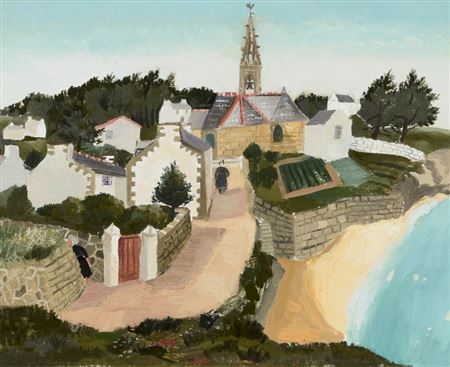
Like Nicholson, Wood admired Alfred Wallis whom they met on a trip to St Ives, and whose primitivism* influenced Woods' stylistic development. He painted coastal scenes, and his finest works are considered to be those painted in Brittany in 1929. He claimed that his "mother's people were Cornish and that he got his love of the sea and for boats from his Cornish ancestry".
In April 1929 Woods held a solo exhibition at Tooth's Gallery in Bond street London where he met Lucy Wertheim at a Private View. She purchased a picture and soon became one of his biggest supporters, buying up his work. For his part Wood apparently appreciated the support, telling Mrs Wertehim at her birthday party that : "I know that my future as a painter from now on will be bound up with your own, and I shall become great through you!"
In May 1930 he had a largely unsuccessful exhibition with Nicholson at the Georges Bernheim Gallery in Paris. In June and July he made a second sojourn to Brittany to create new work. Later in July Wertheim traveled to meet Wood in Paris, to choose the paintings for a one-man show that would be the opening exhibition at her new Wertheim Gallery in October. Discussing the exhibition over lunch the day after her arrival, Wood issued her with an ultimatum: "'I want you to promise to guarantee me twelve hundred pounds a year from the time of my exhibition, one hundred pounds a month being the least I can live on. If I can't have this sum I've made up my mind to shoot myself'". When she complained, he begged her forgiveness, and they went to review the paintings again. Following his death in August the show was cancelled; it was eventually staged as a memorial show at another gallery.
Wood was bisexual. In early summer of 1921, Wood met Antonio de Gandarillas, a Chilean diplomat. Gandarillas, a married homosexual fourteen years older than Wood, lived a glamorous life partly financed by gambling. Their relationship lasted through Wood's life, surviving his affairs with Jeanne Bourgoint and, probably, Jean Cocteau. In 1927 his plans to elope and marry heiress Meraud Guinness were frustrated by her parents whereupon he required emotional support from Winifred Nicholson. (Meraud went on to marry Alvaro Guevara in 1929.) Wood also had a liaison with a Russian émigrée, Frosca Munster, whom he met in 1928.
By 1930, addicted to opium and painting frenetically in preparation for his Wertheim exhibition in London, he suffered paranoia and began carrying a revolver. On August 21 he traveled to meet his mother and sister for lunch at 'The County Hotel' in Salisbury and to show them a selection of his latest paintings. After saying goodbye he jumped under a train at Salisbury railway station, although in deference to his mothers wishes it was reported as an accident.
Christopher Wood is buried in the churchyard of All Saints Church in Broad Chalke. His gravestone was carved by fellow artist and sculptor Eric Gill.
Although his planned exhibition at the Wertheim gallery was cancelled on his death, a posthumous exhibitions was held in February 1931. This was followed by an exhibition at the Lefevre Gallery in 1932.
The 1938 Venice Biennale* included some of his paintings, and later the Redfern Gallery (part of the New Burlington Galleries) compiled a major retrospective as part of the Neo-Romantic movement.
Bibliography
• Alfred Wallis, Christopher Wood, Ben Nicholson. Scottish Arts Council, 1987. ISBN 0-85031-849-1
• Button, Virginia. Christopher Wood. London: Tate, 2003. ISBN 1-85437-466-4
• Cariou, Andre. Christopher Wood: A Painter Between Two Cornwalls. London: Tate, 1996. ISBN 1-85437-224-6
• Faulks, Sebastian. The Fatal Englishman: Three Short Lives: Christopher Wood, Richard Hillary, Jeremy Wolfenden. London: Hutchinson, 1996.
• Ingleby, Richard. Christopher Wood: An English Painter. London: Allison & Busby, 1995. ISBN 0-85031-849-1 (hard) ISBN 0-7490-0263-8 (paper)
• Mason, William. Christopher Wood: The Minories, Colchester. London: Arts Council, 1979. ISBN 0-7287-0192-8
• Newton, Eric. Christopher Wood, 1901-1930. London: Redfern Gallery, 1938.
• Newton, Eric. Christopher Wood: His Life and Work. London: Zwemmer, 1057.
Source:
Wikipedia,
http://en.wikipedia.org/wiki/Christopher_Wood_%28English_painter%29
* For more in-depth information about these terms and others, see AskART.com Glossary http://www.askart.com/AskART/lists/Art_Definition.aspxBiography from Tennants
Christopher Wood (1901-1903), in his short life, became held in high regard amongst artistic circles in both London and Paris, being now remembered as a youthful genius. Born near Liverpool, he began drawing whilst recovering from septicaemia aged 14. After studying architecture and medicine for just a year at university, he moved to London in 1920. Here he met an art collector, who invited him to Paris, where he studied drawing a the Académie Julien. He was drawn effortlessly into fashionable artistic circles, where he met Augustus John and the diplomat Antonio de Gandarillas, whom he moved in with and was supported by. Gandarillas also introduced him to the likes of Pablo Picasso, Jean Cocteau and George Auric, along with opium.
Following the last-minute cancellation of a commission for designs for the Ballets Russe, Wood moved back to London, becoming first a member of the exhibiting collectives the London Group, and then the Seven and Five Society. Formatively, he exhibited with Ben and Winifred Nicholson in 1927, with whom he would become close friends. Wood accompanied the Nicholsons on painting trips to Cumberland and Cornwall, and in St. Ives discovered Alfred Wallis, whose ‘primitive’ expressionism helped him develop his own style.
In 1929 he was given a solo show at Arthur Tooth & Sons, and a rather less successful joint exhibition with Ben Nicholson in Paris. Having had a painting expedition to Brittany, the resulting paintings were due to be exhibited at Wertheim Gallery in London. However, Wood was struck by a train whilst traveling back from meeting his mother, thought to be suicide brought on by psychosis, despite being reported as an accident at the time. Posthumously, his work was widely exhibited.