Page loaded successfully. Showing biography for Christopher Patrick Hussey Murphy.
Christopher Patrick Hussey Murphy BIOGRAPHY
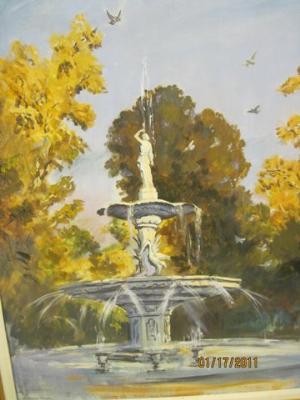
1869 Savannah, Georgia - 1939 Savannah, Georgia. Known for: Street scene and floral outdoor painting.
The following biography has been provided by Karen Towers Klacsmann, Adjunct Assistant Curator for Research, Morris Museum of Art, Augusta, Georgia. Christopher Murphy, a largely self-taught artist,... Read full biography
The following biography has been provided by Karen Towers Klacsmann, Adjunct Assistant Curator for Research, Morris Museum of Art, Augusta, Georgia. Christopher Murphy, a largely self-taught artist, was born in Savannah on December 2, 1869, to Christopher and Mary Murphy, who had immigrated to... Read full biography
The following biography has been provided by Karen Towers Klacsmann, Adjunct Assistant Curator for Research, Morris Museum of Art, Augusta, Georgia. Christopher Murphy, a largely self-taught artist, was born in Savannah on December 2, 1869, to Christopher and Mary Murphy, who had immigrated to Savannah from their native Ireland. The younger Murphy joined his father's commercial painting business at the age of nineteen. Although he did not take formal art lessons, Christopher amassed a library... Read full biography
The following biography has been provided by Karen Towers Klacsmann, Adjunct Assistant Curator for Research, Morris Museum of Art, Augusta, Georgia. Christopher Murphy, a largely self-taught artist, was born in Savannah on December 2, 1869, to Christopher and Mary Murphy, who had immigrated to Savannah from their native Ireland. The younger Murphy joined his father's commercial painting business at the age of nineteen. Although he did not take formal art lessons, Christopher amassed a library of art books, which he used in order to practice drawing and painting. As he gained more skill, the family business evolved to include sign painting, paper hanging, fresco painting, faux techniques, and decorating. In the 1890s, he met the artist... Read full biography
The following biography has been provided by Karen Towers Klacsmann, Adjunct Assistant Curator for Research, Morris Museum of Art, Augusta, Georgia. Christopher Murphy, a largely self-taught artist, was born in Savannah on December 2, 1869, to Christopher and Mary Murphy, who had immigrated to Savannah from their native Ireland. The younger Murphy joined his father's commercial painting business at the age of nineteen. Although he did not take formal art lessons, Christopher amassed a library of art books, which he used in order to practice drawing and painting. As he gained more skill, the family business evolved to include sign painting, paper hanging, fresco painting, faux techniques, and decorating. In the 1890s, he met the artist Lucile Desbouillons and the two married in January 1902, when Christopher returned from military service. The family, which eventua... Read full biography
Artist Biography
Biography page for Christopher Patrick Hussey Murphy ((1869 - 1939)), known for Street scene and floral outdoor painting. Showing 2 biographical entries and 0 sample artworks.
Christopher Patrick Hussey Murphy - Artist Info
About Christopher Patrick Hussey Murphy
Biography from Charleston Renaissance Gallery
CHRISTOPHER PATRICK HUSSEY MURPHY (1869-1939)
Georgia painter Christopher Patrick Hussey Murphy was born to Irish immigrant parents in Savannah. He undertook no formal art training as a youth, but rather built a sizeable collection of art books which he used as resources for study and practice. Murphy joined the family's commercial painting business at the age of nineteen and later served briefly in the military.
In 1902, Murphy married fellow Savannah artist Lucile Desbouillons and the couple became immersed in Savannah's burgeoning art community. The father of seven children, Murphy was able to travel along the East Coast, visiting Baltimore, Philadelphia, Washington, D.C., and New York, recording his impressions and visiting museums. Murphy enrolled in summer plein air painting classes with Eben Comins in Gloucester, Massachusetts in 1915 and soon after began to enter his paintings in exhibitions at the American Water Color Society, becoming an associate member of that organization in 1928.
The artist also worked in oil, pastel, and charcoal, eventually showing at the Fourth Annual Exhibition of American Art in New York, Art Institute of Chicago, Cincinnati Art Museum, Washington Watercolor Club, and Southern States Art League, as well as other local and regional outlets.
Two of the Murphys' seven children followed their parents' example and pursued artistic careers. Their eldest child Christopher enjoyed an exceptionally distinguished career of national repute, while their daughter Margaret became a noted and beloved painter and teacher in Georgia.
This essay is copyrighted by the Charleston Renaissance Gallery and may not be reproduced or transmitted without written permission from Hicklin Galleries, LLC.Biography from Morris Museum of Art
The following biography has been provided by Karen Towers Klacsmann, Adjunct Assistant Curator for Research, Morris Museum of Art, Augusta, Georgia.
Christopher Murphy, a largely self-taught artist, was born in Savannah on December 2, 1869, to Christopher and Mary Murphy, who had immigrated to Savannah from their native Ireland. The younger Murphy joined his father's commercial painting business at the age of nineteen. Although he did not take formal art lessons, Christopher amassed a library of art books, which he used in order to practice drawing and painting. As he gained more skill, the family business evolved to include sign painting, paper hanging, fresco painting, faux techniques, and decorating. In the 1890s, he met the artist Lucile Desbouillons and the two married in January 1902, when Christopher returned from military service.
The family, which eventually came to include seven children, lived in a house on East Perry Street. Christopher's business was housed in the building next door. Christopher and Lucile subscribed to art journals, copied paintings, and were well acquainted with the art community of Savannah, including the visiting artists who were instructors at the Telfair Academy of Arts and Sciences. When possible, Christopher traveled, and his visits to Baltimore, Philadelphia, Washington, D.C., and New York, where he sketched the architectural and sculptural treasures each city had to offer, provided him time to visit museums. In 1911, Christopher was awarded a commission to decorate the interior of the Cathedral of Saint John the Baptist, the diocesan seat of the Catholic Church in southern Georgia. The church had been destroyed by a fire in 1898, and the rebuilding project included complex mural decorations executed by Murphy that he completed in May 1912.
Even as a mature and, by most standards, successful artist, Christopher continued his self-study and was influenced by the watercolors of John Singer Sargent. He enrolled in the summer plein air painting classes of Eben F. Comins in Gloucester, Massachusetts, in 1915. The summer course included classes in life drawing. Within the next few years Murphy began submitting his watercolors for exhibition at the American Watercolor Society in which he became an associate member in 1928. His work was included at the Sixth International Watercolor Exhibition held at the Art Institute of Chicago and at the Cincinnati Art Museum in 1926. On a regional level, his work was exhibited with the Washington Watercolor Club, Southern States Art League, Savannah Art Club, and the Association of Georgia Artists. In the final year of his life, one work of his was included in the Fourth Annual Exhibition of American Art in New York.
Christopher Murphy died on November 27, 1939.
Ten works by Christopher Murphy—six watercolors, two oils, a pastel, and a mixed-media piece—which span his career, are included in the permanent collection of the Morris Museum of Art, illustrating his versatility and the breadth of his interests.