Page loaded successfully. Showing biography for Claude Curry Bohm.
Claude Curry Bohm BIOGRAPHY
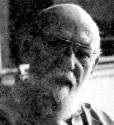
1894 Nashville, Tennessee - 1971 Nashville, Indiana. Known for: Landscape, coastal view, genre, teacher.
C. Curry Bohm, a photographer, painter, and printmaker whose artistic career spanned five decades, was an integral part of the Chicago art scene in the 1920s and a very prominent part of the second... Read full biography
C. Curry Bohm, a photographer, painter, and printmaker whose artistic career spanned five decades, was an integral part of the Chicago art scene in the 1920s and a very prominent part of the second generation of the Brown County, Indiana art colony from his first visit in 1920 until his death,... Read full biography
C. Curry Bohm, a photographer, painter, and printmaker whose artistic career spanned five decades, was an integral part of the Chicago art scene in the 1920s and a very prominent part of the second generation of the Brown County, Indiana art colony from his first visit in 1920 until his death, serving as a charter member of the Brown County Art Gallery Association and helping to transform “Brown County into one of the nation’s outstanding art colonies.” . The short, blonde-haired, gray-eyed... Read full biography
C. Curry Bohm, a photographer, painter, and printmaker whose artistic career spanned five decades, was an integral part of the Chicago art scene in the 1920s and a very prominent part of the second generation of the Brown County, Indiana art colony from his first visit in 1920 until his death, serving as a charter member of the Brown County Art Gallery Association and helping to transform “Brown County into one of the nation’s outstanding art colonies.” . The short, blonde-haired, gray-eyed Curry inherited some of his penchant for paints from his father Robert W. Bohm, a noted portrait, mural, and scenery painter whose family hailed from Louisiana where he was born in 1868 in New Orleans. Between 1886 and 1900, the elder Bohm was... Read full biography
C. Curry Bohm, a photographer, painter, and printmaker whose artistic career spanned five decades, was an integral part of the Chicago art scene in the 1920s and a very prominent part of the second generation of the Brown County, Indiana art colony from his first visit in 1920 until his death, serving as a charter member of the Brown County Art Gallery Association and helping to transform “Brown County into one of the nation’s outstanding art colonies.” . The short, blonde-haired, gray-eyed Curry inherited some of his penchant for paints from his father Robert W. Bohm, a noted portrait, mural, and scenery painter whose family hailed from Louisiana where he was born in 1868 in New Orleans. Between 1886 and 1900, the elder Bohm was associated with Robert L. Struve as a stage set painter for New Orleans theatres such as the St. Charles Theatre and the Academy o... Read full biography
Artist Biography
Biography page for Claude Curry Bohm ((1894 - 1971)), known for Landscape, coastal view, genre, teacher. Showing 3 biographical entries and 0 sample artworks.
Claude Curry Bohm - Artist Info
About Claude Curry Bohm
Name variants
C Curry Bohm
Biography from the Archives of askART
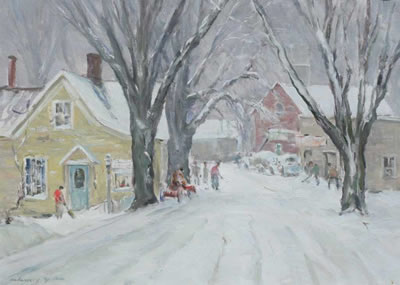 C. Curry Bohm, a photographer, painter, and printmaker whose artistic career spanned five decades, was an integral part of the Chicago art scene in the 1920s and a very prominent part of the second generation of the Brown County, Indiana art colony from his first visit in 1920 until his death, serving as a charter member of the Brown County Art Gallery Association and helping to transform “Brown County into one of the nation’s outstanding art colonies.”
The short, blonde-haired, gray-eyed Curry inherited some of his penchant for paints from his father Robert W. Bohm, a noted portrait, mural, and scenery painter whose family hailed from Louisiana where he was born in 1868 in New Orleans. Between 1886 and 1900, the elder Bohm was associated with Robert L. Struve as a stage set painter for New Orleans theatres such as the St. Charles Theatre and the Academy of Music and for musical venues in Mobile, Alabama.
In addition, they decorated floats and other artwork for carnival parades, including Mardi Gras. Bohm’s mother, Pauline Ogier (sometimes Oger), was born in either 1874 or 1878 in Louisville, Kentucky where her parents had settled after emigrating from France; her father was French, her mother Swiss. How and where Bohm’s parents met has yet to be established but they married around 1894, when she was either twenty or sixteen years old and he was twenty-six; Curry was born soon thereafter. Bohm’s birth has been recorded as taking place in Nashville, Tennessee on October 19, 1894, which would have been two days before his maternal grandfather, Claud Ogier, was buried in Louisville, Kentucky.
According to the 1900 United States Census, Bohm was born in August 1895 in New Orleans, Louisiana. Curry was raised in New Orleans for the first several years of his life in a home on Mandeville Street with a studio for his father near Washington Square not far from the French Quarter, in the 2nd Precinct, 8th Ward, Orleans Parish, New Orleans. Here he watched his father paint and, as he recalled later in life, had his own first adventures with paint and brush.
After the early death of his father at the age of 32 in 1901, a “readjustment of the family affairs became necessary and Curry was brought to Louisville” where his mother had family. He attended primary and secondary school in the city, living there for at least fifteen years. In 1913, eighteen-year-old Curry met fifteen-year-old Lillian Harrington at a New Year’s Eve party and just over seven months later the two eloped, fabricating facts on their marriage license in Clark County, Indiana to be wed. This appears to be when and how Curry Bohm became Claud (Claude) Curry Bohm, adopting his first name from his maternal grandfather. At the time of their marriage, Curry listed his occupation as cable splicer; he was eventually employed as a pressman for Fetters printing house in Louisville and he continued in this trade after the couple moved to Chicago around 1916.
Shortly after settling in Chicago and finding employment at the Lincoln Printing Company, the Bohms relocated for a year to Buffalo, New York, where Curry’s mother was living; Lillian was concerned about the draft. During this visit, or a previous one, Curry visited the Albright Art Gallery, now the Albright-Knox Art Gallery in Buffalo and either here, or at another venue, he saw an exhibition of pictorial photography. This experience inspired him to take up the camera, an art which he practiced for several years after the couple returned to the Windy City.
From the late 1910s to 1932 the Bohms lived and worked primarily in Chicago and Curry became a prominent part of the city’s artistic community. During these years Bohm worked for various printing companies including the Lincoln Printing Company and W. P. Dunn Company and he and Lillian lived in the Bucktown and Ravenswood neighborhoods. Though his work week must have been quite demanding, Bohm found time to indulge his artistic interests and was drawn to painting and photography.
It does not appear that Bohm was a formal student at the Art Institute of Chicago or the National Academy of Design in New York as some reports have indicated. From 1922 to at least 1928 Bohm belonged to the Chicago Business Mens Art Club, an organization of non-professional artists founded by Elbert G. Drew and Erwin S. Barrie, among others. The club was “strictly an amateur organization” open to “men thirty years or over who are not following art as a livelihood and are seeking more art knowledge.” The objective of the group was “to encourage the study and practice of painting and the kindred arts among its members and to co-operate with societies aiming to broaden the appreciation of art in our city and elsewhere.” Monthly meetings were held where members received criticisms from professional artists and there was also weekly evening instruction from Karl A. Buehr and Edward J. Timmons with some members, like Bohm, taking outdoor sketching classes from the latter as well. Eventually the Art Institute of Chicago supplied the group with “a class room and lockers, a meeting place and the use of the library.” The club held occasional exhibitions, had summer cottages for outdoor work near local lakes and rivers, and eventually had its own club rooms and studio.
Bohm was also active in the Chicago Camera Club from at least 1922 when he exhibited with the group at the Art Institute of Chicago, to around 1926; he served as secretary of the group for the 1925-26 season. In 1926, Bohm became a member of the Palette & Chisel Club (later named the Palette and Chisel Academy of Fine Arts) and remained a member for decades. He had a studio at the club for two years and exhibited at the clubhouse frequently, winning a gold medal in 1931.
Bohm’s affiliation with Indiana began around 1920 when he first visited the Peaceful Valley of Brown County. He exhibited at the Hoosier Art Gallery in Chicago and showed regularly at the Hoosier Salon in both Chicago and Indianapolis from 1928 until his death. Over the years Bohm won numerous awards from the Hoosier Salon including the Edward Rector Memorial, the Lawrence A. Downs Prize, Daughters of Indiana of Chicago Award, and the Summer Landscape Prize. He also won prizes from the Indiana Artists’ Club and the Brown County Art Gallery.
After visiting Nashville annually for several years, the Bohms moved there in 1932 and eventually became permanent residents. Bohm was a charter member of the Brown County Art Gallery Association and also served as president, vice-president, and director of the Brown County Art Guild. During his years in Nashville, Bohm also was a mentor and teacher to many aspiring painters. Bohm exhibited regularly throughout lifetime at the Palette & Chisel Club, the Hoosier Salon and various galleries in Illinois, the Hoosier Salon, Indiana Artists’ Club, Brown County Artists Guild, and galleries in Indiana, at the North Shore Art Association and Rockport Art Association in Massachusetts, and elsewhere. His most prestigious accolade came from the selection of his painting The Grey Blanket to represent the state of Indiana in the show of Contemporary Art of the United States from the collection of International Business Machines at the Golden Gate International Exposition in San Francisco in 1940. Claud(e) Curry Bohm died in Nashville, Indiana on November 18, 1971.
Source/Submitted by: © 2020 Laurette E. McCarthy, Ph.D. (Laurette E. McCarthy, Ph.D., the foremost expert on Walter Pach and the leading authority on 1913 Armory Show, specializes in American and Modern art. She also has a sub specialty in historic Indiana art.)Biography from the Archives of askART
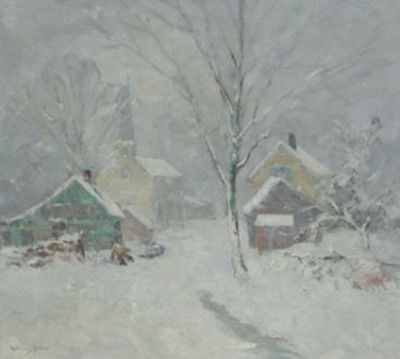 The following is submitted by Tara L. Uebelhor who writes that this is "information that was in my file on C. Curry Bohm. I'm not sure of the original source."
C. Curry Bohm was born in Nashville, Tennessee on October 19, 1894. He studied at the National Academy and also at the Art Institute of Chicago. He also studied with Edward F. Timmons. His watercolors and oils reflect his versatility and love of life. He has always been exceedingly generous in civic affairs and showed his patriotism during World War II by working for General Motors for 28 months. He made his first visit to Brown County in 1920, returning yearly to paint until 1932 when he and his wife, Lillian, made Nashville their permanent home.
C. Curry Bohm is a charter member of the Brown County Art Gallery Association and a member of the Brown County Art Guild. He is also a member of the Hoosier Salon, Rockport Art Association, Rockport, Massachusetts; the North Shore Art Association, Gloucester, Massachusetts.
His associations are the Chicago Palette and Chisel, Academy of Fine Arts.
Mr. Bohm received the Chicago Municipal Art League Prize; The Gold Medal in the Chicago Palette and Chisel; the Frederick N. Vance Memorial Award from the Brown County Art Gallery; the Edward Rector Memorial from the Hoosier Salon; the Lawrence A. Downs Prize; the Tri Kappa Purchase Prize; Daughters of Indiana Award; and the Hoosier Salon Summer Landscape Prize. Mr. Bohm was selected by the International Business Machines Corporation for representation at the World's Fair in 1940.Biography from the Archives of askART
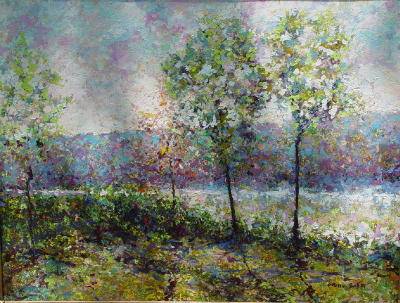 The following museums currently have works by C. Curry Bohm :
Indianapolis Museum of Art
Indiana State Museum
Illinois State Museum
Brauer Museum of Art
Swope Art Museum
Eskenazi Museum of Art, Indiana University
Evansville Museum
Figge Art Museum
Brown County Art Gallery
Brown County Art Guild
Tri Kappa Art Collection at Rose-Hulman Institute of Technology
Indiana Memorial Union Art Collection
Museums in which C. Curry Bohm exhibited during his career :
Art Institute of Chicago
Corcoran Gallery of Art
Smithsonian American Art Museum
Indianapolis Museum of Art
Figge Art Museum
Illinois State Museum
Evansville Museum
Brown County Art Gallery
Brown County Art Guild
Source/Submitted by: Dan Kraft (June 2020)