Page loaded successfully. Showing biography for Claude Langevin.
Claude Langevin BIOGRAPHY
Born 1942 Montreal, Canada. Known for: City scene, rural landscape.
Born in 1942 in Montreal, Claude Langevin first studied medicine at l'Universite de Montreal and then abandoned that subject to become a painter. Interested in art since childhood, he found a job in... Read full biography
Born in 1942 in Montreal, Claude Langevin first studied medicine at l'Universite de Montreal and then abandoned that subject to become a painter. Interested in art since childhood, he found a job in a commercial gallery working with his cousin. After several years, the self-taught artist had... Read full biography
Born in 1942 in Montreal, Claude Langevin first studied medicine at l'Universite de Montreal and then abandoned that subject to become a painter. Interested in art since childhood, he found a job in a commercial gallery working with his cousin. After several years, the self-taught artist had refined his technique, understood his subject, analyzed light and, in short, regarded himself as a true professional artist. After a period of working with acrylic and spatula, he rediscovered Tom Thomson... Read full biography
Born in 1942 in Montreal, Claude Langevin first studied medicine at l'Universite de Montreal and then abandoned that subject to become a painter. Interested in art since childhood, he found a job in a commercial gallery working with his cousin. After several years, the self-taught artist had refined his technique, understood his subject, analyzed light and, in short, regarded himself as a true professional artist. After a period of working with acrylic and spatula, he rediscovered Tom Thomson and Clarence Gagnon and began to use oil and brush. Thus, having chosen his medium, he has painted for the past 20 years city and country scenes throughout the Quebec province and in the Maritimes. He lives in the Laurentians, in Sainte-Adele, and... Read full biography
Born in 1942 in Montreal, Claude Langevin first studied medicine at l'Universite de Montreal and then abandoned that subject to become a painter. Interested in art since childhood, he found a job in a commercial gallery working with his cousin. After several years, the self-taught artist had refined his technique, understood his subject, analyzed light and, in short, regarded himself as a true professional artist. After a period of working with acrylic and spatula, he rediscovered Tom Thomson and Clarence Gagnon and began to use oil and brush. Thus, having chosen his medium, he has painted for the past 20 years city and country scenes throughout the Quebec province and in the Maritimes. He lives in the Laurentians, in Sainte-Adele, and holds regular exhibitions in all the major urban centres of Canada. He is represented in many public and private collections. Sour... Read full biography
Artist Biography
Biography page for Claude Langevin ((Born 1942)), known for City scene, rural landscape. Showing 1 biographical entries and 0 sample artworks.
Claude Langevin - Artist Info
About Claude Langevin
Biography from the Archives of askART
 Born in 1942 in Montreal, Claude Langevin first studied medicine at l'Universite de Montreal and then abandoned that subject to become a painter. Interested in art since childhood, he found a job in a commercial gallery working with his cousin.
After several years, the self-taught artist had refined his technique, understood his subject, analyzed light and, in short, regarded himself as a true professional artist. After a period of working with acrylic and spatula, he rediscovered Tom Thomson and Clarence Gagnon and began to use oil and brush.
Thus, having chosen his medium, he has painted for the past 20 years city and country scenes throughout the Quebec province and in the Maritimes. He lives in the Laurentians, in Sainte-Adele, and holds regular exhibitions in all the major urban centres of Canada. He is represented in many public and private collections.
Source:
Multi Art Ltd., Submitted May 2004 by Natalie Beauchamp, Vice-President
----------------------------------------------------------------------
The following, also from Multi Art Ltd., is written by Marc de Roussan and is published at http://www.multi-art.net/artistes/Langevin/index.htm
CLAUDE LANGEVIN
Artist Statement:
"An artist begins to form his own style when he stops imitating nature and starts interpreting it. At this sage, the distinctive features that identify individual painters are visible in each canvas."
Claude Langevin has been painting for over thirty years. A self-taught artist to whom painting is second-nature, he continues to derive great pleasure from his art. He often finds inspiration riding the bicycle path along the route of the old Laurentian railway to Sainte-Adele, his adopted home. Straddling his bicycle, with a loaf of bread, some cheese and a bottle of wine to enjoy, and his painting gear loaded into a mini trailer, he sets off to explore the countryside, in search of a spot as yet undiscovered by most.
Since he first settled in Sainte-Adele 27 years ago, his Laurentian surrounding have changed dramatically. Urban sprawl has spread as far as Saint-Sauveur, the next village, turning it into a bedroom-community, almost a suburb of Montreal. Under the guise of modernism, civilization has forced the landscape artist even deeper into the country in search of inspiration. Several regions of Quebec have undergone a similar transformation, including Charlevoix, where towering buildings and condos have altered the look of several villages. Claude Langevin often sets up his easel in this area.
"That part of the country is magnificent. I'm not saying it's more beautiful than the Laurentians. When you live in a region fora long time, familiarity diminishes its beauty. You have to visit other places, find other sources of inspiration, before you can finally return and rediscover the charms of home"
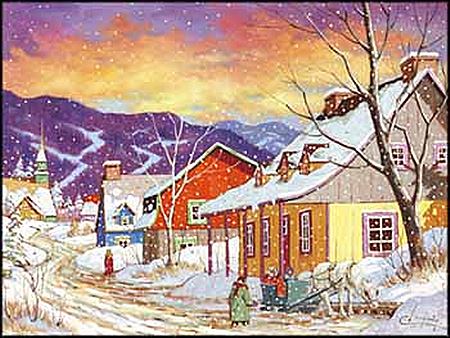
He is often inspired by winter, seeing thousands of contrasting colours in the snow, each one as vibrant as the next. Its whiteness is only superficial. Like water, snow takes on the tones of the sky, becoming at times pink, blue or green, while its luminosity is also affected infinite ways by the changing seasons.
" In my youth, I would often paint in temperatures of 20 degrees. Paint would freeze on my palette. I know better now". Today a wiser Langevin does his preliminary sketches outdoors and completes his canvas in comfort in his studio. When the warmer weather returns, he goes back to making direct sketches from nature of the landscapes he paints. Studio work brings its own difficulties, since the artist must rely on his imagination to recreate the colours and contours of the land. Painting outdoors, he is more aware of the form and closer to the reality he wishes to interpret.
The world of painting has not escaped the madness that has gripped society since the 80's. Caught up in the frenzy, people no longer stop to appreciate the passage of time, the ephemeral shape of a cloud, the free flow of a waterfall, the incomparable colours of autumn. In the country, the city-dweller would once linger to enjoy the change of scenery and pace. Today the urbanite tries to recreate his daily grind in a rural setting that is expected to provide all the comforts and advantages of the city.
Artists are not exempt from this evolution. Langevin feels no bitterness or regret in the face of such blatant modernism. He merely notes that the picturesque side of Quebec villages is gradually disappearing. "I don't know if it's good or bad, but it's a change for sure. We can continue to feel nostalgia form our childhood without necessarily feeling regret". This connoisseur of antique furniture and heritage building interprets an era and serves as an ambassador for a region.
Many artists give workshops for the amateur. Galleries have sprouted everywhere. A young artist will always find an outlet for his work as today's art market reaches a much wider public. We're light years away from the days when galleries and museums were hollowed shrines the uninitiated dared nor enter. And painters had to first prove themselves, demonstrating that their work was worthy to be hung. Now, the good artist, the serious artists, remain on the scene; the others merely make a brief foray: Three rounds and they're gone..