Page loaded successfully. Showing biography for Clementine Reuben Hunter.
Clementine Reuben Hunter BIOGRAPHY
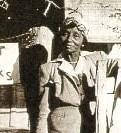
1887 Natchitoches Parish, Louisiana - 1988 Natchitoches Parish, Louisiana. Known for: Southern plantation folk art genre and landscape painting.
Often referred to as "the black Grandma Moses," Clementine Hunter painted four to five thousand paintings, which were boldly colored images in folk art style of plantation life in Louisiana. Her... Read full biography
Often referred to as "the black Grandma Moses," Clementine Hunter painted four to five thousand paintings, which were boldly colored images in folk art style of plantation life in Louisiana. Her subjects included everyday activities such as doing laundry and festive events including weddings,... Read full biography
Often referred to as "the black Grandma Moses," Clementine Hunter painted four to five thousand paintings, which were boldly colored images in folk art style of plantation life in Louisiana. Her subjects included everyday activities such as doing laundry and festive events including weddings, dances, and church going. She also did mural painting, and a number of her works had Christian religious subjects. She was born at Hidden Hill Plantation near Natchitoches, Louisiana, and lived there the... Read full biography
Often referred to as "the black Grandma Moses," Clementine Hunter painted four to five thousand paintings, which were boldly colored images in folk art style of plantation life in Louisiana. Her subjects included everyday activities such as doing laundry and festive events including weddings, dances, and church going. She also did mural painting, and a number of her works had Christian religious subjects. She was born at Hidden Hill Plantation near Natchitoches, Louisiana, and lived there the remainder of her life pf one-hundred-one years, raising seven children and working in the fields. She attended a local Catholic school, but quit at a young age and never learned to read or write. At age sixteen, she moved to nearby Melrose Plantation,... Read full biography
Often referred to as "the black Grandma Moses," Clementine Hunter painted four to five thousand paintings, which were boldly colored images in folk art style of plantation life in Louisiana. Her subjects included everyday activities such as doing laundry and festive events including weddings, dances, and church going. She also did mural painting, and a number of her works had Christian religious subjects. She was born at Hidden Hill Plantation near Natchitoches, Louisiana, and lived there the remainder of her life pf one-hundred-one years, raising seven children and working in the fields. She attended a local Catholic school, but quit at a young age and never learned to read or write. At age sixteen, she moved to nearby Melrose Plantation, where she worked for many years as a field hand. Her first male companion and father of two of her children was Charlie Dupree, who di... Read full biography
Artist Biography
Biography page for Clementine Reuben Hunter ((1887 - 1988)), known for Southern plantation folk art genre and landscape painting. Showing 2 biographical entries and 0 sample artworks.
Clementine Reuben Hunter - Artist Info
About Clementine Reuben Hunter
Biography from the Archives of askART
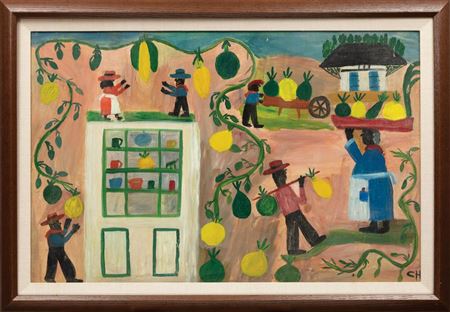 Often referred to as "the black Grandma Moses," Clementine Hunter painted four to five thousand paintings, which were boldly colored images in folk art style of plantation life in Louisiana. Her subjects included everyday activities such as doing laundry and festive events including weddings, dances, and church going. She also did mural painting, and a number of her works had Christian religious subjects.
She was born at Hidden Hill Plantation near Natchitoches, Louisiana, and lived there the remainder of her life pf one-hundred-one years, raising seven children and working in the fields. She attended a local Catholic school, but quit at a young age and never learned to read or write. At age sixteen, she moved to nearby Melrose Plantation, where she worked for many years as a field hand.
Her first male companion and father of two of her children was Charlie Dupree, who died in 1914. Ten years later she married Emanuel Hunter, and moved into the plantation house where she was in charge of the domestic work. Becoming associated with the plantation mistress, Ms. Cammie Henry, changed Hunter's life. Henry, was an archivist and artist who actively encouraged the arts. She opened her home to artists and authors who needed a quiet place to work. It was at Melrose that Hunter first began her production of hand made quilts, dolls, and lace curtains.
Meeting artist friends of Ms. Henry, Hunter met many people in the art world and was especially influenced and promoted by Francois Mignon, who was an artist-in-residence at the plantation. In 1946, under his direction, she did her first work, a plantation baptism scene, from a few partially used tubes of oil paint on a window shade that he provided. Another supporter at that time was James Register, also an artist-in- residence, and he obtained a Julius Rosenwald Foundation Grant for her. He encouraged her to do abstract art, which she did while letting him choose the titles.
But she preferred the folk art style. From that time, she was prolific, and created over four-thousand scenes of plantation life on whatever materials were available from scrap wood to paper bags. She thinned her oil paint so much it resembled watercolor. She sold many of her first works for a dime or quarter to pay for her husband's medical treatment.
Legacy and honors:
One of the more well-known displays of Hunter's artwork is located in a food storage building called "African House" on the grounds of Melrose Plantation. (African House is often referred to as slave quarters, however the building was built for, and always used for food storage.) The walls are covered in a mural Hunter painted in 1955, depicting scenes of Cane River plantation life. When she completed the mural, a local newspaper ran the headline: "A 20th Century Woman of Color Finishes a Story Begun 200 Years Ago by an 18th Century Congo-Born Slave Girl, Marie-Therese, the original grantee of Melrose Plantation."
The cafe and snack bar at the Alexandria Museum of Art is named for Hunter.
She was the first African-American artist to have a solo exhibition at the Delgado Museum (now the New Orleans Museum of Art). She achieved significant recognition during her lifetime, including an invitation to the White House from U.S. President Jimmy Carter and letters from both President Ronald Reagan and U.S. Senator J. Bennett Johnston, Jr..
Radcliffe College included Hunter in its Black Women Oral History Project, published in 1980. Northwestern State University of Louisiana granted her an honorary Doctor of Fine Arts degree in 1986. The following year, Louisiana governor Edwin Edwards designated her as an honorary colonel, a state honor, and aide-de-camp.
Hunter has been the subject of biographies and artist studies, and inspired other works of art. In 2013 composer Robert Wilson presented a new opera about her: Zinnias: the Life of Clementine Hunter, at Montclair State University in New Jersey.
Sources:
Peter Hastings Falk, Editor, Who Was Who in American Art, Volume II
Chuck and Jan Rosenak, Museum of American Art Folk Art Encyclopedia
"Clementine Hunter," Wikipedia, Web, Mar. 2016
Alice Rae Yelen, "Passionate Visions," American Art Review, February, 1995Biography from The Johnson Collection
CLEMENTINE RUEBEN HUNTER (1886-1998)
When asked about her work, Clementine Hunter said: “I tell my stories by marking pictures. The people who lived around here and made the history of this land are remembered by my paintings. I like that. I’m glad the young people of today can look at my paintings and see how easy and uncomplicated things were when we lived off the land. I wanted to tell them. I paint the history of my people. The things that happened to me and to the ones I know.”
Born on Hidden Hill Plantation in rural Louisiana, Hunter spent the majority of her life as a resident laborer and domestic worker on the neighboring Melrose Plantation. Melrose’s owner, Carmelite “Cammie” Henry, an avid patron, fostered an informal art colony on the property, frequently hosting various authors, poets, and artists. Regular interaction with this creative community inspired Hunter to pick up a paintbrush in her fifties. Hunter’s artistic origins are shrouded in myth, but her friend and advocate, Francois Mignon, recounted a moment when Hunter found discarded paint tubes, and with his assistance, gathered an old window shade, brushes, and turpentine. The following morning Hunter completed a painting. Though she did not regularly title her more than five thousand works, when asked for one, she offered colorfully descriptive appellations, such as Trying to Keep the Baby Happy or She’s Not Pretty But She’s Strong.
Through Mignon’s support, Hunter steadily achieved critical recognition for her depictions of the Southern African American experience. A 1953 article in Look magazine, illustrated with a photograph (taken by Clarence John Laughlin) of the artist in her cabin, surrounded by paintings, drew national attention. Three years later, the Delgado Museum (now the New Orleans Museum of Art) organized a solo exhibition for Hunter, marking the first time such an honor was accorded an African American artist by a Louisiana museum. Segregation laws at the time prohibited Hunter from entering the exhibition space until after hours, when white visitors had vacated the premises.
Painted from memory, Cane River Baptism fuses Protestant and Roman Catholic traditions during a sacramental rite that would have been both familiar and meaningful to the artist. Here, Hunter compresses time and space, organizing the ceremonial procession into three horizontal sequences, or registers, with each figure or object firmly resting on a ground line. At once visual storyteller and vernacular historian, Hunter illuminates the complex racial and religious diversity of her homeland.
The Johnson Collection, Spartanburg, South Carolina
thejohnsoncollection.org