Page loaded successfully. Showing biography for Dana Schutz.
Dana Schutz BIOGRAPHY
Born 1976 Livonia, Michigan. Known for: Contemporary macabre narrative, distorted figure painting, open caskets.
"White Artist's Painting of Emmett Till at Whitney Biennial Draws Protests," . by Randy Kennedy, March 21, 2017, . The New York Times, Art & Design section. The open-coffin photographs of the... Read full biography
"White Artist's Painting of Emmett Till at Whitney Biennial Draws Protests," . by Randy Kennedy, March 21, 2017, . The New York Times, Art & Design section. The open-coffin photographs of the mutilated body of Emmett Till, the teenager who was lynched by two white men in Mississippi in 1955, served... Read full biography
"White Artist's Painting of Emmett Till at Whitney Biennial Draws Protests," . by Randy Kennedy, March 21, 2017, . The New York Times, Art & Design section. The open-coffin photographs of the mutilated body of Emmett Till, the teenager who was lynched by two white men in Mississippi in 1955, served as a catalyst for the civil rights movement and have remained an open wound in American society since they were first published in Jet magazine and The Chicago Defender at the urging of Till’s... Read full biography
"White Artist's Painting of Emmett Till at Whitney Biennial Draws Protests," . by Randy Kennedy, March 21, 2017, . The New York Times, Art & Design section. The open-coffin photographs of the mutilated body of Emmett Till, the teenager who was lynched by two white men in Mississippi in 1955, served as a catalyst for the civil rights movement and have remained an open wound in American society since they were first published in Jet magazine and The Chicago Defender at the urging of Till’s mother. The images’ continuing power, more than 60 years later, to speak about race and violence is being demonstrated once again in protests that have arisen online and at the newly opened Whitney Biennial over the decision of a white artist, Dana Schutz,... Read full biography
"White Artist's Painting of Emmett Till at Whitney Biennial Draws Protests," . by Randy Kennedy, March 21, 2017, . The New York Times, Art & Design section. The open-coffin photographs of the mutilated body of Emmett Till, the teenager who was lynched by two white men in Mississippi in 1955, served as a catalyst for the civil rights movement and have remained an open wound in American society since they were first published in Jet magazine and The Chicago Defender at the urging of Till’s mother. The images’ continuing power, more than 60 years later, to speak about race and violence is being demonstrated once again in protests that have arisen online and at the newly opened Whitney Biennial over the decision of a white artist, Dana Schutz, to make a painting based on the photographs. An African-American artist, Parker Bright, has conducte... Read full biography
Artist Biography
Biography page for Dana Schutz ((Born 1976)), known for Contemporary macabre narrative, distorted figure painting, open caskets. Showing 2 biographical entries and 0 sample artworks.
Dana Schutz - Artist Info
About Dana Schutz
Biography from the Archives of askART
 "White Artist's Painting of Emmett Till at Whitney Biennial Draws Protests,"
by Randy Kennedy, March 21, 2017,
The New York Times, Art & Design section.
The open-coffin photographs of the mutilated body of Emmett Till, the teenager who was lynched by two white men in Mississippi in 1955, served as a catalyst for the civil rights movement and have remained an open wound in American society since they were first published in Jet magazine and The Chicago Defender at the urging of Till’s mother.
The images’ continuing power, more than 60 years later, to speak about race and violence is being demonstrated once again in protests that have arisen online and at the newly opened Whitney Biennial over the decision of a white artist, Dana Schutz, to make a painting based on the photographs.
An African-American artist, Parker Bright, has conducted peaceful protests in front of the painting since Friday, positioning himself, sometimes with a few other protesters, in front of the work to partly block its view. He has engaged museum visitors in discussions about the painting while wearing a T-shirt with the words “Black Death Spectacle” on the back. Another protester, Hannah Black, a British-born black artist and writer working in Berlin, has written a letter to the biennial’s curators, Mia Locks and Christopher Y. Lew, urging that the painting be not only removed from the show but also destroyed.
“The subject matter is not Schutz’s,” Ms. Black wrote in a Facebook message that has been signed by more than 30 other artists she identifies as nonwhite. “White free speech and white creative freedom have been founded on the constraint of others, and are not natural rights. The painting must go.” She added that “contemporary art is a fundamentally white supremacist institution despite all our nice friends.”
The protest has found traction on Twitter, where some commenters have called for destruction of the painting and others have focused on what they view as an ill-conceived attempt by Ms. Schutz to aestheticize an atrocity.
Mr. Bright, in a Facebook Live video of his protest, makes some of the same points in objecting to the painting’s inclusion in the show. The biennial is an unusually diverse exhibition of work by 63 artists and collectives; nearly half the artists are female and half are nonwhite. Calling the painting “a mockery” and “an injustice to the black community,” Mr. Bright adds that he believes the work perpetuates “the same kind of violence that was enacted” on Till “just to make a painting move.”
“I feel like she doesn’t have the privilege to speak for black people as a whole or for Emmett Till’s family,” Mr. Bright says in the video. He also objects to the thought that the painting could be sold and make Ms. Schutz, whose work is highly sought after, a significant amount of money.
Ms. Schutz, who first exhibited the painting last year in a gallery in Berlin, has stated that she intends never to sell the work. In a statement on Tuesday, Ms. Schutz said: “I don’t know what it is like to be black in America but I do know what it is like to be a mother. Emmett was Mamie Till’s only son. The thought of anything happening to your child is beyond comprehension. Their pain is your pain. My engagement with this image was through empathy with his mother.” She added: “Art can be a space for empathy, a vehicle for connection. I don’t believe that people can ever really know what it is like to be someone else (I will never know the fear that black parents may have) but neither are we all completely unknowable.”
The curators said that they wanted to include the painting because many of the exhibition’s artists focus on violence — racial, economic, cultural — and they felt that the work raised important questions, especially now, in a political climate in which race, power and privilege have become ever more urgent issues.
“For us it was so much about an issue that extends across race,” said Mr. Lew, who along with his co-curator, Ms. Locks, met with Mr. Bright on Tuesday to discuss his protest.
“Yes, it’s mostly black men who are being killed, but in a larger sense this is an American problem.”
Ms. Locks said: “Right now I think there are a lot of sensitivities not just to race but to questions of identities in general. We welcome these responses. We invited these conversations intentionally in the way that we thought about the show.” She added that she felt the painting was a means of “not letting Till’s death be forgotten, as Mamie, his mother so wanted.”
The story of Till’s murder has begun to resonate loudly again in recent months. News recently emerged that the Mississippi woman who said that the 14-year-old Till whistled at her and was verbally and physically aggressive — an account that led to Till’s abduction, torture and killing — told a historian in 2007 that she had made up the most sensational part of her account.
The Black Lives Matter movement and greater awareness of the killing of black men by the police have led to efforts to film the Till story, with at least three screen adaptations in production.Biography from the Archives of askART
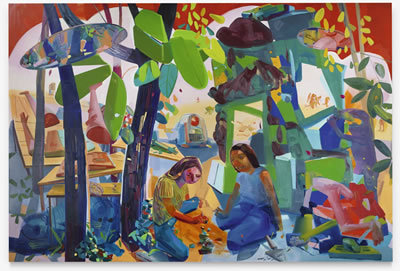 From Livonia, Michigan, Dana Schutz is a painter known for macabre depictions such as autopsies, people eating their body parts, headless animals, and birthing scenes. She did undergraduate art study at the Cleveland Institute of Art and graduated with an MFA from Columbia's School of Fine Arts in New York in 2002. That same year, she had a successful gallery show titled "Frank from Observation", in New York City.
In 2003, her work was entered in the Venice and Prague Biennales, and in 2006, Raphaela Platow, chief curator of the Rose Art Museum at Brandeis University, organized a traveling exhibition of nearly four dozen works by Schutz. Included were incongruous paintings with scenes including Bill Gates and other corporate CEOs walking half naked through woods pounding on drums; President George Bush and Condolezza Rice hopelessly entangled in microphone cords; and Mussolini and Stalin fishing on a small, foliage covered lake.
Not surprisingly the paintings of Dana Schutz have received controversial attention, and some collectors gave her very early attention, which concerned some art professionals who feared she was ascending the market ladder too fast.
She works from a 1,000 square foot studio in an industrial loft in Brooklyn near the Gowanus Canal. She works many hours at a stretch, and gets some of her ideas from the Internet. Schutz is married to Ryan Johnson, a sculptor, and they live near her studio.
From the time she was a youngster, she exhibited art talent and wass encouraged by her mother, who was a junior high school art teacher.
Source:
Steven Litt, "What if People Could Eat Themselves", ARTnews, May 2007, pp. 136-139