Page loaded successfully. Showing biography for Daqian Zhang.
Daqian Zhang BIOGRAPHY
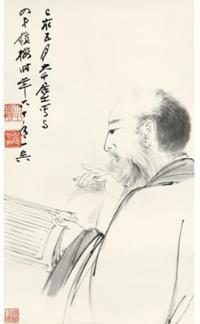
1899 Neijiang, Sichuan, China - 1983. Known for: Forgery, landscape painting, textile dying, ink splashing.
"Zhang Daqian (1899-1983) casts a long shadow over the modern history of Chinese painting. As a painter, he was known for his singular ability to mix traditional techniques and styles with... Read full biography
"Zhang Daqian (1899-1983) casts a long shadow over the modern history of Chinese painting. As a painter, he was known for his singular ability to mix traditional techniques and styles with contemporary ideas and currents. As a collector, he accumulated important examples from all genres of Chinese... Read full biography
"Zhang Daqian (1899-1983) casts a long shadow over the modern history of Chinese painting. As a painter, he was known for his singular ability to mix traditional techniques and styles with contemporary ideas and currents. As a collector, he accumulated important examples from all genres of Chinese painting and left behind copious seals and inscriptions. As a forger, Zhang so mastered the art of deception that his fakes were purchased unwittingly by nearly every major art museum in the United... Read full biography
"Zhang Daqian (1899-1983) casts a long shadow over the modern history of Chinese painting. As a painter, he was known for his singular ability to mix traditional techniques and styles with contemporary ideas and currents. As a collector, he accumulated important examples from all genres of Chinese painting and left behind copious seals and inscriptions. As a forger, Zhang so mastered the art of deception that his fakes were purchased unwittingly by nearly every major art museum in the United States—the MFA included. Indeed, the first question asked by experts when a work is considered suspect is: "Could this be by Zhang Daqian?". Quoted from: Museum of Fine Arts, Boston. Zhang Daqian: Painter, Collector, Forger. Saturday, December 15, 2007... Read full biography
"Zhang Daqian (1899-1983) casts a long shadow over the modern history of Chinese painting. As a painter, he was known for his singular ability to mix traditional techniques and styles with contemporary ideas and currents. As a collector, he accumulated important examples from all genres of Chinese painting and left behind copious seals and inscriptions. As a forger, Zhang so mastered the art of deception that his fakes were purchased unwittingly by nearly every major art museum in the United States—the MFA included. Indeed, the first question asked by experts when a work is considered suspect is: "Could this be by Zhang Daqian?". Quoted from: Museum of Fine Arts, Boston. Zhang Daqian: Painter, Collector, Forger. Saturday, December 15, 2007 - Sunday, September 14, 2008. Born in a family of artists in Neijiang, Sichuan, China, he studied textile dye... Read full biography
Artist Biography
Biography page for Daqian Zhang ((1899 - 1983)), known for Forgery, landscape painting, textile dying, ink splashing. Showing 4 biographical entries and 0 sample artworks.
Daqian Zhang - Artist Info
About Daqian Zhang
Name variants
Dai-Chien Chang, Daqian Chang, Chang Chien, Da Qian Zhang, Daqian Jiade Zhang
Biography from the Archives of askART
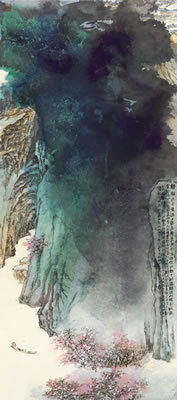 "Zhang Daqian (1899-1983) casts a long shadow over the modern history of Chinese painting. As a painter, he was known for his singular ability to mix traditional techniques and styles with contemporary ideas and currents. As a collector, he accumulated important examples from all genres of Chinese painting and left behind copious seals and inscriptions. As a forger, Zhang so mastered the art of deception that his fakes were purchased unwittingly by nearly every major art museum in the United States—the MFA included. Indeed, the first question asked by experts when a work is considered suspect is: "Could this be by Zhang Daqian?"
Quoted from: Museum of Fine Arts, Boston
Zhang Daqian: Painter, Collector, Forger
Saturday, December 15, 2007 - Sunday, September 14, 2008
Born in a family of artists in Neijiang, Sichuan, China, he studied textile dyeing techniques in Kyoto, Japan and returned to establish a successful career selling his paintings in Shanghai. A staunch supporter of the Kuomintang, he left China in 1948 and moved to Mogi das Cruzes, Brazil, and then to Carmel, California, before finally settling in Taipei, Taiwan.
Sullivan, Michael (2006). Modern Chinese artists : a biographical dictionary. Berkeley, California: University of California PressBiography from Zhong Cheng Auction (CLOSED)
Chang Daqian was born in 1899, during the time of political climate. When old Chinese cities were invaded by Western enemies, Chang remain unmoved by the fear that was brought upon his people. Instead, he sought out ancient aesthetic literature with the aim to preserve the historical essence of the East by sustaining the arts of the past. Xu Beihong used the phrase “One man every five hundred years” to describe the unique significance of Chang Daqian as an individual.
Chang Daqian was very gifted. His bold yet romantic expression was widely admired. By acquiring the wisdom of the past thousand years, Chang was able to utilize this knowledge in his own artistic interpretation. He created grand, generous gestures that spoke timeless essence conveyed only by traditional Chinese paintings.
Chang Daqian’s style evolved throughout his life. His aesthetic manner was light and delicate in early years, during the middle stage of his life however, he began to explore expressions that were stronger and bolder. It was only in later years when Chang Daqian mastered the ink-splashing technique that created spontaneous abstract composition; the inspiration came from his travel to Europe and America.
In 1940, Chang traveled deep into the Dunhuang dessert with one of his students. Although it was a difficult journey, the two successfully reached their destination- a cave that housed hundreds of Buddhist sculptures. Chang made the cave his home for the next two and a half years. The experience assisted him in achieving a new level of aesthetic enlightenment. Writer Gao Yang said, “Being able to reside in Dunhuang for more than two years! That in itself is an impossible and admirable achievement.”
Since his journey to Dunhuang, Chang Daqian mastered the technique in portraying atmospheric sceneries. The work Lonely Fisherman completed in 1946, focused on precise composition within scholarly temperaments. The center of the painting was cleverly left blank to represent the abundant supply of water, from afar depicts a single sail boat progressing into the distance. The artist skillfully depicts negative space enabling a strong sense of dimension and depth.
Contrary to delicate brushworks, Chang Daqian chose to use free flowing lines to portray his subjects. Thus, the work suggests a modern minimalist take on conveying traditional themes. Close up of pine trees and hills are illustrated in clear resolute details, accompanying realistic texture that can only be captured by the variation of shades. The bottom left corner of the work, stood a thoughtful scholar in isolation looking far beyond the water. The context of the work embraces East millennium culture that integrates with present day perspectives. The work is exceptional to either ancient or modern expressions; instead it is in the innovative style of Chang Daqian’s timeless aesthetics.
In art history, Chang Daqian is an eternal legend and will always be remembered as the most prodigious Chinese artists of the twentieth century. The content and form of his creations are extended expression of glory and elegance from the past. He was a present day scholar and a classical romantic.Biography from Bonhams Bond Street
The Koo family immigrated to Palo Alto, California in 1963. While in California, Mr. Koo met and befriended Zhang Daqian and his son through their love for the arts and Chinese antiquities. In 1972, Mr. Koo was instrumental in putting together 'Chang Dai-chien: A Retrospective Exhibition' at the Asian Art Museum in San Francisco.
Zhang Daqian (1899-1983) is considered one of the greatest Chinese artists of the 20th century. He was born in Sichuan Province. In 1917 he went to Kyoto to learn textile dying techniques and later returned to Shanghai in 1919 to establish a successful career selling his paintings. In the late 1920s and 1930s, Zhang moved to Beijing where he befriended other famous artists, including Yu Feian, Wang Shensheng,
Ye Qianyu, Chen Banding, Qi Baishi, and Pu Xinyu. In the early 1940s, Zhang led a group of artists in copying the Buddhist wall paintings in the Mogao and Yulin caves. It was from this time that he made great advances in his use of line and colour, and became more skilled at painting lotuses in the meticulous gongbi style. From the 1960s, he tended toward more expressionistic brushwork with splashed ink techniques.
Over his artistic career of nearly six decades, he tirelessly studied the painting of lotuses, which became one of his most signature subjects. Throughout his life, Zhang had a fascination with lotuses, which since the Song dynasty scholar Zhou Dunyi (1017-1073) were considered 'pure and solemn, like the bearing of a gentleman'.
Zhang painted countless works of lotuses and in his youth, he began by imitating works by ancient masters such as Xu Wei (1521-1593) and Bada Shanren (1626-1705), both of whom were also known for their lotus paintings.Biography from Kingsley Art Auction (CLOSED)
Chang Dai-Chien was a native of Nei-Chiang, Sichuan. His original given name Chuan was later changed to Yuan, while his childhood name Chi was later incorporated into his studio name Chi-yuan. At the age of 21 he studied under Tseng Hsi and Li Jui-Ching. Taking Shih Tao and Pa-ta Shan-jen as his starting point, he sought out as many paintings by famous artists of past centuries as he could to copy.
Beginning with an impressionistic style and progressing to meticulous brushwork, he developed the ability to move between these techniques with complete master. In 1941 he traveled to Dun Huang where he spent two years and seven months copying wall paintings. Here he studied traditional coloration and line drawing methods, being particularly moved by the grand scale and complex layout of the high Tang style.
The sumptuous splendor of high Tang art inspired him with the desire to create great art Besides copying from old masters, Chang Dai-Chien was also expert at painting from life. In his later years, he combined splashed ink and splashed color with the masterly texture strokes and liberation of his early years to form a new synthesis. Hovering between concrete and abstract, reveling in freedom and unpredictability, Chang Dai-Chien's work created a whole new style of modern Chinese painting.