Diego Rivera BIOGRAPHY
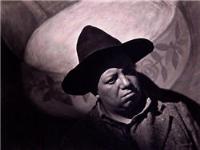
Artist Biography
Biography page for Diego Rivera ((1886 - 1957)), known for Social realist mural painting. Showing 5 biographical entries and 0 sample artworks.
Diego Rivera - Artist Info
About Diego Rivera
Biography from the Archives of askART
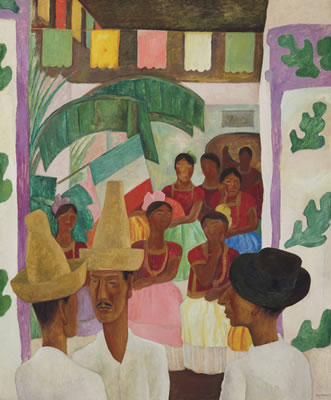 Diego Rivera was born on December 13, 1886 in the mountain town of Guanajuato in Mexico. His mother was an ardent Catholic and his father was a rich and aristocratic revolutionary fighter and an atheist. Little Diego decided in favor of atheism. He swore his family had to leave Guanajuato when he was six because of his diatribes against the Church. When he was eleven he attended the San Carlos Academy of Fine Arts; his real teacher was Jose Posada, whose printmaking shop stood near the school.
At the age of twenty he won a traveling scholarship and spent the next three years in
museums and painting in Europe, expressing little of what he felt. In 1910 he returned to Mexico and became involved in the revolution that ended with the forcing out of office the aging dictator Diaz. In 1911 his scholarship was renewed and he sailed for Europe again, this time for a period of ten years. In Paris, he set up housekeeping with a pretty Russian blonde named Angeline Beloff, his first common-law wife; from her he learned the Russian language and from her friends he learned all about Marxism. He also learned about Cubism and Picasso.
A trip to Italy gave him a chance to study Giotto, Uccello and Andrea del Castagno. In 1922 he returned again to Mexico and joined forces with two other revolutionaries, Siqueiros and Orozco. They formed a government-backed syndicate of artists who changed from easel painting to working on murals. In the next decade he did what was probably his greatest work: frescoes in Cuernavaca and in Chapingo, where his favorite model was Guadalupe Marin, a tempestuous olive-skinned beauty. They married and she bore him two daughters. He proved to be a master of figure composition, of space and light, of crowds of farm workers and battle scenes, etc.
In 1927 Rivera decided it was time for a visit of homage to Moscow; he met and sketched Stalin for which he was very honored. Later he did a complete reversal about Stalin. When he got home from Moscow he met and married a pretty art student named Frida Kahlo. They moved into her home in Coyoacan, a Mexico City suburb. Among their many guests was Leon Trotsky who lived with them for two years while he wrote a biography of Stalin, his enemy. Kahlo died in 1954 and not long after, Rivera married again; this time he married Emma Hurtado, a magazine publisher who also had a gallery dealing in Rivera paintings.
Rivera was notorious for his murals in which he openly expressed his opinions on many controversial subjects of the day. The most notorious of these was the one in Rockefeller Center which was reduced to dust by the Rockefeller family after Rivera refused to remove the painting of Lenin uniting the workers. Rivera also worked hard at painting society portraits by the dozen; he did very popular flower paintings, sexy nudes and typical Mexican scenes. He painted the beautiful Dolores Del Rio and Paulette Goddard, the movie actress who posed for him at least twelve times. He made a lot of money which he got rid of as fast as he could make it. He was known as the softest touch in all of Mexico, giving away money to friends, guests and street beggars. He died in Mexico City on November 24, 1957.
Written and submitted by Jean Ershler Schatz, artist and researcher from Laguna Woods, California.
Sources include:
The Long Voyage Home, article in Time magazine, April 4, 1949
From Mexico to Montparnasse - and Back by Edward J. Sullivan in Art in America, November 1999
Time magazine, December 9, 1957
Diego Rivera, Art & Revolution, Calendar Section of LA Times, May 24, 1999
The Tumultous Life and Times of the Painter Diego Rivera by William Weber Johnson, magazine and
date unknown
From the Internet, www.artnet.comBiography from the Archives of askART
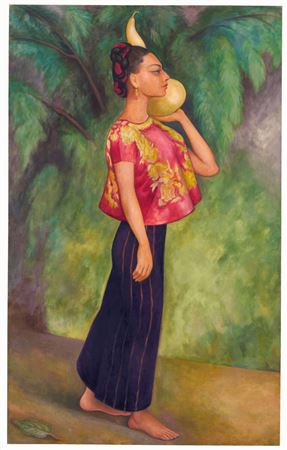 Born in Guanajuato, Mexico in 1886. Rivera studied art in Europe and was greatly influenced by Picasso, Cézanne, and Giotto. He was Mexico's most renowned muralist when, at the urging of Ralph Stackpole, in 1930 he was brought to San Francisco to paint murals in the Stock Exchange and Art Institute. While there he had his first American solo exhibition at the CPLH. He also painted a small fresco for Mrs. Sigmund Stern which is now in Stern Hall at UC Berkeley. Rivera returned to Mexico in 1931 to complete mural decorations in the Palacio Nacional. He painted murals in the Detroit Art Institute (1933) and Rockefeller Center in NYC (1934). In 1940 he was again in San Francisco to paint a 1,650 square foot fresco for the GGIE entitled Culture of the Americas. This fresco is now installed in the foyer of the Little Theater at San Francisco City College. After the GGIE he returned to Mexico and died there on Nov. 25, 1957. Although his greatest inspiration was from the work of Giotto, his work is rooted in Aztec and Mayan forms. In: SF General Hospital; Mexican Museum (SF); Mills College (Oakland); SFMA; CPLH.
Biography from Nuevo Santander Gallery
Born in Guanjuato, Mexico, Diego Rivera grew up in Mexico City, attending the San Carlos Academy of Fine Arts. He also worked in the studio of José Guadalupe Posada, the leading popular printmaker of the period.
Between 1907 and 1921, he traveled in Europe, experimenting with a number of artistic styles, cubism in particular. Returning to Mexico, Rivera and his fellow artists José Orozco and David Siqueiros initiated the Mexican mural renaissance. Many artists found a model for their own social and artistic aspirations in Diego Rivera's political radicalism and populist imagery.Biography from Art Cellar Exchange
Diego Rivera (1886-1957) is considered by many to be the greatest Mexican painter of the twentieth century. His contributions to modern Mexican art came in the form of mural as well as conventional painting. Probably the most important credit attributed to Rivera was his reintroduction of fresco painting into modern art and architecture, which incited the entire Mexican muralism movement.
Diego Rivera was born in 1886 in Guanajuato, Mexico and began studying painting at an early age. His artistic abilities became apparent early on and his talent was fostered by scholarships from the Mexican government and travels to Europe. As a young man Rivera moved to Europe and spent most of 1907 until 1921 in Paris, where he encountered and was influenced by the work of great masters, including Cezanne, Gauguin and Matisse. In 1920, Rivera traveled to Italy, where he studied Renaissance frescos and investigated the mural techniques of Giotto. It was Giotto's work that provoked Diego Rivera to use the fresco as a means to present his imagery to the everyday lives of the people.
Diego Rivera returned to Mexico with a vision of the fresco in his mind as well as a strong allegiance to public art. Along with David Alfaro Siqueros and Jose Clemente Orozco, Rivera founded what is known as the "Mexican school of painting." Mural painting was so attractive to these men because it allowed them to take their art to a broad audience, to the streets and to the buildings while using a precise and direct language with a realistic style, full of social meaning.
Diego Rivera was very involved in politics and his artistic vocabulary demonstrated this while also incorporating the imagery of modern European masters with Aztec and Mayan symbols. Rivera's art combined images of Mexico's pre-Colombian past with themes of the Mexican Revolution and the customs and daily lives of the people. Throughout his career, images of the land, the factory and the land workers persisted. "Landscape in Chihuahua" is indicative of his interest in his homeland as well as the indigenous style that persisted throughout his career.
--Gretchen Van Camp
Latin American Art
Art Cellar ExchangeBiography from Phillips New York
Diego Rivera began drawing at the age of three, and by ten he was enrolled at the San Carlos Academy in Mexico City. In 1907, he traveled to Europe on a scholarship to continue his artistic studies. Whilst in Paris, Rivera embraced the advent of Cubism, and later Post-Impressionism, taking inspiration from such European artists as Picasso and Cézanne.
In 1921, Rivera returned to Mexico and became involved in the government-sponsored Mexican mural program. He became best-known for his frescoes painted in a distinctive style characterized by bold colors and ample, Renaissance-inspired figures. Rivera was an atheist and joined the Mexican Communist party in 1922. He was married five times, including twice to Frida Kahlo, with whom he had a famously volatile relationship.
InsightsIn 1939, Leon Trotsky lived with Rivera and Kahlo in Mexico City whilst in exile.
In 1933, Rivera completed Detroit Industry, a series of 27 frescoes at the Detroit Institute of Arts. During the era of 1950s McCarthyism, a large sign was erected condemning Rivera's politics as 'detestable' while defending the murals' artistic merit.
In 1931, Diego Rivera became the first Latin American artist to have a one-man show at the Museum of Modern Art in New York.