Page loaded successfully. Showing biography for E Ambrose Webster.
E Ambrose Webster BIOGRAPHY
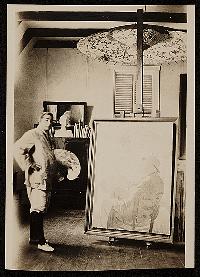
1869 Chelsea, Massachusetts - 1935. Known for: Modernist painting and teaching.
A painter, lecturer, teacher and also a descendant of Daniel Webster, E Ambrose Webster was a prominent and pioneering proponent of modernism on Cape Cod, Massachusetts. By his own painting as well... Read full biography
A painter, lecturer, teacher and also a descendant of Daniel Webster, E Ambrose Webster was a prominent and pioneering proponent of modernism on Cape Cod, Massachusetts. By his own painting as well as lecturing and writing, he promoted a style that moved beyond Impressionism to a Fauve-like... Read full biography
A painter, lecturer, teacher and also a descendant of Daniel Webster, E Ambrose Webster was a prominent and pioneering proponent of modernism on Cape Cod, Massachusetts. By his own painting as well as lecturing and writing, he promoted a style that moved beyond Impressionism to a Fauve-like handling of color. One of his writings was a booklet on color. He was criticized by traditionalists for participating in the 1913 New York Armory Show that showcased modernism. Webster was born in Chelsea,... Read full biography
A painter, lecturer, teacher and also a descendant of Daniel Webster, E Ambrose Webster was a prominent and pioneering proponent of modernism on Cape Cod, Massachusetts. By his own painting as well as lecturing and writing, he promoted a style that moved beyond Impressionism to a Fauve-like handling of color. One of his writings was a booklet on color. He was criticized by traditionalists for participating in the 1913 New York Armory Show that showcased modernism. Webster was born in Chelsea, Massachusetts, and studied at the Boston Museum School of Fine Art with Frank Benson and Edmund Tarbell. From 1896 to 1898, he studied in Paris at the Academie Julian with Jean Paul Laurens and Benjamin Constant. In 1900 in Provincetown, he... Read full biography
A painter, lecturer, teacher and also a descendant of Daniel Webster, E Ambrose Webster was a prominent and pioneering proponent of modernism on Cape Cod, Massachusetts. By his own painting as well as lecturing and writing, he promoted a style that moved beyond Impressionism to a Fauve-like handling of color. One of his writings was a booklet on color. He was criticized by traditionalists for participating in the 1913 New York Armory Show that showcased modernism. Webster was born in Chelsea, Massachusetts, and studied at the Boston Museum School of Fine Art with Frank Benson and Edmund Tarbell. From 1896 to 1898, he studied in Paris at the Academie Julian with Jean Paul Laurens and Benjamin Constant. In 1900 in Provincetown, he established a summer school of painting, the Webster Art School, and was active in the Provincetown Art Associ... Read full biography
Artist Biography
Biography page for E Ambrose Webster ((1869 - 1935)), known for Modernist painting and teaching. Showing 2 biographical entries and 0 sample artworks.
E Ambrose Webster - Artist Info
About E Ambrose Webster
Name variants
Edwin Ambrose Webster
Biography from the Archives of askART
 A painter, lecturer, teacher and also a descendant of Daniel Webster, E Ambrose Webster was a prominent and pioneering proponent of modernism on Cape Cod, Massachusetts. By his own painting as well as lecturing and writing, he promoted a style that moved beyond Impressionism to a Fauve-like handling of color. One of his writings was a booklet on color. He was criticized by traditionalists for participating in the 1913 New York Armory Show that showcased modernism.
Webster was born in Chelsea, Massachusetts, and studied at the Boston Museum School of Fine Art with Frank Benson and Edmund Tarbell. From 1896 to 1898, he studied in Paris at the Academie Julian with Jean Paul Laurens and Benjamin Constant.
In 1900 in Provincetown, he established a summer school of painting, the Webster Art School, and was active in the Provincetown Art Association. He also traveled frequently in Bermuda.
Exhibition venues included the Boston Art Club, the Pennsylvania Academy, the Corcoran Gallery and the Art Institute of Chicago.
Sources include:
American Art Review, April 2002
Peter Falk, Who Was Who in American ArtBiography from Sotheby's New York
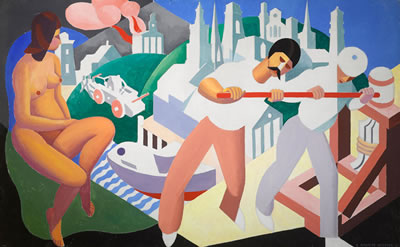
Born in 1869 in Chelsea, Massachusetts, Edwin Ambrose Webster is best known today for the Fauvist-inspired landscapes he produced of exotic locations such as Jamaica, Bermuda and the Azores, as well as of his home of Provincetown, Massachusetts, where he moved in 1900. Webster gravitated towards the seaside town for the distinctive quality of light created by the water. There he opened the Summer School of Art where he promoted the idea of utilizing the effects of light and shadow on the landscape to create brilliant color harmonies.
The late 1920s, however, marks a distinct shift in Webster's style as he moved away from the expressive landscapes of his earlier work to embrace an aesthetic characterized by a remarkable integration of Cubist and figural elements.
"Always analytical by nature," explains Gail R. Scott, Webster's "work had long evidenced a predilection for linear structure, though often functioning more as a compositional backbone in his paintings that are otherwise dominated by spectacular color effects. His move toward abstraction had been emerging for some time. From this point onward, composition and line assume paramount importance in the artist's figural work and in his teaching. In his figurative work, along with an emphasis on linear, abstracted composition, came a new working method in the form of extensive preparatory drawings and small studies leading up to one or more finished versions in oil, as in 'Greenwich Village in Geometry'" (E. Ambrose Webster: Chasing the Sun, Manchester, Vermont, 2009, pp. 168, 172).
Painted in 1929, Greenwich Village in Geometry demonstrates Webster's interest in and unique interpretation of the theory of Dynamic Symmetry. As promoted by Jay Hambidge, an illustrator and mathematician who previously studied under William Merritt Chase, Dynamic Symmetry emerged as Hambidge's reaction to the Cubist paintings he first encountered at the Armory Show of 1913.
Based on the ancient Greek ideals of proportion and symmetry, the concept attracted a number of American painters in the early 20th century including Robert Henri, George Bellows and Maxfield Parrish. Hambidge purported that utilizing the ratios of the diagonals of a square created the impression of movement in a composition, mimicking the same "dynamic beauty" present in the natural world.
"As we look back on the art of the 20th century," Scott continues, "Webster's late paintings make a significant statement that has yet to be appreciated for its vigor and integrity. Seen in the context of a figurative artist like Edward Hopper, a Cubist innovator like Stuart Davis, a Precisionist like Charles Sheeler, or an individualist like Georgia O'Keeffe, Webster's work stands out for its chromatic power, strength of design, monumental scale and symbolic import. He was a precursor, developing new approaches to color and compositional structure long before other artists began to experiment in similar ways and helping to shape and define American Modernism" (Scott, p. 185).