Page loaded successfully. Showing biography for Edgar Samuel Paxson.
Edgar Samuel Paxson BIOGRAPHY
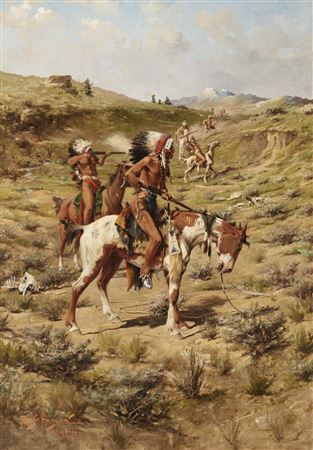
1852 Orchard Park, New York - 1919 Missoula, Montana. Known for: Indian-frontier-animal, portrait painting.
Edgar Paxson (1852-1919). Charles M. Russell was a friend of Edgar Paxson, and although they did not meet often, they admired each other and relished their time together. Along with John L. Clarke,... Read full biography
Edgar Paxson (1852-1919). Charles M. Russell was a friend of Edgar Paxson, and although they did not meet often, they admired each other and relished their time together. Along with John L. Clarke, Earl Heikka, and O.C. Seltzer, they are Montana’s most noted artists. Born on April 25, 1852 near... Read full biography
Edgar Paxson (1852-1919). Charles M. Russell was a friend of Edgar Paxson, and although they did not meet often, they admired each other and relished their time together. Along with John L. Clarke, Earl Heikka, and O.C. Seltzer, they are Montana’s most noted artists. Born on April 25, 1852 near Buffalo, New York, Paxson grew up reading dime novels about the West. He was fascinated with the Indian. His only schooling was one year in a Quaker schoolhouse—Friends Institute in East Hamburg, New... Read full biography
Edgar Paxson (1852-1919). Charles M. Russell was a friend of Edgar Paxson, and although they did not meet often, they admired each other and relished their time together. Along with John L. Clarke, Earl Heikka, and O.C. Seltzer, they are Montana’s most noted artists. Born on April 25, 1852 near Buffalo, New York, Paxson grew up reading dime novels about the West. He was fascinated with the Indian. His only schooling was one year in a Quaker schoolhouse—Friends Institute in East Hamburg, New York. In fact, he had no formal art training, but learned on the job from his father who was a sign painter. Close to the same time the Nez Perce and Chief Joseph were fleeing from the U.S. cavalry, in 1878 Paxson hired on with Montana ranchers, then as... Read full biography
Edgar Paxson (1852-1919). Charles M. Russell was a friend of Edgar Paxson, and although they did not meet often, they admired each other and relished their time together. Along with John L. Clarke, Earl Heikka, and O.C. Seltzer, they are Montana’s most noted artists. Born on April 25, 1852 near Buffalo, New York, Paxson grew up reading dime novels about the West. He was fascinated with the Indian. His only schooling was one year in a Quaker schoolhouse—Friends Institute in East Hamburg, New York. In fact, he had no formal art training, but learned on the job from his father who was a sign painter. Close to the same time the Nez Perce and Chief Joseph were fleeing from the U.S. cavalry, in 1878 Paxson hired on with Montana ranchers, then as a hunter, and briefly as a scout. Over time, he set up shop in Deer Lodge, Montana as a sign painter. His first attempt at becoming a pro... Read full biography
Artist Biography
Biography page for Edgar Samuel Paxson ((1852 - 1919)), known for Indian-frontier-animal, portrait painting. Showing 6 biographical entries and 0 sample artworks.
Edgar Samuel Paxson - Artist Info
About Edgar Samuel Paxson
Name variants
Edgar Samuel Paxon
Biography from the Archives of askART
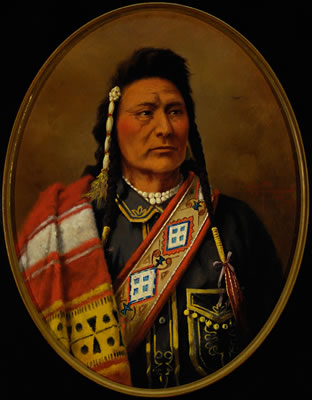 Edgar Paxson (1852-1919)
Charles M. Russell was a friend of Edgar Paxson, and although they did not meet often, they admired each other and relished their time together. Along with John L. Clarke, Earl Heikka, and O.C. Seltzer, they are Montana’s most noted artists. Born on April 25, 1852 near Buffalo, New York, Paxson grew up reading dime novels about the West. He was fascinated with the Indian. His only schooling was one year in a Quaker schoolhouse—Friends Institute in East Hamburg, New York. In fact, he had no formal art training, but learned on the job from his father who was a sign painter.
Close to the same time the Nez Perce and Chief Joseph were fleeing from the U.S. cavalry, in 1878 Paxson hired on with Montana ranchers, then as a hunter, and briefly as a scout. Over time, he set up shop in Deer Lodge, Montana as a sign painter. His first attempt at becoming a professional artist came a year later when he entered a painting at a fair in Helena. By 1880 he had moved to Butte, Montana and found work as a scenery painter for the Renshaw Opera House while he continued his sign painting. According to his biographer William Edgar Paxson, Jr., “There are few sketches extant that Edgar did before 1890, but he had opportunities during that time to sketch famous Indians whom he painted many years later…. He wrote that he met Chief Joseph in 1877-8.” Paxson spent ten years in the Montana National Guard, serving eight months in the Philippines around the time of the Spanish- American War.
Paxson is best remembered for his mammoth mural Custer’s Last Stand, which was essentially completed by 1898 and measured seven by ten feet. It toured the country and is now displayed—purchased in 1963—at the Buffalo Bill Center of the West in Cody, Wyoming. He considered that project the beginning of his career as a professional painter and spent years interviewing participants of the Battle of the Little Bighorn. He also was an accomplished illustrator and watercolorist. He specialized in painting oils of various Montana subjects and also watercolor portraits of mainly Indians—the hundreds of watercolors were painted on days in Butte when the coal pollution produced poor lighting.
He moved to Missoula in 1906, and Russell visited Paxson there on occasion. A local paper reported that on one visit Russell and Paxson, “would sit up most of the night sometimes playing cards and having a big time…. He was always having friendly arguments with Paxson. He’d accused Paxson of being unable to paint an Indian and Paxson would declare Russell couldn’t paint a horse.” In 1881 Paxson had worked for Russell’s friend and first serious dealer Charles Schatzlein at his paint and art supply store in Butte. Over the years, the three completed several paintings together. For example, two of them were 1904 Indian head
watercolors (one is in the Sid Richardson Museum in Fort Worth, Texas and signed by all three and the other is in the author’s collection and is only signed by Schatzlein). On both watercolors Schatzlein contributed the hair, Paxson the head and neck, and Russell the robe. Another corroboration by all three was a mural completed in 1906 which hung in Schatzlein’s
dining room for years.
Still, the two artists’ most famous collaboration was for the new House of Representatives wing of the Montana State Capitol in Helena, Montana. As stated in Resolution No. 4, passed on February 2, 1911, the new paintings for the capitol were to depict “early Montana scenes and figures, as are of value from a historical standpoint, and that such decorations be executed by Montana Artists of recognized ability and standing.” Paxson was commissioned to portray a series of events in the history of Indian-white relations in Montana for the vestibule of the House. Landscape artist Ralph DeCamp from Helena was to paint a series of paintings for what was then the law library. Russell completed his mural Lewis and Clark Meeting Indians at Ross’ Hole, 12 x 25 feet, and it was instantly hailed as his masterpiece.
For his part, Paxson drew on his knowledge of Montana history to create six outstanding murals. His finest easel paintings are La Heliographa and Seeking the Whiteman’s Book. The latter was associated with one of the murals. During the 1830s, there was a fabled story of four delegations of Salish-led Indians living in the Bitterroot Valley in what is now western Montana who trekked all the way to St. Louis in order to obtain the Bible or plead with the Jesuit missionaries to serve their homeland with the Word. The first delegation headed east in 1831.
One delegation found Father De Smet at Council Bluffs in 1839. The mural Seeking the White Man’s Book or After the Whiteman’s Book measures 81 inches by 47 inches and hangs in the House lobby. The five other 1912 Paxson murals that accompany it are The Border Land, Lewis at Black Eagle Falls, Pierre de la Verendrye, Lewis and Clark at Three Forks, and Surrender of Chief Joseph.
Paxson followed up that famous commission with his second most noted, six murals—he was paid $1,500—for the Missoula County courthouse which were completed in 1914: Early Transportation; The Flatheads in the Buffalo Country; The Flatheads Leaving Their Bitterroot Home, October, 1892; Gov. Stevens’ Treaty with the Pend D’Oreilles, Flatheads and Kootenais at Council Grove, July 9,1855; Lewis and Clark’s Camp at Traveler’s Rest, Lolo Creek 1804; and Lewis Party Crossing the Clark’s Fork, July 3, 1806. All were 5 ½ feet high, but the length varied from 5 ½ feet to 10 feet. They spanned 135 years of the frontier from 1742 when Pierre de La Verendrye became the first white male to visit the future state of Montana to October 5, 1877 with the surrender of Chief Joseph.
The last two years of his life were challenging due to poor vision and paralysis caused by a series of strokes. When Paxson died on September 9, 1919, his greatest tribute came from Russell, “Paxson has gone, but his pictures will not allow us to forget him. His work tells me that he loved the Old West, and those who love her I count as friends. Paxson was my friend, and today the west that he knew is history that lives in books. His brush told stories that people like to read. Civilization is nature’s worst enemy. All wild things vanish when she comes.
Where great forests once lived, nothing now stands but burned stumps—a black shroud of death. The iron heel of civilization has stamped out nations of men, and Paxson was one of the men gifted to make them. I am a painter, too, but Paxson had done some things that I cannot do. He was a pioneer and a pioneer painter. He was a soldier who fought under the colors of our country. Paxson loved Montana. May the land where he has gone be even more beautiful than them mountains that he loved.”
When Russell mentioned that Paxson, “had done some things that I cannot do,” he probably was referring to Paxson’s bread and butter, Indian portraits in watercolor. In fact, after 1902 Russell rarely painted them—an unspoken tribute to the great Montana artist from Missoula.
Source: Excerpt from The American West Reimagined (2021) by Dr. Larry Len PetersonBiography from the Archives of askART
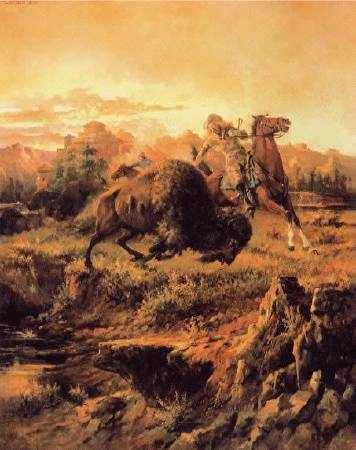 An artist of the vanishing West, Edgar Paxson was on the frontier just before Frederic Remington and Charles Russell, and his 1877 arrival in Montana occurred when Chief Joseph and the Nez Perce Indians were warring their way through Canada. Paxson became a close friend of Russell, who arrived in Montana in 1880, and the two men became the state's most famous early or pioneer resident artists. Among the things they shared was a mutual pride at being self taught and a love of expressing aspects of Montana's frontier history.
One of his major artistic subjects became the expedition of Lewis and Clark, which he completed in mural form, but his most sought after work are his small watercolors.
Another major paintings was Custer's Last Battle on the Little Big Horn, containing more than two-hundred figures locked in mortal combat, and completed twenty-three years after the event. The work is in the permanent collection of the Buffalo Bill Historical Center in Cody, Wyoming and is revered for its attention to detail. Some of the Indian Chiefs in that battle served as Paxson's models.
He was born in Orchard Park, upstate New York, and the only art training he had was from his father who was a sign painter and carriage decorator. He attended school in a log schoolhouse and also had one year at the Quaker run Friends' Institute in East Hamburg. He was first inspired to go West from reading novels by James Fennimore Cooper and then in 1876, from hearing about the Battle of the Little Big Horn.
He went on ahead and in 1879, sent for his wife and child, whom he had left in Buffalo. In the meantime, he worked odd jobs as a cowboy, meat hunter, guard for the Overland Stage, and scout in the Nez Perce war, 1877-78. The family settled in Deer Lodge, Montana, where he worked as a commercial artist and sign painter, including decorating saloons and painting theater sets. In 1881, the Paxsons moved to Butte, where he found more lucrative business, and in 1905, he settled in Missoula. His appearance was described as "in the frontier style, with long hair, full mustache, and pointed goatee". (Samuels 363). His studios in Butte and Montana were popular gathering places for artists visiting the West from other parts of the country.
For ten years, he was a member and government scout of the Montana National Guard, and during the Spanish-American War, he was in the Philippines for eight months.
During his career, he sought out participants in the Custer battle to paint their portraits. One of his primary sources was the Sioux chief, Gall, who gave Paxson many details of the actual fighting, and their relationship gave the artist much insight into the culture of the Sioux.
Paxson generally lauded Indian leaders for their dignity, honesty and strength, and one of his subjects was Charlo, Chief of the Flatheads. For each painting, he changed the pose and the wardrobe combination.
Other artistic endeavors include producing eight murals for the Missoula County courthouse of famous western persons and events (1912) and painting a frontispiece titled John Colter, the Discoverer of Yellowstone Park for the book, Your National Parks, by Enos Mills.
Sources:
Michael David Zellman, 300 Years of American Art
Harold and Peggy Samuels, Encyclopedia of Artists of the American West
Peter Hassrick, Drawn to YellowstoneBiography from Coeur d’Alene Art Auction
 Edgar Samual Paxson was born in Buffalo, New York. After completing school he went into business with his father who was a sign painter and decorator of carriages. Other than the training he received from his father there is no evidence of any formal instruction.
The novels of James Fenimore Cooper fired Paxson with the desire to see Indians in their original surroundings, and so, at the age of twenty five, he left his wife and child in New York and went to Montana to seek his fortune. He arrived in the winter of 1877, a year after the Custer Battle. Filled with the spirit of adventure, he worked at whatever jobs were available, reveling in danger and absorbing the myriad details of frontier life which would later serve him well as he recreated his experiences on canvas. Two years after he arrived in Montana, he sent for his family and they lived for a time in Deer Lodge. They later moved to Butte, where they resided for twenty-four years.
After serving in the Spanish-American War, Paxson turned to easel painting as his means of livelihood. He wanted to preserve great moments in the history of the West, and so undertook a series of murals for the Missoula County Courthouse depicting the Lewis and Clark Expedition, and six others which can be seen in the State Capitol building in Helena, Montana. His most famous work is the massive painting "Custer's Last Battle on the Little Big Horn". So all-encompassing was his conception of this historic battle that it took him six years to complete. Some of the Indian chiefs who had participated in the actual massacre posed for him. This painting secured his success and lasting popularity. He continued to paint and receive wide recognition and acclaim until his death in 1919.Biography from Altermann Galleries and Auctioneers, V
Born: East Hamburg, New York 1852
Died: Missoula, Montana 1919
Important pioneer Montana painter, illustrator, muralist specializing in Western Indian and settler life.
Paxson was educated in a log schoolhouse with one year at Friends' Institute in East Hamburg. He became his father's helper as a sign painter and decorator. In 1877, the year after Custer's battle, he went to Montana, leaving his wife and child in Buffalo. He worked at odd jobs in Montana, on a cattle ranch, as a meat hunter, as a dispatch rider, as a stage driver, and as a scout in the Nez Perce war (1877-78). In 1879, he brought his family to Deer Lodge, where he began to paint in oil while working as a commercial artist, painting signs, decorations for saloons and theater sets. In 1881, he moved to Butte where there was more demand for his services.
He served in the Montana National Guard for 10 years, spending eight months in the Philippines during the Spanish-American War. In 1905, he settled in Missoula. His most famous painting was Custer's Last Battle on the Little Big Horn, and took six to eight (or 20) years to paint. It was nationally exhibited, producing recognition for Paxson, although his small watercolors were considered more successful artistically. His dress and grooming were in the frontier style, with long hair, full moustache, and pointed goatee.
Resource: SAMUELS' Encyclopedia of ARTISTS of THE AMERICAN WEST,
Peggy and Harold Samuels, 1985, Castle PublishingBiography from Caldwell Gallery Hudson
Edgar Samuel Paxson assisted his father with sign painting and decorating before beginning his professional career as a muralist. In 1877 Paxson served as a scout in the Nez Perce War in Missouri, which turned his artistic interest to American Indian and pioneer life. Two years later he settled in Deer Lodge MO and gained success for several important commissions.
He produced eight murals based on the Lewis and Clark Expedition for the Missoula County Court and six for the State Capitol Building in Helena. His best known work is a 6'x10' mural entitled "Custer's Last Battle" which took him many years to make. It was exhibited nationally and was lauded for its accuracy in detail. Paxson died in 1919.Biography from Thomas Nygard Gallery
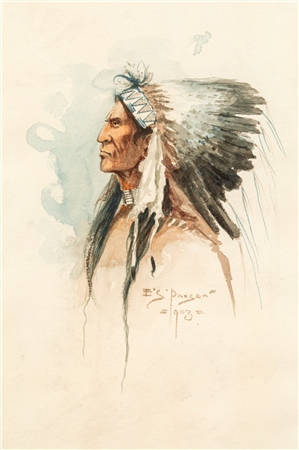 EDGAR SAMUEL PAXSON (1852-1919)
Edgar Samuel Paxson was born in East Hamburgh, New York in 1852. After school he assisted his father in his business as a sign painter and decorator. Paxson was always fascinated by the frontier life and had a great longing to see the West, so in 1877 he pulled up his roots and moved to the Montana Territory. There he became employed on ranches, learning the tricks of surviving the range's variable weather and occasional Indian conflicts. Through his rustic journey West, his ranch work, and his experiences as a scout in the Nez Perce war of 1877-1878, Paxson truly lived the "Wild West" that has been portrayed in literature, movies, and television throughout the last century. His experiences became the inspiration and the subjects for his work, from small sketches in his journal to monumental murals.
Paxson began by simply sketching, for which he had a natural talent. Without any academic training in the arts, he was able to capture the movement and characteristics of the Western Frontier. His subject matter typically ranges from Native Americans to historical battles, hunting scenes to early exploration. Paxson's goal was to immortalize the Old West he knew so intimately. Because of the rapidly occurring changes in Montana, he felt the necessity to record the West before it became unrecognizable. His works are nostalgic, romantic, and sentimental yet hold historical importance within late 19th and early 20th century fine art.
Custer's Last Battle On The Little Big Horn won Paxson immediate recognition. The painting measures six by ten feet and took him over seven years to complete. His works are held by the Whitney Gallery of Western Art, Montana County Courthouse, Montana State Capitol building, the University of Montana and the Anschutz Collection.