Page loaded successfully. Showing biography for Edouard (Jean-Édouard) Vuillard.
Edouard (Jean-Édouard) Vuillard BIOGRAPHY
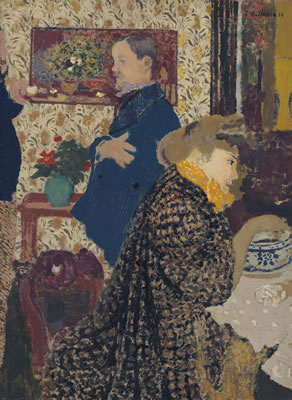
1868 Cuiseaux, France - 1940 La Baule, France. Known for: Interior, landscape, figure, portrait and genre painting.
A post-impressionist French painter who was one of the revolutionaries of the Nabis movement that paved the way for abstraction, Edouard Vuillard had a long career spanning the late 19th and nearly... Read full biography
A post-impressionist French painter who was one of the revolutionaries of the Nabis movement that paved the way for abstraction, Edouard Vuillard had a long career spanning the late 19th and nearly half of the 20th Century. His work, often with luminosity, became increasingly abstract and colorful,... Read full biography
A post-impressionist French painter who was one of the revolutionaries of the Nabis movement that paved the way for abstraction, Edouard Vuillard had a long career spanning the late 19th and nearly half of the 20th Century. His work, often with luminosity, became increasingly abstract and colorful, which some art historians link to Henri Matisse and the Fauves. Among his subjects were figures in interiors, landscapes, portraiture and large-scale decorations, and methods included drawings,... Read full biography
A post-impressionist French painter who was one of the revolutionaries of the Nabis movement that paved the way for abstraction, Edouard Vuillard had a long career spanning the late 19th and nearly half of the 20th Century. His work, often with luminosity, became increasingly abstract and colorful, which some art historians link to Henri Matisse and the Fauves. Among his subjects were figures in interiors, landscapes, portraiture and large-scale decorations, and methods included drawings, graphics, folding screen painting, theatre-program designs, ceramics and photographs as well as oil painting. Of his five panel screen, Place Vintimille, he completed in 1911 and that is an elaborate depiction of city life around a park, he wrote: "Voilà:... Read full biography
A post-impressionist French painter who was one of the revolutionaries of the Nabis movement that paved the way for abstraction, Edouard Vuillard had a long career spanning the late 19th and nearly half of the 20th Century. His work, often with luminosity, became increasingly abstract and colorful, which some art historians link to Henri Matisse and the Fauves. Among his subjects were figures in interiors, landscapes, portraiture and large-scale decorations, and methods included drawings, graphics, folding screen painting, theatre-program designs, ceramics and photographs as well as oil painting. Of his five panel screen, Place Vintimille, he completed in 1911 and that is an elaborate depiction of city life around a park, he wrote: "Voilà: Place Vintimille, so green with spring and full of life! I love this view from my apartment wind... Read full biography
Artist Biography
Biography page for Edouard (Jean-Édouard) Vuillard ((1868 - 1940)), known for Interior, landscape, figure, portrait and genre painting. Showing 2 biographical entries and 0 sample artworks.
Edouard (Jean-Édouard) Vuillard - Artist Info
About Edouard (Jean-Édouard) Vuillard
Name variants
J Vuillard, Jean-Edouard Vuillard
Biography from the Archives of askART
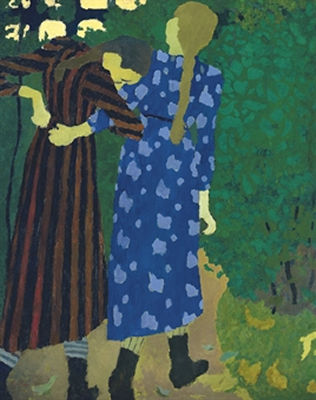 A post-impressionist French painter who was one of the revolutionaries of the Nabis movement that paved the way for abstraction, Edouard Vuillard had a long career spanning the late 19th and nearly half of the 20th Century. His work, often with luminosity, became increasingly abstract and colorful, which some art historians link to Henri Matisse and the Fauves. Among his subjects were figures in interiors, landscapes, portraiture and large-scale decorations, and methods included drawings, graphics, folding screen painting, theatre-program designs, ceramics and photographs as well as oil painting.
Of his five panel screen, Place Vintimille, he completed in 1911 and that is an elaborate depiction of city life around a park, he wrote: "Voilà: Place Vintimille, so green with spring and full of life! I love this view from my apartment window. Do you see the narrow brown buildings across the park and the double-decker cart in the street below? Look, there is a boy checking his bicycle tire, and nearby, a man sleeping against the fence. Of course, you can always find all sorts of vendors and nannies walking with their little ones. For me, the sidewalk winds around the park like a creamy ribbon, wrapping everything in a package of sparkling color." (National Gallery of Art)
The availability of Kodak cameras and their portability to get lasting images from which to model was a big enhancement to Vuillard and other painters of his era, especially the Nabis that included Pierre Bonnard, Maurice Denis and Felix Vallotton. When Vuillard began using the camera frequently at the turn of the century, his output of landscape paintings increased, one of the reasons being that he loved staying in the countryside to take photos.
Born in Cuiseaux in Saone-et-Loire with the full name of Jean-Edouard Vuillard, he spent his childhood in Paris and attended the Lycée Condorcet where Maurice Denis was a fellow student. In 1885, when he was seventeen, he joined the studio of Diogene Maillart (1840-1926) and received the basics in art training. At that time he began a pattern of frequently visiting the Louvre and filling his journals with sketches, particularly of the Dutch and Italian Old Master. Unlike most of his male peers who joined the army, he determined to become an artist. He remained unmarried and lived with his mother, a dressmaker, until he was age sixty.
He died in La Baule, France in 1940.
In January to May, 2003, an exhibition of work by Vuillard opened at the National Gallery in Washington DC and then traveled to collaborating museums: Montreal Museum of Fine Arts, the Réunion des musées nationaux/Musée d'Orsay, Paris, and the Royal Academy of Arts, London.
Sources include:
http://www.nga.gov/cgi-bin/pbio?32500
http://www.nga.gov/exhibitions/vuillardinfo.shtm
http://www.nga.gov/programs/abstracts/vuillard.shtm
http://en.wikipedia.org/wiki/Edouard_VuillardBiography from Anderson Galleries, Inc.
Edouard Vuillard was born in 1868 in Cuiseaux, a tiny French town near the Swiss border. At the age of nine, he moved with his family to Paris. Edouard's father, a retired army officer, died several years later, leaving Edouard's mother, Marie, to support the three children with only a small income. She came from a family of textile designers, and to make a living she first operated a lingerie shop and then a dressmaking business from the succession of Paris apartments that the family occupied.
Surrounded by the women and fabrics that filled her workroom, Edouard lived with his mother, his greatest supporter for her entire life. In his paintings, he confined himself primarily to scenes of cozy, cluttered interiors, often using his mother and sister as models. His interior scenes are characterized by a lavish use of pattern—wallpaper, upholstery, and dress fabrics, closely juxtaposed to create an almost collage-like effect.
In 1888, Vuillard studied briefly at the Ecole des Beaux-Arts under Jean-Léon Gérôme, but soon left because he disliked the conservative approach. Later that year he moved to the Académie Julian, where he met other young artists who rejected both academic art and Impressionism. Vuillard associated with this group, known as the Nabis. By the turn of the century he was making striking, large-scale decorative wall paintings, folding screens, and portraits of prosperous French families. While Vuillard's art remained figurative, his intense focus on the picture surface itself—the flattened, sometimes unpainted support patterned with figures that blended with their surroundings—would foreshadow elements of abstraction in the 20th century.
Museum Collections Include: Metropolitan Museum of Art, New York; Musee d'Orsay, Paris; Norton Simon Museum, Pasadena; Fine Arts Museums of San Francisco; Art Institute of Chicago; Hermitage, St. Petersburg; Fitzwilliam Museum, Cambridge; Museum of Fine Arts, Houston; Museum of Fine Arts, Boston; Museum of Modern Art, New York; National Gallery, Washington, D.C.; Los Angeles County Museum of Art; Clark Art Institute, Williamstown; Cleveland Museum of Art; Tate Gallery, London; numerous other international and regional museums