Page loaded successfully. Showing biography for Edouard Joseph Goerg.
Edouard Joseph Goerg BIOGRAPHY
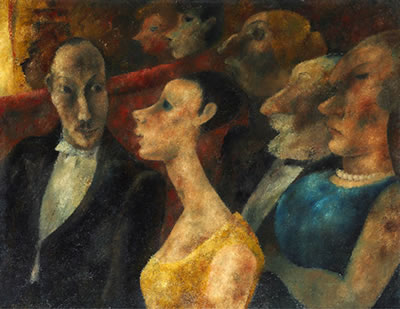
1893 Sydney, Australia - 1969 Callian, France. Known for: Expressionist painting, female figure subjects, engraving, illustration.
Édouard Goerg, born in Sydney (Australia) on June 9, 1893 and died in Callian (Var) on April 13, 19692, is a French expressionist painter, engraver and illustrator. Born in Australia3 of French... Read full biography
Édouard Goerg, born in Sydney (Australia) on June 9, 1893 and died in Callian (Var) on April 13, 19692, is a French expressionist painter, engraver and illustrator. Born in Australia3 of French parents, in a family of champagne merchants, Édouard Goerg then gained their counter in Great Britain,... Read full biography
Édouard Goerg, born in Sydney (Australia) on June 9, 1893 and died in Callian (Var) on April 13, 19692, is a French expressionist painter, engraver and illustrator. Born in Australia3 of French parents, in a family of champagne merchants, Édouard Goerg then gained their counter in Great Britain, where he stayed a few years before settling in Paris in 1900. From then on, he traveled a lot in France as in Italy, India and Ceylon. Breaking with his bourgeois family who intended to resume trading... Read full biography
Édouard Goerg, born in Sydney (Australia) on June 9, 1893 and died in Callian (Var) on April 13, 19692, is a French expressionist painter, engraver and illustrator. Born in Australia3 of French parents, in a family of champagne merchants, Édouard Goerg then gained their counter in Great Britain, where he stayed a few years before settling in Paris in 1900. From then on, he traveled a lot in France as in Italy, India and Ceylon. Breaking with his bourgeois family who intended to resume trading in champagne, Goerg is moving towards painting. He became a pupil of Paul Sérusier and Maurice Denis at the Ranson Academy in Paris where he studied from 1913 to 1914. There he met the painter from Bordeaux Georges Préveraud Sonneville (1889-1978)... Read full biography
Édouard Goerg, born in Sydney (Australia) on June 9, 1893 and died in Callian (Var) on April 13, 19692, is a French expressionist painter, engraver and illustrator. Born in Australia3 of French parents, in a family of champagne merchants, Édouard Goerg then gained their counter in Great Britain, where he stayed a few years before settling in Paris in 1900. From then on, he traveled a lot in France as in Italy, India and Ceylon. Breaking with his bourgeois family who intended to resume trading in champagne, Goerg is moving towards painting. He became a pupil of Paul Sérusier and Maurice Denis at the Ranson Academy in Paris where he studied from 1913 to 1914. There he met the painter from Bordeaux Georges Préveraud Sonneville (1889-1978) with whom he became friends, then he follows the teaching of Antoine Bourdelle4. Goerg was mobilized during th... Read full biography
Artist Biography
Biography page for Edouard Joseph Goerg ((1893 - 1969)), known for Expressionist painting, female figure subjects, engraving, illustration. Showing 2 biographical entries and 0 sample artworks.
Edouard Joseph Goerg - Artist Info
About Edouard Joseph Goerg
Name variants
Edouard Joseph Georg, Edward Joseph Goerg
Biography from the Archives of askART
 Édouard Goerg, born in Sydney (Australia) on June 9, 1893 and died in Callian (Var) on April 13, 19692, is a French expressionist painter, engraver and illustrator.
Born in Australia3 of French parents, in a family of champagne merchants, Édouard Goerg then gained their counter in Great Britain, where he stayed a few years before settling in Paris in 1900. From then on, he traveled a lot in France as in Italy, India and Ceylon. Breaking with his bourgeois family who intended to resume trading in champagne, Goerg is moving towards painting.
He became a pupil of Paul Sérusier and Maurice Denis at the Ranson Academy in Paris where he studied from 1913 to 1914. There he met the painter from Bordeaux Georges Préveraud Sonneville (1889-1978) with whom he became friends, then he follows the teaching of Antoine Bourdelle4.
Goerg was mobilized during the First World War, until 1919. He was sent to the Western Front, then posted to the eastern parts of the front and discovered Greece, Turkey and Serbia. The dramatic experience of the war will strongly influence the nature of his work in the next twenty years. One of these works, Thus goes the world under the eye of the police, is an anti-war manifesto which will inspire to Pablo Picasso his Guernica.
The conflict that pitted him against his father for a long time until his death in 1929 shifted Goerg's painting towards a critique of bourgeois society and its hypocritical manners. From 1920, he became one of the major figures of French expressionism, his work is characterized by deep colors, strange compositions and themes with social content (religion, circus). A whole period of his work also brought him closer to surrealism, particularly his work in the field of lithography. As an illustrator, he produces many bibliophile books4.
In the inter-war period, his success was evident. He nevertheless took part in the workshops of sacred art with his former master Maurice Denis.
During the Occupation, he refused to participate in the trip initiated by Arno Breker that French artists5 are invited to do in the Reich to meet Hitler. His first wife, Andrée Bérolzheimer, of Jewish origin, has to hide with their daughter Claude-Lise and dies for lack of access to care. Goerg feels a deep trauma. He is treated by electroshock and then remarries in 1946.
He is, with André Fougeron and Édouard Pignon, one of the three national leaders of the National Front of Arts. He participated in the album entitled Defeat, published in June 1944 for the benefit of FTP, made with André Fougeron, Boris Taslitzky, Jean Aujame, Edward Pignon, etc.
In the 1950s, he taught etching at the École des Beaux-Arts in Paris and painting at the Académie de la Grande Chaumière. He became president of the Society of French Painters-Engravers from 1945 to 1958, and in 1965 he was elected member of the Academy of Fine Arts to the Willem van Hasselt chair. His second wife encourages him to paint again.
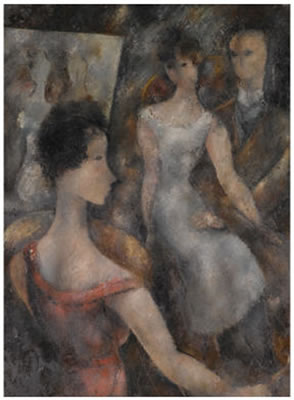
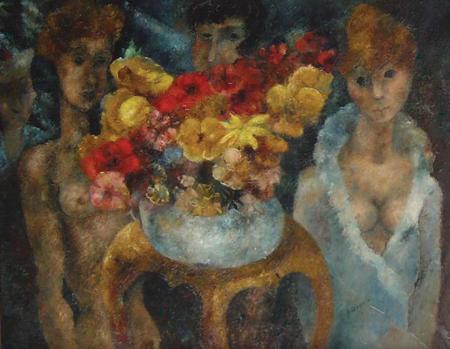
The woman is one of his favorite themes, which comes back in several periods. The best known is that of women-flowers with a discreet and serene melancholy.
As he prepares to leave his wife, he dies in 1969. His death in a mysterious way is complicated by the disappearance of all his writings and memoirs he had held since 1912. He is buried with his wife, who died in November 1988, in the park of his "castle" in Callian.
WORKS IN PUBLIC COLLECTIONS
Clermont-Ferrand, Roger Quilliot Museum of Art.
Menton (Alpes-Maritimes), Museum of Fine Arts: Nude woman lying and dog, W/C on paper.
Montpellier, musée Fabre: On the port, oil on canvas.
Reims, Museum of Fine Arts: Ladies choosing neckties, oil on canvas8.
Saint-Rémy-de-Provence, Estrine museum.
Source:
Wikipedia, Google Translate, Jan. 2019Biography from Papillon Gallery
 Edouard Goerg was born in Sydney, Australia in 1893. His parents were French. After spending several years in England, he settled with his family in Paris in 1900. Between 1910 and 1914, Goerg traveled to France, Italy, and India.
Goerg studied at Academie Ranson in 1913-1914 with Maurice Denis and Paul Sérusier. He was mobilized for World War One and was in the military until 1919. During his time in the military, he traveled to Greece, Turkey, and Serbia.
After being refused several times, he was accepted at the Salon des Indépendants. in 1922, he exhibited at the Salon d'Automne, Salon des Tuileries, and Salon des Pientres Témoins de Leur Temps, as well as Salon d 'Art Français Indédendant.
Goerg exhibited at Galerie Berthe Weill in 1922 and 1924, included were his friends and contemporaries Marcel Gromaire, Jules Pascin and Per Krogh.
His first one-man exhibition was in Paris in 1925. He showed in Brussels at Galerie du Centaure in 1926, Nouvel Essor, in 1927 and 1929 at Galerie Georges Bernheim. Goerg continued to exhibit for the following four decades. He had an exhibition at museums in San Paulo, Rio de Janeiro, and Athens.
Goerg also exhibited in New York, Findley Gallery in Chicago, Boston, and Philadelphia. Goerg illustrated more than dozen books.
Early in Goerg's career he was compared to James Ensor, the Belgian who was part English, and whose work was a forerunner of Expressionism. Goerg's paintings are surely rooted in Expressionism, the mood is somber, the colors deep, and his figures are haunting. His early works have elements of Cubism, but he abandoned that discipline.
His paintings contain social commentary, strange and unusual composition, and the dark eyes of his subjects suggest hidden secrets. There are strong parallels between Éduard Goerg and Marcel Gromaire. They exhibited together and their artistic documentation of Paris over a period of several decades gives the observer a deep insight of Les Année Folles.
Waldemar George wrote a small illustrated book on Goerg in 1929, and a large book with much color illustration in 1960. Gaston Diehl also did a book on Goerg in 1947 and is included in Raynal's Modern French Painters, and Jean-Jacques Leveque's Les Années Folles.